
Delimitation buzz sparks hope, anxiety in state

Vijayawada: A proposed nationwide delimitation exercise ahead of the 2029 elections is fast emerging as a major political flashpoint in Andhra Pradesh, with the expected expansion of Assembly and Lok Sabha seats triggering both opportunity and uncertainty across the state’s political landscape.
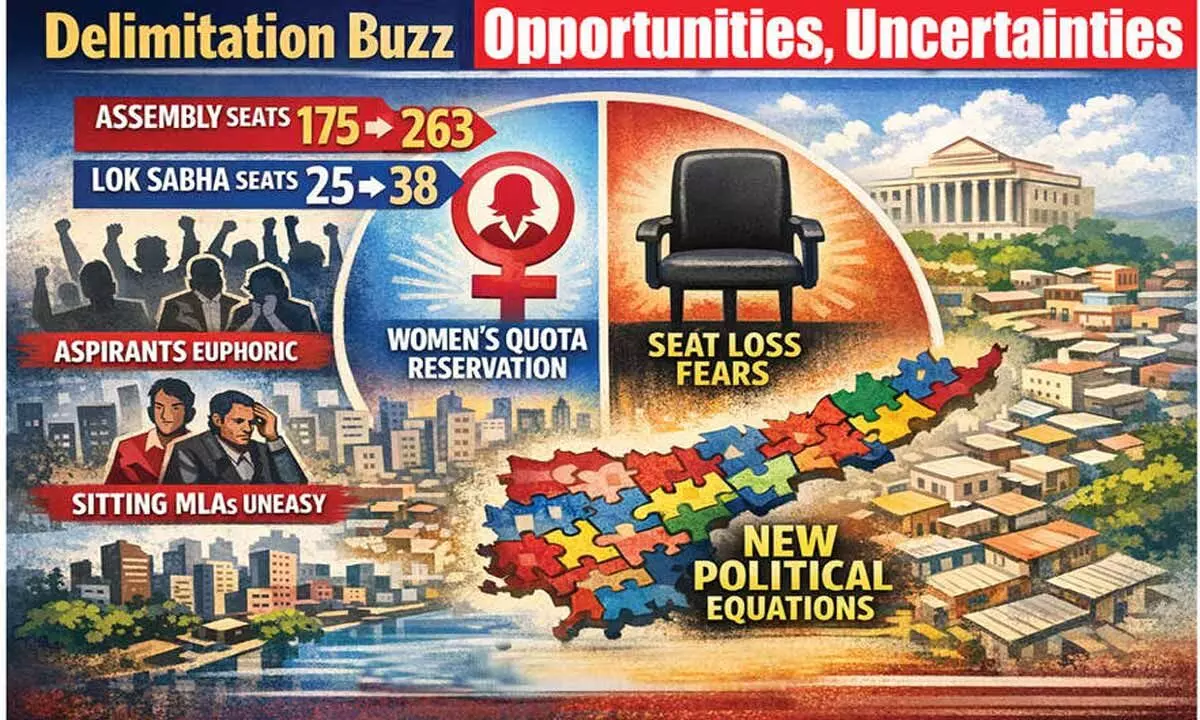
Under the proposal, Andhra Pradesh’s Assembly strength is likely to increase from 175 to around 263 seats, while Lok Sabha representation could rise from 25 to 38. The move is part of a broader plan by the Centre to expand constituencies across the country by nearly 50 per cent, with implementation expected after the next Census. While the expansion promises greater representation, it has also set off intense political churn within major parties, including the ruling alliance and the opposition YSRCP. The issue of delimitation, coupled with the pending rollout of women’s reservation, is now dominating internal discussions from the state level down to constituency-level leadership.
For many aspirants who missed out on tickets in the 2024 elections, the development has opened a fresh window of opportunity. At the same time, sitting MLAs are grappling with uncertainty, particularly over how reservation of constituencies will be implemented.
Political circles are actively debating whether women’s reservation will be applied through rotation, lottery, or a phased system. With no clarity yet, several leaders are already exploring fallback options, including promoting family members as candidates if their constituencies are reserved.
The expansion is expected to add nearly 88 new Assembly segments in the state, intensifying competition among emerging leaders. However, the key question remains: where will these new constituencies come from.
Urban centres are widely expected to benefit the most due to rapid population growth and migration. Cities such as Vijayawada, Visakhapatnam, Guntur and Tirupati are likely to see an increase in seat share, reflecting changing demographic patterns.
For instance, Vijayawada, which currently has three constituencies, could be expanded to four segments under the new structure. Similarly, in regions like the erstwhile Krishna district, the number of constituencies could see a proportional rise, significantly altering local political equations.
Beyond numbers, the political implications are far-reaching. The reorganisation of constituencies will also reshape SC and ST reservations, while the implementation of one-third reservation for women could result in nearly 88 seats in Andhra Pradesh being reserved, drastically altering candidate selection dynamics.
There are also concerns within political parties about the behavioural impact on sitting legislators. Senior leaders said that uncertainty over future constituency boundaries could affect governance, with fears that some MLAs may prioritise areas likely to remain within their segments while neglecting others.
Such shifts, if they occur, could impact development works, welfare delivery and public sentiment, particularly in the run-up to the next elections.
The delimitation process, once formally approved, will be carried out by a Delimitation Commission, which will conduct ground-level consultations before finalising constituency boundaries. While the timeline points to implementation by 2029, political activity around the issue has already intensified across Andhra Pradesh.
As the debate unfolds, delimitation is no longer just a technical exercise, it is rapidly becoming a defining political factor that could reshape leadership, electoral strategies and power structures across the state.


