
From Farmland To Fast Lane: New urban growth corridor emerges beyond Vijayawada

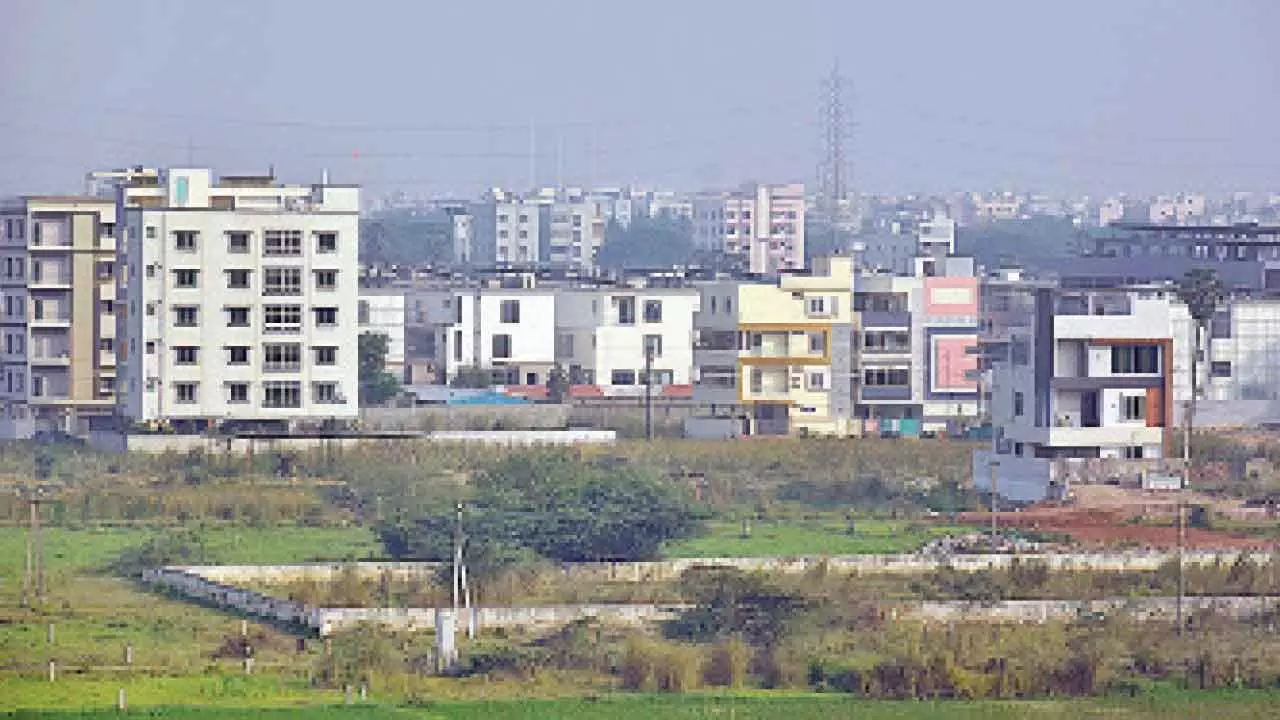
Vijayawada: Vijayawada is witnessing the rise of a new urban growth corridor on its outskirts, with rapid development transforming once-quiet villages such as Gunadala, Ramavarappadu, Nunna, and Ambapuram into bustling residential and commercial hubs. What were largely agrarian pockets just a few years back are now fast evolving into an extended urban landscape, driven by massive infrastructure works and real estate investments running into several crores of rupees.
The city’s outward expansion has gathered pace due to improved road connectivity, seamless access to the Vijayawada West Bypass from Chinna Avutapalli to Kaza via Gollapudi, and the strategic location of these areas along the Chennai–Kolkata National Highway. Ongoing and proposed projects involving internal roads, underground drainage, water supply networks, and other civic amenities have further accelerated urbanisation, attracting both developers and homebuyers.
A major catalyst for this transformation is the development and expansion of the Satellite Railway Station at Gunadala, which has significantly enhanced rail connectivity in the region. Gunadala Railway Station is undergoing major upgradation as a key satellite station for Vijayawada under the Amrit Bharat Station Scheme (ABSS), aimed at decongesting Vijayawada Junction.
The first phase of the project is being taken up at an estimated cost of Rs 35.50 crore.
Improved passenger movement and better access to key destinations have made the surrounding localities increasingly attractive for commercial establishments and housing projects. In addition, Vijayawada International Airport at Gannavaram is located in close proximity to these areas, enabling air passengers to reach the airport within minutes without facing major traffic congestion. This seamless connectivity has further boosted real estate demand. Developers have launched a series of gated communities, apartment complexes, and mixed-use developments, largely targeting middle- and upper-middle-income groups.
Officials note that the rapid growth is also driven by saturation in Vijayawada’s core city areas, where limited land availability and rising property prices have pushed urban expansion outward. Compared to the city centre, land prices in Gunadala, Ramavarappadu, Nunna, Pathapadu, P. Nainavaram, and Ambapuram remain relatively affordable making them preferred destinations for investors, first-time homebuyers, and institutions. Residential plot prices currently range from Rs. 18,000 to Rs. 35,000 per square yard, adding to the region’s attractiveness.
Nitya Infra Managing Director Bonthu Srinivas Reddy said that when the company began operations, there were hardly any real estate projects in the Ramavarappadu Ring Road, Gunadala, and Nunna areas. Land prices then ranged between Rs.15,000 and Rs.17,000 per square yard. With rapid urbanisation and growing demand, prices have now surged to Rs.40,000–Rs.50,000 per square yard, clearly indicating the area’s strong growth potential.
The urban footprint is expanding steadily with the arrival of educational institutions, hospitals, shopping complexes, warehouses, and service centres, lending a distinct city-like character to the region.
Renowned international schools and competitive coaching centres are being established, while improved employment opportunities in the construction sector and allied services have contributed to better livelihoods for residents.
However, residents and civic groups have cautioned that rapid growth must be matched with planned and sustainable development. They have urged the authorities to prioritise adequate drinking water supply, efficient sanitation systems, reliable public transport connectivity, and the creation of green spaces to support the growing population and prevent unplanned urban sprawl.
Echoing similar opinion, Veda Infra Managing Director Bhumula Bala Sekhar Reddy said the company entered the real estate sector five years ago with projects around the Ramavarappadu Ring Road, anticipating rapid expansion on Vijayawada’s outskirts. He noted that areas such as Ramavarappadu Ring Road, Gunadala, and Nunna have grown much faster than the core city due to improved connectivity and increased infrastructure investments. He expressed confidence that the Inner Ring Road and Vijayawada West Bypass would soon become key growth corridors, predicting the region would be recognised as “New Vijayawada City” within the next one to two years.
Urban planners believe that if development continues in a systematic and regulated manner, the fast-growing outskirts could soon emerge as a well-integrated satellite city of Vijayawada.
With sustained public and private investments and coordinated efforts by civic bodies, the new growth corridor is expected to play a crucial role in shaping the city’s future urban expansion and economic landscape.
SLV Group Chairman and Managing Director Penmatsa Srinivasa Raju said the region is increasingly preferred due to easy access to road, rail, and air transport. He pointed out that compared to areas such as Penamaluru and Kankipadu on Bandar Road, traffic congestion is minimal.


