
Krishna Basin water storage drops to critical levels ahead of kharif

Vijayawada: Water storage levels in reservoirs across the Krishna river basin have dropped sharply this year, raising serious concerns over water availability for the upcoming Kharif season.
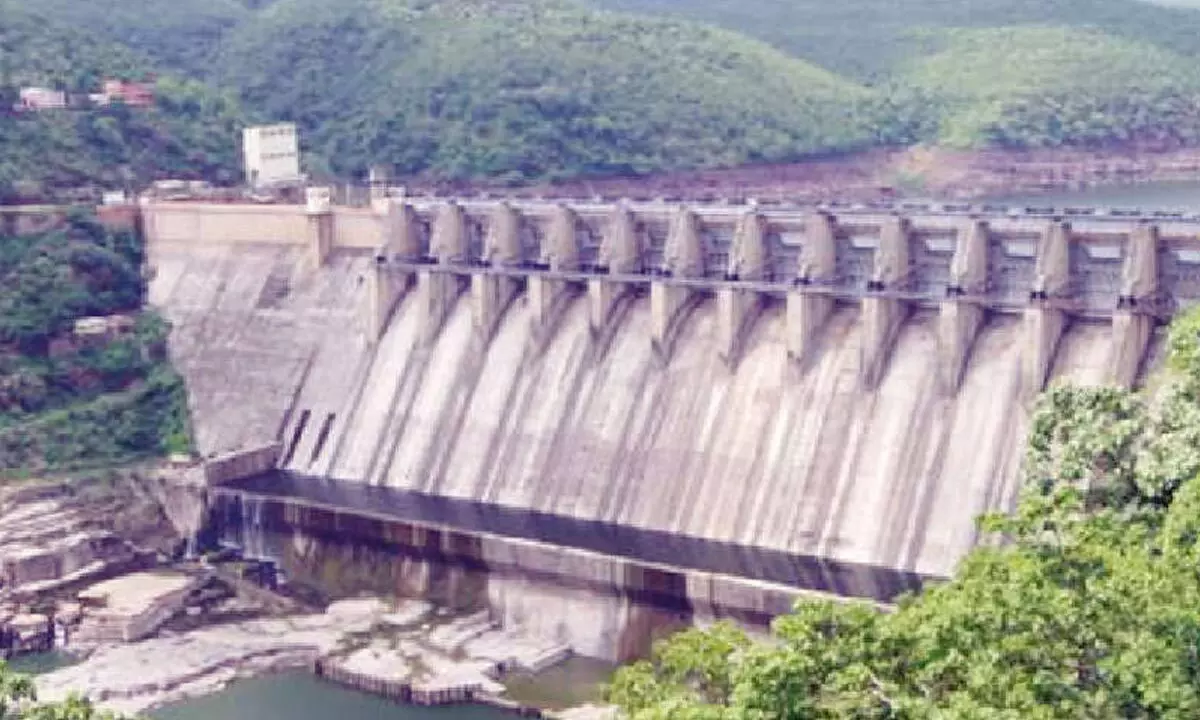
According to official data, the total gross storage capacity of major reservoirs, dams and projects in the Krishna basin is 695.45 tmc ft. However, the current availability stands at only 132.04 tmc ft, accounting for just 18.99 per cent of the total capacity. This reflects a steep decline compared to the same period last year, when storage was 254.08 tmc ft (36.54 per cent), indicating nearly a 50 per cent drop. At the Srisailam project, the present water storage is 46.44 tmc ft at a level of 826.90 feet, against the Full Reservoir Level (FRL) of 215.81 tmc ft at 885 feet. The storage is marginally lower by about 2 TMC compared to last year’s 48 TMC. With the dead storage level pegged at 10.16 tmc ft (705 feet), the current situation is a matter of concern for farmers dependent on the Krishna basin.
The Nagarjuna Sagar reservoir currently holds 180.91 tmc ft of water at 536.40 feet, as against its FRL of 312.05 tmc ft at 590 feet. Interestingly, this is higher than 29.43 tmc ft last year’s storage of 151.48 tmc ft at 521.40 feet during the same period.
Similarly, the Pulichintala project currently holds 34.59 tmc ft of water at 167.26 feet, slightly higher than last year’s 33.67 tmc ft at 166.57 feet. However, the available storage is still insufficient to meet drinking water needs and to support the preparation of seed beds for the upcoming Kharif season.
The state government is planning to advance the kharif season to May to avoid potential natural calamities typically occurring during September and October. Despite marginal improvements in some reservoirs, the overall water availability in the basin remains critically low.
Irrigation experts have cautioned that the current storage levels may not be sufficient to meet the demands of the Krishna delta region, which includes Krishna, Guntur, Palnadu, NTR and Eluru districts. Though there is a possibility of diverting surplus Godavari water into the Krishna river through the Pattiseema Lift Irrigation Scheme, the present storage in the Godavari river stands at only 26.71 tmc ft, limiting such prospects.
Regions such as Kurnool and Nandyal are also likely to face a severe water crunch due to inadequate reserves at the Srisailam reservoir. Additionally, major reservoirs in the upper catchment of the Krishna River, including Almatti, are also reporting low water storage levels.
Experts attribute the decline in water levels primarily to the impact of the El Niño phenomenon, which has led to below-normal rainfall and reduced inflows during the monsoon and post-monsoon periods.
With the kharif season fast approaching, concerns are mounting among farmers and officials over water availability for irrigation, particularly for water-intensive crops like paddy. Authorities are also balancing water usage for irrigation, drinking purposes and power generation, adding to the challenge.
Experts have stressed the need for judicious water management and advised farmers to opt for less water-intensive crops and adopt efficient irrigation practices to mitigate the impact of the shortfall.
Officials are closely monitoring the situation and are expected to take decisions on water allocation in the coming weeks, depending on inflows and weather conditions.


