






- Delhi Seemapuri Building Collapse: Several Feared Trapped As Rescue Operation Underway
- Claude Users Can Work Across Google Docs, Sheets and Slides In-App
- Rapido Ride Turns Into Nightmare After Captain Flees With Injured Passenger
- 7 Must-Watch OTT Releases For Your Dussehra Holidays
- ‘His Lips Turned Blue’: Dentist Recalls 45-Minute Effort To Save Flydubai Pilot Smit Machchhar
- Airtel Postpaid Plans Bring Free International Roaming From Rs 499
- 'Politics means nation building to him': Rajnath Singh on PM Modi's 25 years in public service
- 'Rising Together': India sets out vision for 2036 Olympic and Paralympic Games ambition
Why India’s balance of payments recovery deserves scrutiny
In Short
India’s external accounts have had a rough quarter. In Q1 FY27 (April- June 2026), India’s current account swung from a surplus of $6.5 billion in the preceding quarter to a deficit of $4.2 billion.

Share :
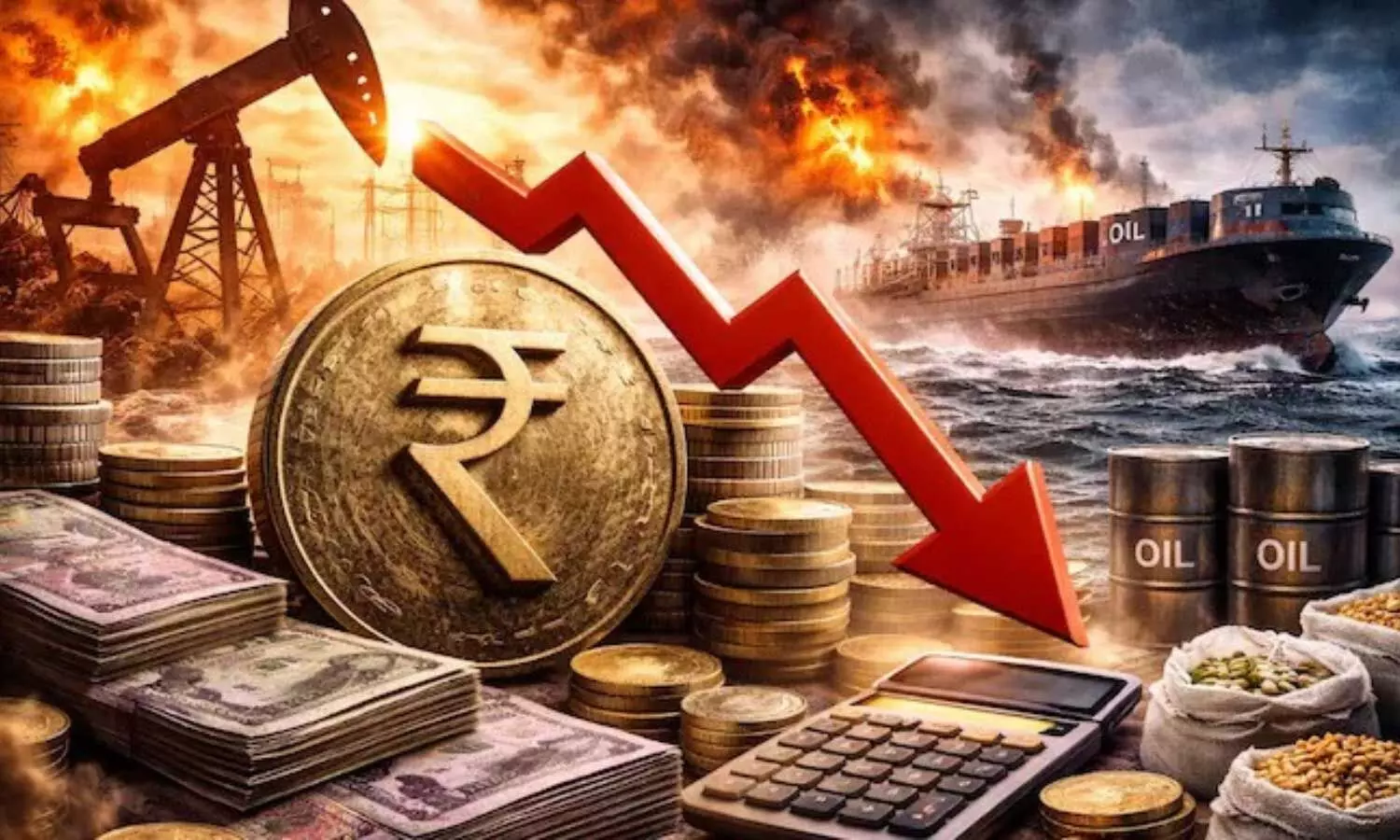
India’s external accounts have had a rough quarter. In Q1 FY27 (April- June 2026), India’s current account swung from a surplus of $6.5 billion in the preceding quarter to a deficit of $4.2 billion. That is a reversal of $10.7 billion in a single quarter. The numbers, by themselves, are not catastrophic. But the story behind them - and the nature of the recovery being projected - deserves far more public scrutiny than it is currently receiving.
An oil-dependent economy in an oil-volatile world
The immediate cause of the deterioration is well known and, to a degree, understandable. The West Asia conflict - involving the collapse of the US-Iran memorandum of understanding, renewed hostilities, disruptions to traffic through the Strait of Hormuz, and escalating Houthi threats around the Bab el-Mandeb Strait - has kept global energy markets on edge. Higher energy prices have widened India’s merchandise trade deficit. This is the direct transmission channel.
India imports roughly 85 per cent of its crude oil requirements. Every sustained spike in global oil prices hits the import bill hard and fast. This is not a new vulnerability. It is a structural one. India has known for decades that its current account is hostage to energy price volatility. Yet the dependence persists. When West Asia burns, India’s import bill rises and the current account pays the price.
The services sector and remittances have provided some cushion. India’s merchandise goods exports have picked up strongly, growing 16 per cent in Q1 FY27 after a weak FY26. Services exports and remittances - India’s two most reliable external earners - have remained healthy. These are genuine positives. They reflect the resilience of India’s IT sector, its business process out systems industry, and the income flows from its large diaspora. But they have not been enough to offset the damage from the energy import bill. The current account is in deficit, and the deficit is projected to widen to between 0.8 per cent and 1.2 per cent of GDP for the full year FY27, according to projections from both CareEdge Ratings and CRISIL.
To put this in perspective: India’s current account deficit was just 0.6 per cent of GDP in FY26 and 0.6 per cent in FY25. The projected widening to up to 1.2 per cent of GDP represents a doubling of external pressure in one year. That is not alarming in absolute terms - it is far removed from the crisis-level 4.8 per cent of GDP recorded in FY13. But the direction matters as much as the level.
The capital account: Outflows, inflows and a rescue package
If the current account deterioration is troubling, the capital account picture is more complicated - and, in some ways, more revealing. Persistent net outflows from Foreign Portfolio Investors (FPI) and higher outflows from other capital components have widened the capital account deficit. The rupee has come under pressure, depreciating by 12.2 per cent year-on-year as of May 2026. India’s Balance of Payments recorded a deficit of $ 23.6 billion in FY26 - the second consecutive year of BoP deficit.
Against this backdrop, the Reserve Bank of India announced a package of measures on June 5, 2026. These included concessional swap windows for Foreign Currency Non-Resident Bank - or FCNR(B) - deposits, External Commercial Borrowings (ECBs), and Overseas Foreign Currency Bonds (OFCBs). The response has been striking. Between June 5 and July 31, 2026, these measures attracted $40.8 billion in inflows - comprising $ 36.7 billion through FCNR(B) deposits alone and $4.1 billion through ECBs and OFCBs. Some smaller banks have reportedly offered deposit rates close to 7 per cent, with foreign bank leverage of between 19 and 29 times in certain cases.
CareEdge Ratings now projects total FCNR and related inflows of $90-95 billion for FY27, lifting the capital account surplus from a mere $2 billion in FY26 to a projected $98 billion. As a result, the overall BoP is projected to swing to a surplus of around $64 billion in FY27, from a deficit of $23.6 billion in FY26.
These are remarkable numbers. But they raise a question that deserves to be asked plainly: is this a genuine strengthening of India’s external position, or is it a borrowed surplus?
The 2013 comparison: A mirror with warnings
The RBI deployed a similar instrument in September 2013, when India faced a genuine external crisis. The rupee had depreciated by nearly 14 per cent year-on-year. The current account deficit stood at 4.8 per cent of GDP. Inflation was at 10 per cent. The FCNR(B) scheme launched then attracted $ 24.5 billion between September and November 2013 and was instrumental in stabilising the rupee.
Today’s context is different. GDP growth in FY26 was a robust 7.8 per cent. Inflation was a benign 2.1 per cent. The CAD was a modest 0.6 per cent of GDP. The June 2026 package was not a crisis response. It was a pre-emptive measure to strengthen external buffers in a more challenging global environment. That is a sign of improved institutional foresight.
But there is a telling difference in outcomes. In 2013, the rupee appreciated by around 7 per cent within 60 working days of the FCNR measures. In 2026, despite attracting far more money far faster, the rupee has remained broadly flat. The reason, analysts note, is that the RBI appears to be using part of the inflows to unwind its large net forward short position, which stood at $ 103.3 billion as of June 2026. The medicine is working - but the benefits are being absorbed by prior obligations rather than flowing through to the exchange rate.
The RBI’s net forward short position of over $100 billion deserves wider public attention. It is a contingent liability on India’s foreign exchange reserves. It means that a portion of the FCNR inflows now being celebrated is already spoken for.
Structural questions that projections cannot answer
The macroeconomic projections for FY27 are broadly reassuring. The CAD is expected to remain manageable. The BoP is expected to return to surplus. GDP growth is projected at 6.7-7.0 per cent. The RBI’s Monetary Policy Committee has kept rates on hold, maintaining a growth-supportive stance.
But projections are not guarantees. Several risks remain live. The West Asia conflict has not been resolved. Oil price volatility continues. Food inflation is expected to peak in Q3 FY27, with the real interest rate potentially turning temporarily negative. A weak or uneven monsoon adds further uncertainty. The FCNR inflows, when they mature, will create repayment obligations that could reverse capital flows sharply.
More fundamentally, the structural nature of India’s vulnerability has not changed. India remains deeply dependent on imported energy. Its merchandise exports, while growing, are still relatively narrow in their sectoral base. The services sector and the diaspora - both reliable earners - cannot indefinitely compensate for an import bill driven by global factors beyond India’s control.
Conclusion: Managing well is not the same as managing right
India’s external sector is, as analysts note, “managing well” amid global volatility. That assessment is fair. But managing well is not the same as managing right. A current account that swings by $10.7 billion in a single quarter because of oil price volatility in a distant conflict is an external sector with a structural fragility it has not resolved.
The FCNR lifeline is real. The FDI improvement is encouraging. The services and remittance cushion is valuable. But a BoP surplus built substantially on concessional deposit schemes and borrowed capital is not the same as a BoP surplus built on competitive exports and sustained investment flows.
India’s policymakers deserve credit for acting pre-emptively and attracting capital at speed. What they have not yet done - and what no quarterly BoP number will solve - is reduce the economy’s fundamental dependence on imported energy and build the export base that would make the current account structurally resilient.
Until that work is done, every escalation in West Asia will be an economic event in India too. That is the uncomfortable truth that the numbers, however carefully managed, cannot conceal.
(The author is with the Cholleti BlackRobe Chambers, Hyderabad, and writes on economy, politics and law)


