







Before manifestation became a trend, Bharat had a protocol
In Short
Today, manifestation is a buzzword. Yesterday, Bharat lived it as a disciplined way of life. Open social media and manifestation appear everywhere. Young people create vision boards, repeat affirmations, practice visualisation and write down dreams.

Share :
Before manifestation became a trend, Bharat had a protocol
Today, manifestation is a buzzword. Yesterday, Bharat lived it as a disciplined way of life. Open social media and manifestation appear everywhere. Young people create vision boards, repeat affirmations, practice visualisation and write down dreams. The contemporary world has found a vocabulary for intention.
Yet Bharat’s traditions reveal a fascinating cultural parallel.
The vocabulary was different, the philosophical framework was deeper, and the practices followed defined methods. Sankalpa, mantra, yantra and tantra created structured ways of bringing intention, attention, sound, symbol, discipline and action together.
Manifestation can therefore become a contemporary doorway into an ancient Bharatiya idea: conscious intention can influence the way human beings think, act and experience life.
Sankalpa: Give Your Intention a Direction
Every creation begins with an intention. Modern manifestation often starts with a statement about what one wishes to achieve. Bharatiya traditions offered sankalpa—a conscious resolve that gives direction to effort.
A sankalpa carries greater depth than a casual wish. It invites clarity, commitment and purposeful action.
The question moves from “What do I want?” to “What do I intend to create?”
A student, artist or entrepreneur who commits to meaningful work is giving consciousness a direction.
The intention becomes the seed.
Mantra: When Intention Takes the Form of Sound
A mantra is much more than a positive sentence. Traditional practices associate mantra with sacred sound, precise pronunciation, repetition, concentration and a particular context.
Repetition gives the mind an anchor. Sound creates rhythm. Meaning gives direction. Practice builds continuity.
This offers an interesting comparison with contemporary affirmations. A young person may repeat, “I am capable,” to reinforce confidence. A traditional practitioner may repeat a mantra as part of a disciplined spiritual practice.
Both approaches value repeatedly directing attention towards a chosen principle, while traditional mantra retains its spiritual and ritual significance.
When Everyday Life Became Sacred
The remarkable feature of Bharatiya practice was its integration into ordinary life.
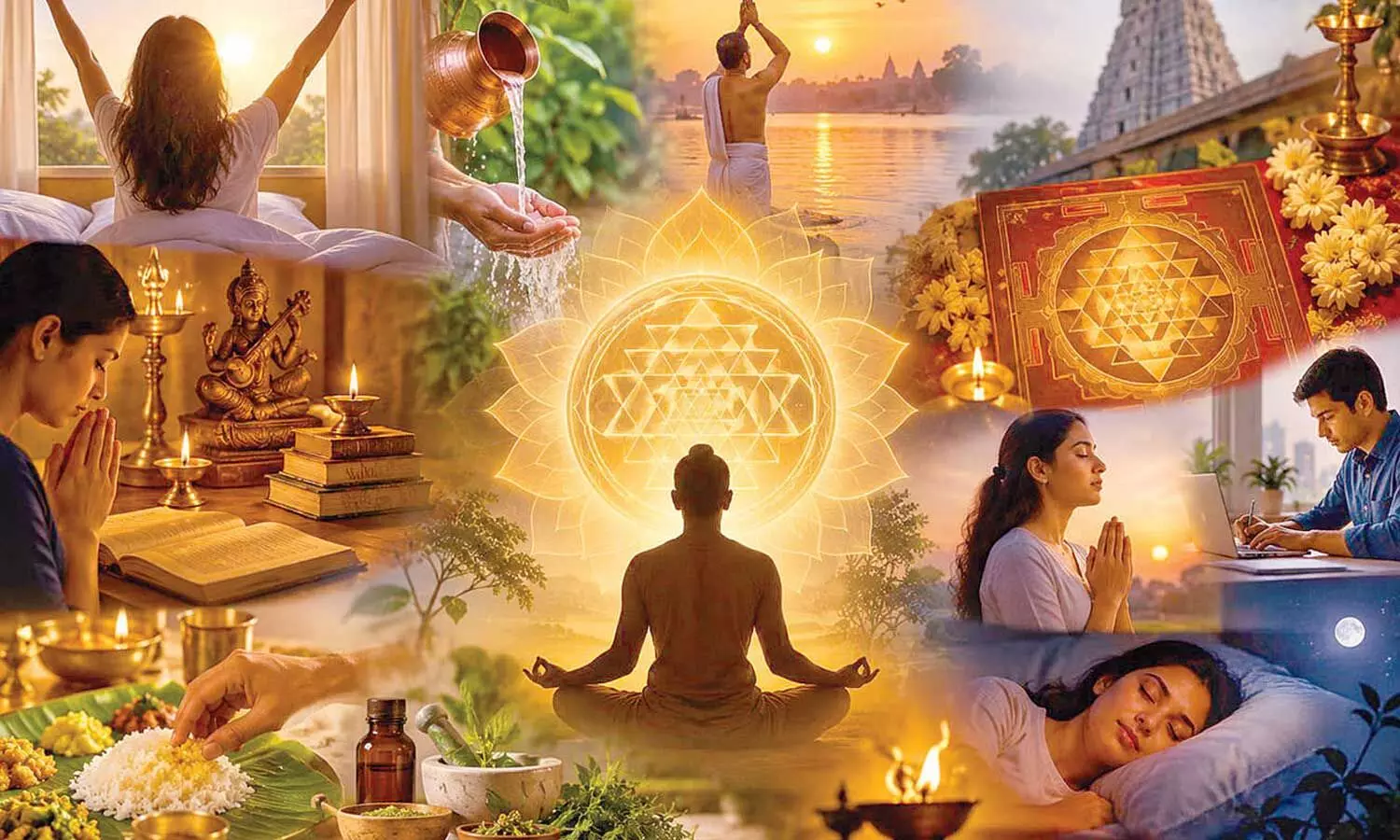
Sacred remembrance could accompany waking, bathing, meals, learning, work, travel and rest. Traditional households preserved shlokas and mantras for different moments of the day.
On waking, remembrance could establish gratitude before beginning dailyactivity. Bathing could become an opportunity for purification and renewal. Before food, a shloka or prayer could transform eating into gratitude. Before learning, an invocation could honour knowledge.
At the junctions of the day, Sandhyā Vandana brought together mantra, contemplation, prayer and disciplined remembrance. At night, prayers and remembrance could create a peaceful transition towards sleep.
This rhythm reveals an insight: consciousness could accompany daily life.
Waking, bathing, eating, learning, working and resting could all carry intention. The routine became a pathway for awareness.
Today, wellness practices encourage morning affirmations, gratitude journals and nighttime reflections. Bharat’s traditions offer a structured vocabulary for meaningful daily transitions.
Food: Receiving with Awareness
Consider the practice of reciting a shloka before eating.
The Shrimad Bhagavad Gita presents the verse beginning “Brahmārpa Brahma Havir…”, describing the act of offering through a sacred vision.
The individual pauses, gives food attention, welcomes gratitude and connects eating with nourishment.
The Taittiriya Upanishad also gives food a profound place in its understanding of life and nourishment.
For a contemporary young person, the lesson is simple: pause before consumption, recognise nourishment, and receive it consciously.
Medicine and the Intention to Heal
Traditional Bharatiya knowledge systems brought together physical care, mental orientation, prayer and ritual in various contexts.
Mantra and sacred remembrance could accompany practices connected with healing and wellbeing.
This offers a complementary dimension of human experience. Medicine addresses physical processes, while hope, confidence, prayer and emotional strength can support the person’s overall journey.
The principle is valuable: intention becomes meaningful when it accompanies appropriate action.
Yantra: Giving Intention a Form
If mantra gives intention sound, yantra gives it form.
Yantras are structured sacred diagrams containing geometric patterns and symbolic arrangements. They have specific meanings and applications within different traditions.
Modern manifestation culture uses vision boards to keep aspirations visible. Bharatiya traditions developed sophisticated visual forms for concentration and contemplation.
A visual symbol can become a reminder. A repeated visual focus can organise attention. A meaningful form can help the practitioner remain connected with an intended principle.
Thus, yantra offers another dimension of conscious practice: an inner intention receives an outer form.
Tantra: The Protocol
Tantra encompasses all Bharatiya traditions and systems involving practices such as mantra, meditation, visualisation, ritual and sacred diagrams.
Its most relevant connection with contemporary manifestation lies in the importance of method.
Traditional practices often involved preparation, sequence, repetition, discipline and prescribed procedures.
The Bharatiya approach brings together:
Sankalpa (intention), Mantra (sound), Yantra (form), Tantra (method) and Karma (action)
Together, they create a framework in which aspiration receives structure.
A Message for the Contemporary Generation
The young generation has rediscovered the language of manifestation.
Bharat offers an opportunity to deepen that conversation.
A dream can become a sankalpa. A meaningful thought can become a daily affirmation or contemplative practice. A symbol can keep an aspiration visible. A routine can become disciplined practice. Every aspiration can find expression through purposeful action.
Do not merely imagine the life you desire. Give your intention direction, give your direction discipline, and give your discipline meaningful action.
Perhaps manifestation is not a new discovery after all.
It is a new conversation with an ancient aspiration and Bharat has been conducting that conversation through sound, symbol, ritual, discipline and conscious living for generations.
(The writer is a creative economy expert)
Year-long commemorative programmes marking Guru Tegh Bahadur’s 350th Shaheedi Diwas conclude in Delhi
GIFT City to host high-level global financial events during Vibrant Gujarat Summit; CM reviews preps
The Making Video Of Sharwanand’s Bhogi Is Out
'People's concerns must be considered': Karnataka CM Shivakumar says elephant relocation operation halted
AP Panchayat and ULBs elections live updates: Polling begins for first phase
'People's concerns must be considered': Karnataka CM Shivakumar says elephant relocation operation halted
Sindhu hails BAI for bringing the 2028 Finals home, dreams of winning the Uber Cup with Team India
Congress Samarashankham to protect the Constitution
Tejashwi targets BJP, Nitish over Anand Mohan verdict, says betrayal has consequences
Ramayana Team Meets Central Home Minister Amit Shah


