







Being part of the art
In Short
Chunchula’s paintings are built around contradictions.

Share :
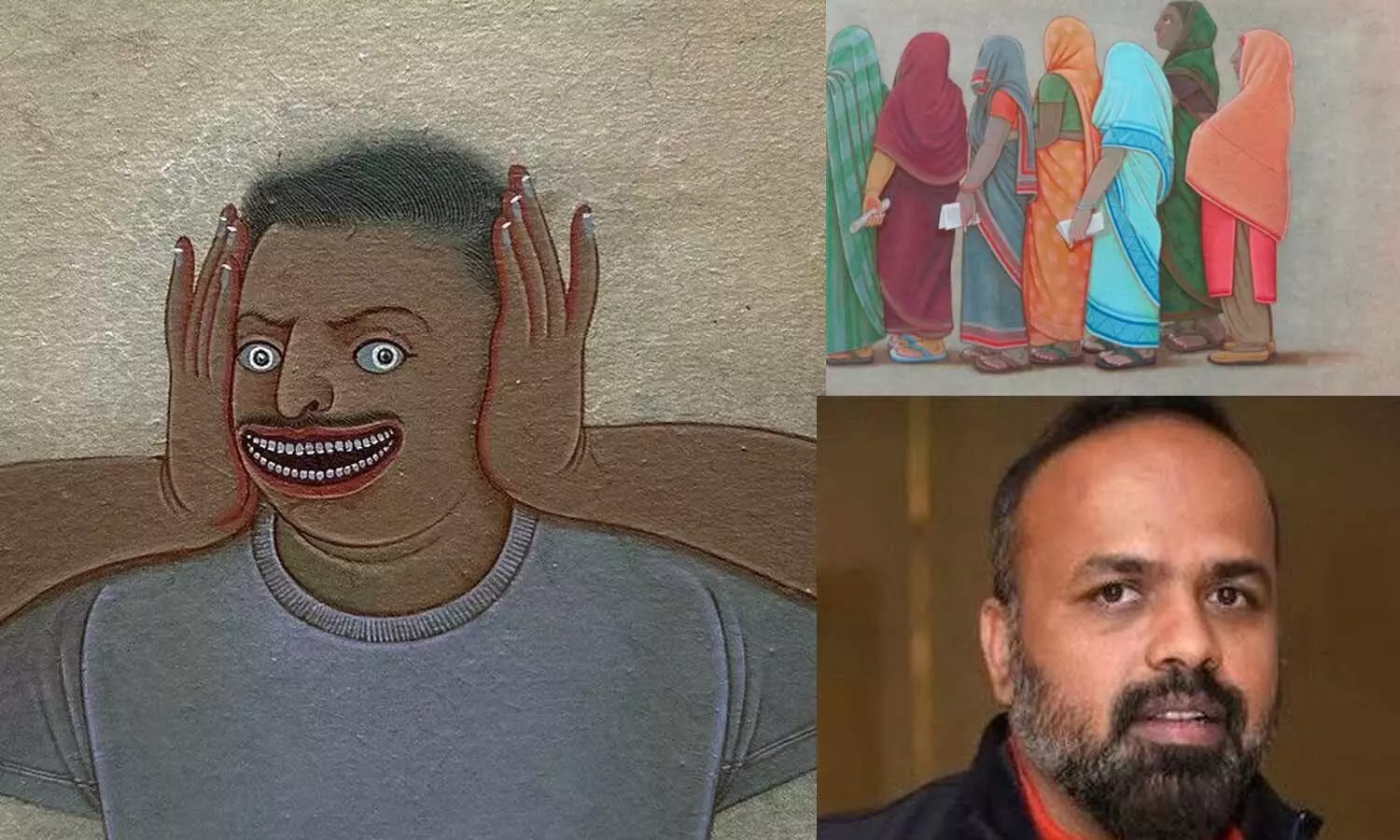
Ravi Chunchula’s work
Champatree Art Gallery from New Delhi showcased Ravi Chunchula’s works, titled ‘We Are Part of It?’, at Design Democracy 2026, held at HITEX, Hyderabad. A Hyderabad-based artist, Chunchula completed his Masters in Art from the University of Hyderabad and has worked as an illustrator for the BBC. His creative practice also includes murals and restaurant design projects, while his works form part of the permanent collection at the Museum of Sacred Arts (MOSA) in Belgium.
Chunchula’s paintings are built around contradictions. Figures appear in unexpected spaces, emerging from windows, grids and architectural surfaces, often with miniature details of faces, hands or other body parts. Human and animal forms are sometimes deliberately distorted, creating a visual language that combines humour, satire and observation.
There is a theatrical quality to these compositions, where ordinary situations are transformed into something slightly strange. The distortion is not merely decorative; it encourages viewers to pause and consider the situations being portrayed. His use of gouache on fragile rice paper adds another layer to the work. The delicate material, soft colours and layered textures create an almost gentle appearance, even when the ideas beneath the surface are sharper.
“My influences are not limited to one or two artists. I am very interested in Indian miniature traditions, particularly Mughal, Deccani, Rajasthani and Pahari painting, as well as illuminated manuscripts. I also look at the Dutch Golden Age tradition,” says Chunchula. His influences, however, extend well beyond art history. Stories, theatre, history, everyday experiences and people around him find their way into his visual vocabulary. He also draws inspiration from Vemana’s simple yet powerful social observations, as well as Panchatantra stories and childhood narratives.
For Chunchula, satire becomes a way of looking more closely at reality rather than simply making fun of it. “In this exhibition, satire is used not to make light of the world, but to reveal its contradictions. Through theatrical situations and surreal imagery, one tries to understand a reality where conflict, politics, culture, entertainment and everyday life often exist together,” he says.
His advice to young artists reflects the same emphasis on developing a distinctive voice. While exhibitions can help artists understand how their work is received, meet curators and build networks, he believes the studio should remain at the centre of an artist’s practice. “I feel it is more important to build a practice than to simply build a list of exhibitions. Exhibitions will come and go, but the work and your own visual language are what stay with you,” he says, encouraging young artists to experiment, make mistakes, read, observe and understand why they are making their work. The exhibition also comes at an important moment for Champatree Art Gallery. Founded by Pooja Bahri and Archana Sapra, the gallery is set to open its Hyderabad branch at ARTYK, Jubilee Hills, on October 10, 2026.
With Chunchula’s works, the gallery brings together an artistic language that is playful on the surface yet reflective underneath. His figures may appear amusing, unexpected or surreal, but the questions they raise are firmly rooted in everyday life. And perhaps that is where the title ‘We Are Part of It?’ finds its strongest resonance—within the viewer who pauses, looks again and recognises something familiar in the strange.


