
Beyond GDP: Why Bharat’s creative economy must be counted

A recent remark by Zerodha co-founder Nithin Kamath— “Cook dinner instead of ordering in, GDP falls”—has sparked a familiar yet unresolved debate. The example is simple: when value is created outside the market, it disappears from Gross Domestic Product (GDP). When the same activity becomes a paid service, it is counted.
This paradox is more than theoretical. It highlights a deeper concern: GDP measures transactions, not value. In a country like Bharat, where creativity, culture and knowledge systems form the backbone of economic life, this gap is increasingly significant.
As the country positions itself as a fast-growing economy, it must ask a more fundamental question: What kind of economic activity are we choosing to recognise—and what are we ignoring?
Invisibility of creative work
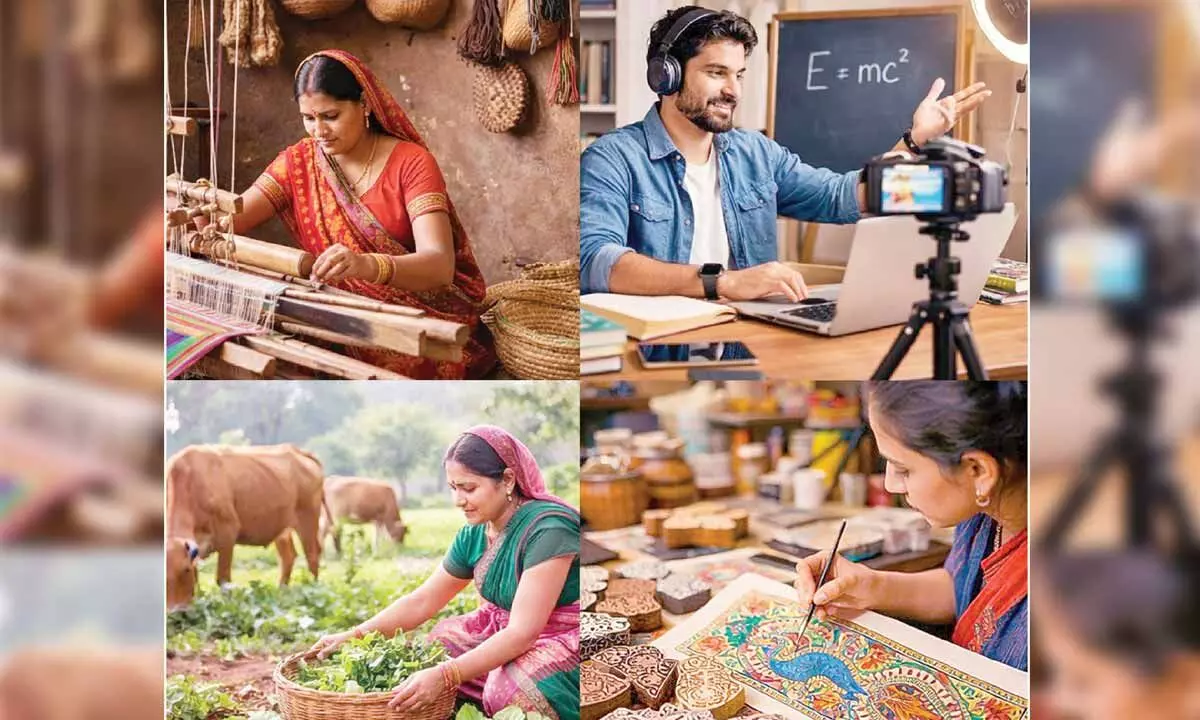
Bharat’s economy is not just industrial or service-driven; it is deeply creative and cultural. From artisans and storytellers to digital educators and local innovators, millions contribute to value creation that is only partially captured in official statistics.
According to UNESCO estimates, Bharat’s creative industries contribute around 2.5% to 3% of GDP. The handicrafts sector alone engages over 7 million artisans, as per the Ministry of Textiles. Yet, these figures tell only part of the story.
A significant share of creative work in Bharat: Operates in informal settings; blends cultural expression with livelihood; often does not pass through formal markets. As a result, much of its value remains statistically invisible.
Continuum of creativity
Bharat’s creative economy is not confined to heritage sectors. It spans a wide spectrum:
1. Traditional and rural creativity
Handlooms, handicrafts, folk arts and indigenous knowledge systems continue to sustain livelihoods across rural India. These are more than cultural artefacts—they are economic assets rooted in sustainability and local resource use.
However, when artisans produce for local use or barter-based systems, their contribution is rarely reflected in GDP.
2. Knowledge and learning ecosystems
Bharat has a long tradition of knowledge sharing through gurukuls, community learning, and oral traditions. Today, this has evolved into Independent trainers and coaches, Skill-based micro-enterprises and Alternative education platforms. Much of this operates outside formal institutional structures, making measurement difficult.
3. The digital creator economy
With over 800 million internet users (TRAI), India is witnessing a surge in content creators, educators, and digital entrepreneurs.
From YouTube teachers to regional content producers income is often fragmented and platform-based and value creation includes learning, awareness, and cultural preservation. Yet, existing GDP frameworks struggle to fully capture this decentralised and non-linear economic activity.
Why does GDP fall short in capturing creativity?
GDP was designed in an industrial era to measure output. It works well for manufacturing, large-scale services, and normal sector activity.
But the creative economy operates differently as the value is often intangible, output is not always monetised as the impact extends beyond immediate transactions
For instance: A craft passed down generations builds cultural capital but adds little to GDP unless sold commercially. A digital educator teaching thousands at low cost creates social value that far exceeds recorded income. This creates a structural bias: market-driven, standardised production is prioritised over decentralised, creative value creation.
Undervaluing Bharat’s strengths
An over-reliance on GDP can lead to misaligned priorities.
1. Creative sectors remain under-supported
Despite employing millions, sectors like handicrafts and cultural industries receive limited institutional backing compared to industrial sectors.
2. Informal creativity is seen as “low productivity”
Activities rooted in self-reliance and local creativity may appear economically weak simply because they generate fewer monetary transactions.
3. Gendered dimensions remain ignored
Creative and household-based work—often led by women—remains outside formal recognition. The Time Use Survey (2019) shows women spend three times more time than men on unpaid domestic work, much of which involves creative and productive labour.
4. Cultural erosion
When economic value is defined narrowly, traditional practices risk being replaced by standardised, market-driven alternatives, leading to long-term cultural loss.
Rethinking economic measurement
Bharat needs to rethink its economic measurement with a creative economy lens rather than abandoning GDP, but it must expand its framework to include creative and human-centred value systems.
1. Recognise the creative economy formally with a national framework of mapping creative workers across sectors, tracking their economic and social contribution by enabling targeted policy support
2. Build satellite accounts for culture and creativity, just as agriculture and environment are tracked separately, the country can create dedicated accounts for creative industries and capture both formal and informal contributions
3. Integrate unpaid and community-based work with time use survey data, unpaid creative labour—especially in households and communities—can be partially monetised for policy visibility.
4. Strengthen digital economy measurement with statistical systems that must evolve to capture: platform-based income, micro-entrepreneurship and knowledge-driven value creation.
5. Bharat’s creative economy is inherently sustainable which relies on local resources, encourages circular practices and preserves ecological balance. Recognising this linkage can align economic growth with environmental goals.
An opportunity to lead globally
At a time when many economies are grappling with the limits of GDP, India has a unique opportunity. Its strength lies not only in scale, but in diversity of value creation—from rural crafts to digital knowledge networks.
By redefining economic metrics to include creativity, culture and community, India can build a more inclusive growth model that can strengthen livelihoods without excessive industrial strain. It offers an alternative framework for global economic thinking
GDP tells us how much an economy produces, but not what it preserves, creates, or sustains. In Bharat, where creativity is embedded in daily life—from kitchens to crafts to classrooms—this distinction matters.
If the country’s growth story is to be both meaningful and sustainable, it must move beyond counting transactions to recognising creative value. Only then can India’s economy reflect not just its output, but its civilisational strength and future potential.
(The writer is a Creative Economy Expert)


