
From cow dung to kilowatts: India’s untapped rural energy story
It is time the opposition stops playing the victim card, abandons the politics of appeasement, and undertakes a serious reinvention. If it aspires to return to power—even by 2034—it must reconnect with its roots, recognise India’s less tapped growth potential, and craft a fresh, forward-looking narrative grounded in opportunity rather than grievance.
The oft-repeated claim that nearly 40% of young graduates are unemployed, may carry elements of truth. But political rhetoric rarely ventures beyond lament. What is missing is a constructive framework that highlights opportunities—particularly in rural India—where new economic possibilities are steadily emerging. The challenge is not merely job creation; it is the dissemination of information, alignment of policy, and the creation of an enabling ecosystem that encourages young people to look beyond urban-centric aspirations.
For this to happen, governance must undergo a subtle but critical shift. Bureaucracies, often conditioned to default to “No,” must be encouraged to say “Yes” to proposals. Young entrepreneurs frequently find themselves entangled in procedural delays and regulatory hesitation. A proactive administrative approach—where officials engage with, rather than obstruct, innovation—can transform the landscape.
Equally important is exposure. Policymakers and bureaucrats must step out of their air-conditioned offices and cars into rural India, where quiet transformations are already underway. By studying these changes with an open mind, and by placing themselves in the shoes of aspiring entrepreneurs, they can design policies that genuinely empower. This requires insulating decision-making from undue political influence at national and local levels and focusing instead on long-term economic and ecological gains.
A renewed focus on the rural economy, without compromising natural resources, holds immense promise. Such an approach can reduce dependence on LPG imports, cut power purchase costs, and simultaneously revive indigenous livestock systems. The growth of bull populations, often overlooked in modern agricultural discourse, can improve cattle quality and strengthen cow-based rural industries. This, in turn, can catalyse a shift toward natural and organic products—an area where global demand is rising. One of the most compelling examples of this rural potential is the use of bull-powered biogas generation. Far from being a rustic curiosity, it represents a viable model of decentralised, sustainable energy rooted in India’s traditional strengths. At a time when energy security and climate resilience are national priorities, such systems offer a powerful blend of tradition and technology.
Biogas is produced through anaerobic digestion, where organic matter such as cattle dung decomposes in the absence of oxygen, releasing methane-rich gas. This gas can fuel generators to produce electricity. While India has long experimented with biogas, the real opportunity lies in scaling it efficiently.
Several states have already demonstrated the model’s viability. Gujarat has emerged as a leader, achieving near-total district coverage under the Gobardhan scheme, with over 190 gaushala-based and dairy-linked models, including large bio-CNG initiatives. Maharashtra has integrated urban and rural biogas systems, converting waste into energy in cities like Mumbai. Karnataka and Tamil Nadu are promoting household and community biogas plants, linking them with organic farming. Chhattisgarh is rapidly expanding village-level units, while Bihar, Assam, Jharkhand, and Andhra Pradesh are scaling up coverage with promising results. This is, in many ways, a quiet revolution. More than 1,100 biogas plants are operational across over 550 districts in India, spanning gaushalas, dairy cooperatives, village clusters, and urban waste systems. Yet, this transformation rarely finds mention in mainstream political discourse.
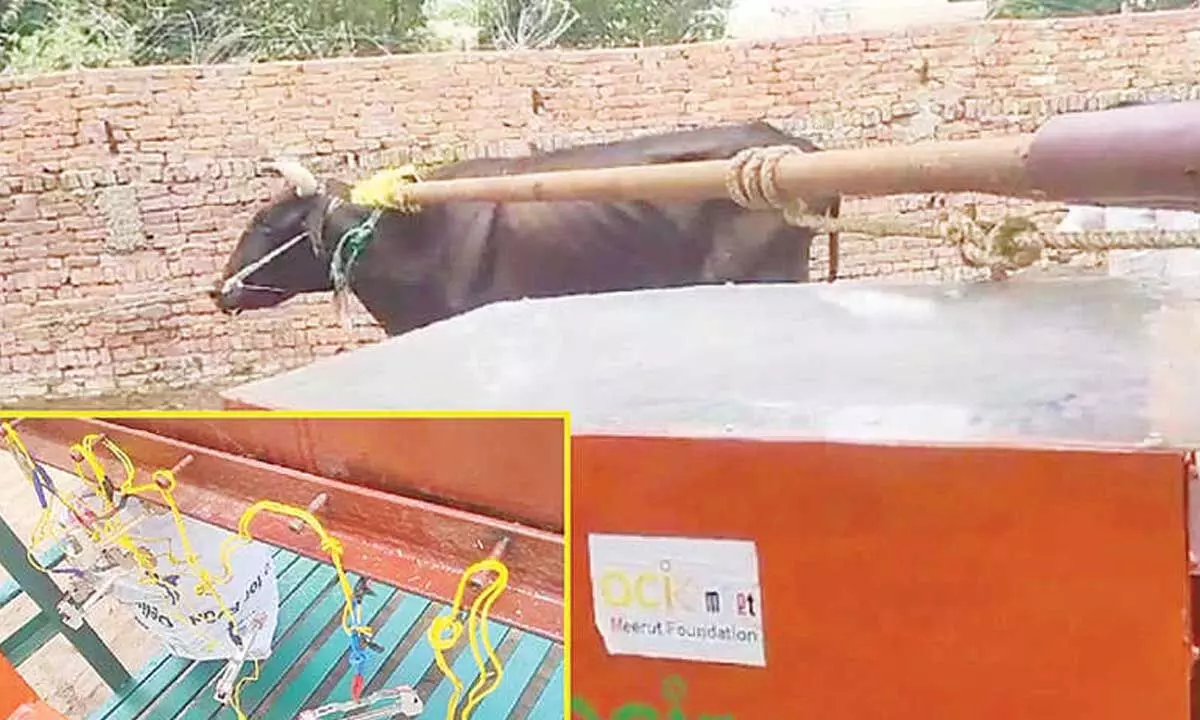
Technical assessments presented at the Gautech 2026 summit in Pune underline the model’s practicality. A single bull produces approximately 10–15 kg of dung daily. With 28 bulls, this translates to 280–420 kg of dung per day, capable of generating 12–18 cubic meters of biogas. Given that one cubic meter of biogas can produce about 1.8–2 kWh of electricity, such a system can sustain a generator producing close to 8 kW of power for several hours daily.
This is not a theoretical construct. Institutions like the Khadi and Village Industries Commission have long supported integrated models combining cattle sheds, biogas digesters, and power generation units. The system operates on a simple cycle: dung mixed with water is fed into a digester, where it ferments over 30–40 days to produce methane. The gas is then channelled into an engine—often a dual-fuel system that reduces diesel consumption or, in advanced setups, runs entirely on biogas.
The by-product—fermented slurry—is a high-quality organic fertiliser. It enhances soil health, reduces reliance on chemical inputs, and completes a sustainable, circular cycle.
The implications are significant. An 8-kW system can meet the energy needs of a small rural cluster—lighting homes, powering irrigation pumps, and supporting cottage industries. Villages can reduce dependence on grid electricity and diesel generators, while surplus power can be used for micro-enterprises such as flour mills or cold storage. What was once waste becomes a valuable economic resource. Environmental benefits are equally substantial. Methane, a potent greenhouse gas, is captured and utilised rather than released into the atmosphere, aligning with India’s climate commitments under global frameworks like the Paris Agreement.
However, challenges remain. Efficient dung collection requires disciplined livestock management. Water availability is essential for slurry preparation. Initial capital costs, though subsidised, can deter small farmers. Maintenance is another concern; poorly managed systems can underperform or leak gas, undermining efficiency. Awareness, training, and technical support are crucial for long-term success.
Biogas integrates seamlessly into a circular rural economy, where agriculture, livestock, and energy production reinforce one another. It aligns naturally with organic farming initiatives and offers a pathway for sustainable rural development.
For India to fully realise this potential, policy support must be complemented by grassroots innovation. Subsidies, training, and community participation are essential. Equally important is the involvement of young engineers, entrepreneurs, and rural youth who can modernise and scale these systems.
An 8-kW biogas generator powered by 28 bulls may appear modest in isolation. But its true strength lies in its replicability. Scaled across thousands of villages, it can transform rural India—economically, environmentally, and socially.
Ultimately, the lesson for policymakers—and particularly for the opposition—is clear. India’s future narrative cannot be built on pessimism alone. It must be anchored in solutions that harness the country’s inherent strengths. The real power of models like biogas lies not just in the energy they produce, but in the philosophy, they embody: self-reliance, sustainability, and a profound respect for nature’s cycles.


