






Voicing environmental concerns through art

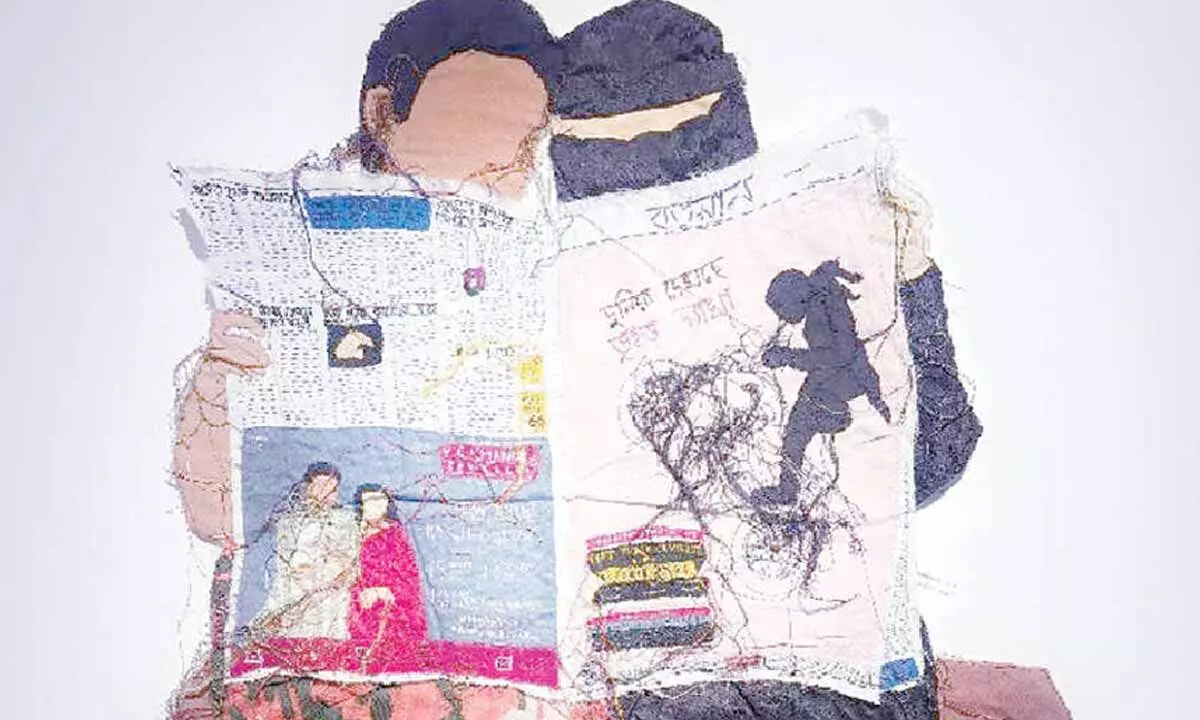
At Srishti Art Gallery, ‘Triloka’ brings together Moumita Basak, Nayanjyoti Barman, and Nirmal Mondal in a compelling exploration of memory, heritage, and changing landscapes
At Srishti Art Gallery, a quiet yet compelling dialogue unfolds through
‘Triloka,’ a group exhibition that brings together three emerging voices—Moumita Basak, Nayanjyoti Barman, and Nirmal Mondal. Each artist navigates a distinct visual language, yet their works converge in exploring memory, environment, and cultural inheritance.
Moumita Basak’s practice is rooted in the tactile and the lived. Working with worn-out fabrics, she transforms fragments of domestic life into evocative narratives of rural women in West Bengal. Her appliqué compositions present faceless figures—deliberately stripped of identity—yet animated through posture and gesture. The absence of detailed features does not diminish their presence; instead, it universalizes their experience, allowing the viewer to sense both resilience and rhythm in their everyday labour.
In contrast, Nirmal Mondal draws from the weight of history. His terracotta ceramics echo temple architecture and scriptural iconography, carrying the patina of time. These works resemble excavated relics, as though unearthed from forgotten ruins, speaking in whispers of a rich cultural past. Mondal extends this dialogue through experimental forms—painting with pigment-mixed mud on inherited garments such as his grandparent’s dhoti, and assembling a poignant suitcase installation. Here, archival images merge with an audio recording of his grandfather’s voice, creating a layered experience where memory is both seen and heard.
Nayanjyoti Barman’s works shift the gaze toward the contemporary landscape shaped by industry. Influenced by his father’s career across power plants, Barman’s pen-and-ink drawings capture the uneasy tension between technological advancement and ecological loss. Birds—once integral to these habitats—appear displaced or diminished. His smaller installations further critique urban clutter, highlighting the chaotic sprawl of cable wires that dominate city skylines. These visual intrusions, often overlooked, become metaphors for the cost of unchecked development.
Together, ‘Triloka’—suggesting three worlds—becomes a thoughtful convergence of past, present, and lived realities. From the intimacy of fabric and familial memory to the vast implications of industrial expansion, the exhibition invites viewers to reflect on what is preserved, what is lost, and what continues to evolve.
On view until May 22, the exhibition offers not just artworks, but experiences that linger—quietly urging a deeper engagement with the worlds we inhabit and inherit.
NITI Aayog council meet: Dharmendra Pradhan pushes for strengthening human capital
India-Oman CEPA special due to crucial timing, strategic location: Report
India's bowling combination, not batting, the real concern heading into Women's T20 WC, says Nasser Hussain
Omar meets PM Modi in Delhi, presses for early restoration of J&K statehood
Air India denies putting pressure on families of AI-171 Boeing crash victims
India Finland Relations, S Jaishankar, Digitalisation, Sustainability, Strategic Partnership


