






‘Vilasa’ celebrates classical brilliance with Apoorva Mallela and Arushi Mudgal

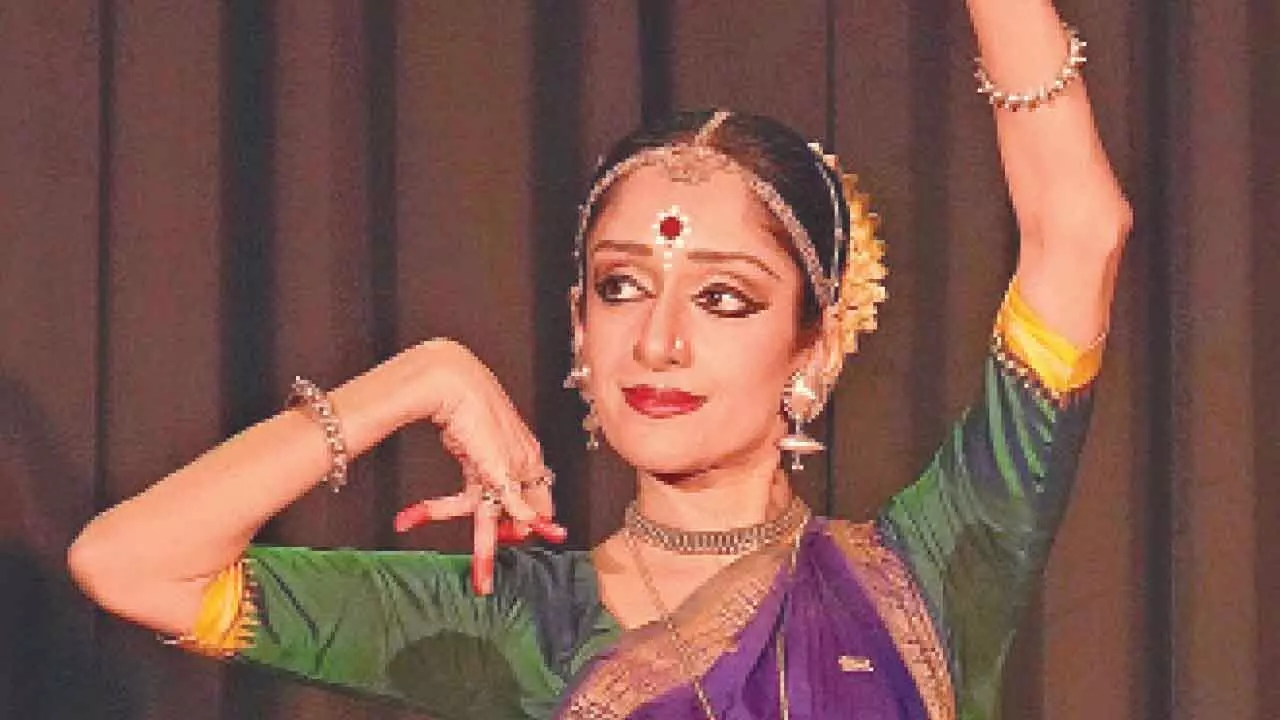
Saptaparni Indoor Auditorium last Sunday evening featured elegant Bharatanatyam and stirring Odissi recitals by Apoorva Mallela and Arushi Mudgal, respectively. The festival, “Vilasa”, brought together artistes and audiences for an intimate performance celebrating the richness of Indian classical arts. It was conceptualized and curated by the artiste couple from the U.S., Apoorva and Tejas Mallela, to showcase young maestros of different art forms in collaboration with Saptaparni and with the support of Anuradha Prasad.
The first Bharatanatyam performance by Apoorva was titled ‘Sahaja – Movement from Within.’ Apoorva Mallela is a Bharatanatyam dancer based in the United States, known for presenting both traditional repertoire and original choreographies that explore new creative directions. Trained primarily in the Dandayudhapani style, her work is enriched by insights drawn from other traditions. Holding a Master of Fine Arts degree, she is a seasoned soloist who has presented her work at prestigious sabhas and festivals globally. She is noted for her musical sensitivity, interpretive depth, and thoughtful engagement.
Apoorva appeared in a costume of sombre hue enlivened with just a dash of colour, with very sparing ornamentation. In her introduction, she explained that sahaja resembles a natural continuum—an unenforced progression, like a flower whose petals unfold gradually without effort. Similarly, body movements resonate by listening to music as a natural, intuitive language. The vocals and violin were by Tejas Mallela, with mridangam by Chandrakanth, adding value to the program.
The opening pure dance item was ‘Bahudari’ by Chitti Babu. The raga’s feminine, lilting quality was reflected in Apoorva’s sparkling, crystalline dance. The choreography emphasized buoyancy, responsiveness, and clarity. The simple movement vocabulary created woven patterns that seemed to follow and blend into the music, making for a refreshing experience.
Balamurali’s javali ‘Marulu Minchera’ in Jhenjutti was interpreted as the containment of immense feeling within a condensed moment of time, where it appears to pause while holding all heartfelt emotion. Sringara was explored through the lens of tranquil companionship. Subtle gestures and controlled pauses conveyed intimacy and desire through distilled shades of abhinaya.
Apoorva remarked that some experiences require time to mature, like her childhood memories of Kashi. The art acquired an inward dimension as movement rested without searching in the following piece. Lord Vishweswara is eulogized as residing in Varanasi in Swathi Thirunal’s ‘Vishweswara Darshan Kar’ in Sindhu Bhairavi. Surrender and compassion were highlighted, with philosophical acceptance of mortality as a pathway to liberation.
The concluding eponymous piece ‘Vilasa’ (nritta pravaha), created by Tejas, was a continuous flow of rhythmic movement embodied in repetition, variation, and play of laya. Apoorva expressed this through lively, spontaneous, and instinctive gestures.
Arushi Mudgal, among the leading Odissi dancers today, is celebrated for her technical brilliance and expressive depth. She trained under her aunt and Guru Madhavi Mudgal in Delhi, continuing a distinguished lineage while bringing a fresh perspective. She has taken Odissi to audiences worldwide, shaping it anew while remaining deeply rooted through interdisciplinary collaborations.
Arushi, in an enchantingly glowing emerald aharya, presented the Odissi recital ‘Athaah – Infinite Creativity Within Tradition.’ ‘Kamalaa’ in Ragamalika, with music composed by Madhup Mudgal, opened with a folksy Oriya prayer to the Goddess. Her procession is eagerly anticipated by devotees who participate joyously. Arushi’s depiction of their eager attentiveness was an ode expressed through soulful abhinaya. The dialogue between Lakshmi and her devotees was symbolic, while verses from the Sri Suktam extolled the manifold aspects of the Goddess.
An excerpt from Kalidasa’s Ritusamhara—’Vasant’—described the advent of spring. The languorous, exquisite, hauntingly beautiful verses, laden with melody in Ragamalika, were delicately portrayed by Arushi in precisely measured cadences. The God of Love, Kamadeva, appears as trees bloom with flowers and the lotus opens, while the scented breeze beckons. Lovelorn maidens wander aimlessly, stirred by cuckoos and humming bees, as Cupid conquers all hearts.
An Oriya Champu, in which Radha is chided by her sakhi, offered scope for radiant nritta and teasing abhinaya. Could she pluck heavenly flowers or lie on a bed of sharp swords unharmed? Radha’s naivety is highlighted in her impossible love for Krishna, fraught with peril.
‘Raam Haun’ in Mishra Peelu by Tulsidas portrayed the pathos of loss, as a heartbroken Kaushalya is separated from her beloved son Rama. The exile is lamented through unbearable memories, reaching the acme of grief in Arushi’s strikingly expressive and intensely piercing abhinaya.
The magnificent finale, ‘Aahlaad’ in Sahana, was a pure dance of glorious abandon, into which the dancer merged blissfully. Beginning at a slower pace, it built into a crescendo of footwork that blazed with incandescent energy, culminating in breathtaking speed.
Arushi excelled in elucidating complex movements of her art form, translating them effortlessly with lucid clarity. The packed audience gave a well-deserved standing ovation to the artistes.
Sunetra Pawar warns leaders against ‘unnecessary interference’, hints at tough decisions
NCW summons comedians More, Jangra over Rs 370 biryani row
CM Fadnavis outlines ‘Viksit Maharashtra 2047', sets target for $5 trillion economy
Pakistan trying to reshape authority through 28th Constitutional Amendment: Report
Mir, Shah knocks help Afghanistan A get four-run win over India A via DLS method
Pro-Khalistan groups continue to provoke youth, advance own political agendas: Report


