






Where tradition breathes through expression

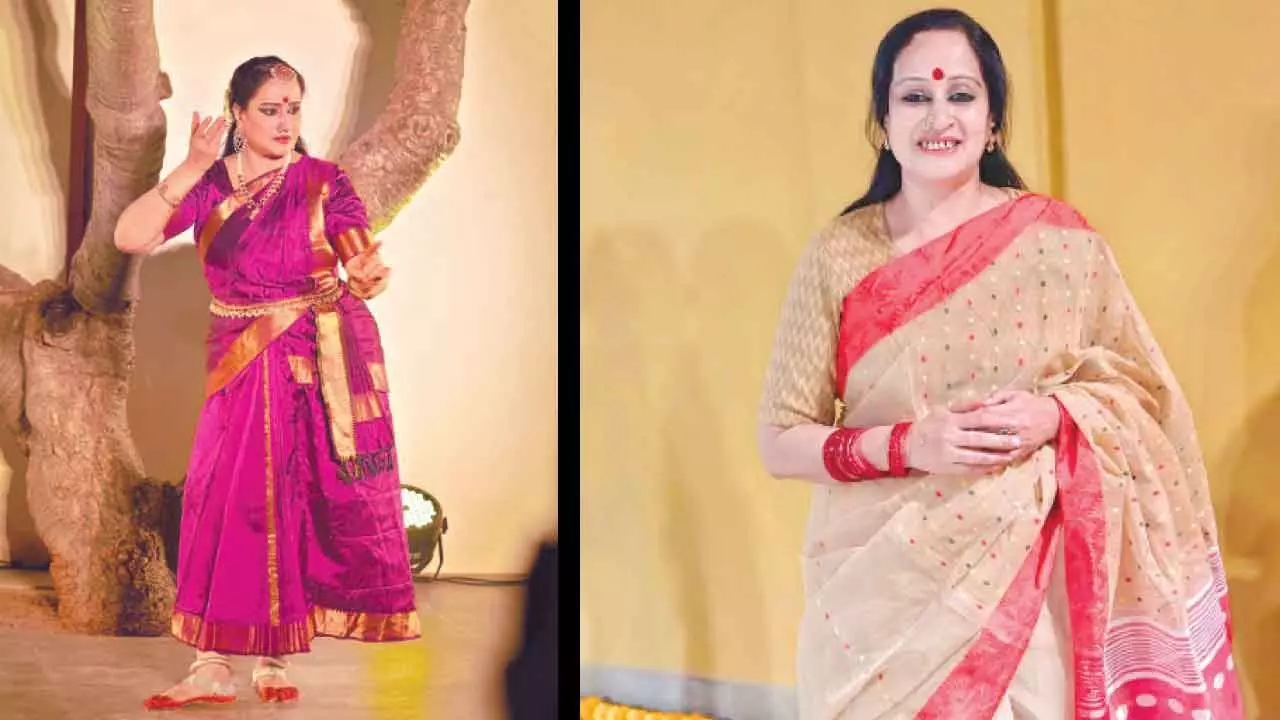
Dr Anupama Kylash’s journey through dance becomes a journey through thought, emotion, and tradition. In her work, abhinaya, scholarship, and lived experience find a luminous voice
Dr. Anupama Kylash, fondly addressed as “Akka” by her students, is a multifaceted personality in the dance firmament of Hyderabad. She has learnt ‘Kuchipudi’ from the doyen Dr. Uma Rama Rao and ‘Vilasini Natyam’ from the renowned Padma Bhushan awardee Dr. Swapnasundari. Having given over a thousand performances and workshops across ten countries, the founder of ‘Anubhav Centre for Performing Arts’ has authored fascinating books on Annamayya and Kshetrayya to critical acclaim. Her verdant prose style is like a garden with choice flowers to be appreciated by the discerning reader.
As a faculty member at various institutes, she has the ability to illustrate and illuminate even the most recondite topics of Indian history, art, and culture with ease. Owing to her encyclopedic erudition, she is an authoritative resource person consulted on myriad subjects. Her sought-after workshops across various cities brim with charming wit that engages students. Her expositions are sketched with the bravura of a Rembrandt in outline and contain the verisimilitude of a Vermeer in detail. Knowledge is savoured and sipped, encouraging participants to revel in mastering intricacies and to embark on their own explorations.
Her ability to connect strands across multiple disciplines and create an overarching thematic exuberance was evident in her curation of speakers for the ‘Ramayana Kalpavrksham Festival Series’, displaying admirable curatorial talent.
Taking time off from her busy schedule, Dr. Anupama shared her outlook and experiences. She began by expressing her good fortune in having stalwart Gurus. Dr. Uma Rama Rao, she said, encouraged her interest in the literature of dance and allied subjects. Having worked on compositions of various vaggeyakaras, she enhanced Anupama’s understanding of subtle nuances and emphasized the importance of properly compiling and utilizing the existing wealth of Indian classical literature. She was also a living embodiment of the beauty of the traditional ‘Kuchipudi’ style.
Dr. Swapnasundari, she noted, apart from being an erudite scholar, is also a genius performer. Having trained under her for over two decades, Anupama remarked that her own approach and masterly understanding of intricate abhinaya—especially in delving into esoteric and philosophical dimensions—are blessings shaped by her Guru’s methodology. She emphasized the immense influence of Dr. Swapnasundari, stating that every expressive gesture she elucidates even today is inspired by her Guru, to whom she dedicates it.
While ‘Kuchipudi’ was the first and much-loved art form she learnt, she feels that ‘Vilasini Natyam’ is her true métier, fulfilling her search for a dance form embodying femininity. In her view, ‘Kuchipudi’ is a more vigorous and dramatic form, originally conceived in a manner more suited to the male body.
She was inspired by the ‘Sringara Prakasham’ thesis of Dr. V. Raghavan and mentored by Dr. Nandini Ramani, a great source of support who provided her an opportunity at the Natya Kala Conference. Her appreciation of Annamacharya’s vast corpus was originally nurtured by Dr. Kamishetty Srinivasulu, who guided her in her doctoral study of the poet’s sringara keertanas. She also acknowledged Dr. Ananda Shankar Jayant, her collaborator in the ‘Ramayana Kalpavrksham Festival Series’, and Dr. Jayachandran among her influential mentors. Her book ‘Nayikas of Kshetrayya’ was her Master’s thesis, published under the Writer’s Workshop imprint in the Young Authors series.
Her second work, her doctoral thesis on the nayika prototypes of Annamacharya, has become an essential reference for young students. This gives her immense satisfaction, as there are very few books in English in this field authored by a dancer who is also an academic.
Summing up her experiences with abhinaya, she explains that there are essentially three types: narrative or storytelling in natya; the literary or imagery-based approach, as seen in devadasi dance; and the emotive approach, where emotions speak for themselves, rooted in fundamental expression.
A glimpse of her artistry could be seen in pieces performed during her recent abhinaya-oriented recital at Saptaparni. In “Rasikudu Tirupati Raghuveera,” the female protagonist is fiery and passionate. The shikha-nakha varnam describing the charming Rama highlights Sita’s affectionate banter with him. “Anila Tarala” interprets the ashtapadi through the lenses of Kashmiri Shaivism, Shakta, and Tantra philosophies, where Radha is the Hladini Shakti, energizing Krishna, who represents sensory knowledge and finds repose in her creative presence. “Subhadra Vilapam” vividly portrays Subhadra’s anguish at confronting the lifeless body of her son Abhimanyu, her grief transforming into anger as she questions the Pandavas’ valor and even berates Krishna, compelling him to promise revenge.
Her workshops range from the most esoteric to the most accessible topics. Many have explored the sringara keertanas of Annamacharya, as well as his sense of humour reflected through spirited heroines. Her recent exploration of the deeper layers of the ‘Gita Govindam’ has led her into uncharted territories, uncovering elements of Shakta and Tantra traditions, as well as its connections to Sahajiya Vaishnavism.
She also recalled her fondness for Hindi literature and her work in Awadhi, Maithili, and Braj Bhasha dialects. Pada sahityam, she suggests, is her forte, though she has also worked on Kalidasa and Prabandha literature.
Broadly, Bhakti literature remains her chosen field of study. Her engagement with Viswanatha Satyanarayana’s magnum opus, she notes, revealed the internal dichotomies of characters between thought and expression—a profound psychological journey.
Concluding with a brief sketch of her family background, she mentioned that her mother learnt Kathak in Kolkata and ‘Kuchipudi’ from Jagannatha Sarma, while she herself trained in Hindustani classical music during her younger years.
Sunetra Pawar warns leaders against ‘unnecessary interference’, hints at tough decisions
NCW summons comedians More, Jangra over Rs 370 biryani row
CM Fadnavis outlines ‘Viksit Maharashtra 2047', sets target for $5 trillion economy
Pakistan trying to reshape authority through 28th Constitutional Amendment: Report
Mir, Shah knocks help Afghanistan A get four-run win over India A via DLS method
Pro-Khalistan groups continue to provoke youth, advance own political agendas: Report


