
From Assam to Kerala: A vote against noise, a push for clarity
Record turnout across States offers early clues to evolving political alignments
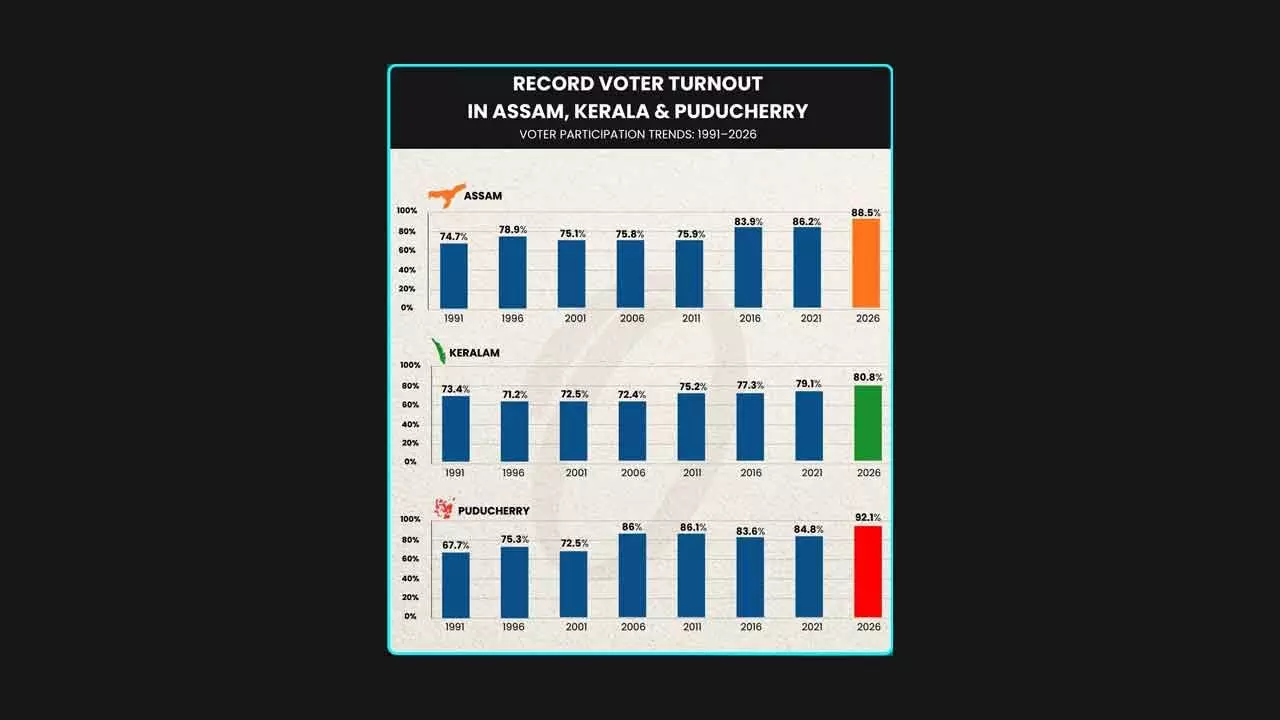
Voting for the Assembly elections in Kerala, Assam and Puducherry concluded smoothly under heightened security, with the fate of candidates now sealed in EVMs. While political parties must wait until May 4 for the verdict, early ground assessments suggest that the high voter turnout—about 86 per cent in Assam, 79 per cent in Kerala and an impressive 90 per cent in Puducherry—may hold crucial clues. Initial indications point to an advantage for the BJP in Assam and Puducherry, while the UDF appears to have an edge in Kerala.
Assam, historically, rarely produces “confused verdicts” when turnout surges. A high turnout typically signals a decisive mandate. In this context, the Congress appears to have committed a serious self-goal. Its alleged misuse of technology—circulating AI-generated fake documents, including purported passports, to discredit the government of Himanta Biswa Sarma—has not only backfired but may have alienated voters. What was perhaps intended as a tactical strike now risks becoming a strategic blunder.
The episode involving fabricated allegations against the Chief Minister’s wife, Rinki Biswas Sarma, has further compounded troubles of the Congress. A criminal defamation case against party media in-charge Pavan Khera followed, exposing the party to embarrassment. Notably, instead of firmly standing by its claims, the Congress appeared to retreat. Khera sought anticipatory bail from the Hyderabad High Court, arguing that arrest was unnecessary—yet without convincingly defending the authenticity of the allegations. This retreat has raised serious questions about credibility.
Such incidents underscore a worrying trend: the growing misuse of social media and artificial intelligence as political weapons. While these tools can amplify narratives, their reckless deployment risks eroding public trust. In Assam, rather than weakening the incumbent, these tactics seem to have allowed Himanta Sarma to turn the narrative in his favour by highlighting governance and development. Despite the inevitable undercurrents of anti-incumbency, the high turnout does not appear to reflect a consolidated anti-BJP sentiment.
More broadly, the opposition’s political strategy continues to suffer from a lack of coherence and originality. Driven largely by an intense opposition to Prime Minister Narendra Modi, many parties appear to rely more on rhetoric than on substantive policy alternatives. The attempt to treat voters as monolithic “vote banks” has repeatedly failed. Indian voters are far more discerning; they evaluate performance, credibility and leadership rather than blindly adhering to identity-based appeals.
In some instances, opposition parties have gone to the extent of excessive appeasement politics, particularly targeting minority communities. Such approaches not only risk alienating broader sections of the electorate but also underestimate the diversity of opinion within communities themselves. Voters are increasingly resistant to simplistic narratives and demand more grounded, issue-based politics.
In Puducherry, another interesting factor is the emergence of the Tamilaga Vettri Kazhagam (TVK), led by actor Vijay. By fielding candidates including two sitting MLAs—among them former minister Sai J Saravanan Kumar—the party could cut more into Congress votes than those of the BJP. This dynamic may tilt the balance further in favour of the BJP-led alliance.
Kerala presents a different picture. The relatively high turnout suggests a possible undercurrent for change. The ruling LDF may find itself on the defensive, with the UDF seemingly benefiting from voter sentiment. There are also signs of increased polarisation. The BJP, while not yet in a position to capture power, has made notable inroads. It has consolidated sections of Hindu voters, particularly by raising issues such as the Sabarimala controversy, and has also reached out to Christian communities.
One instance that appears to have worked in BJP’s favour is its response to disputes involving the Wakf Board, where villagers—many of them Christians—felt threatened by land claims. The perceived lack of support from both the Congress and the LDF in such cases may have helped the BJP expand its appeal. Even so, the party may still need more time before it can seriously contend for power in Kerala.
As the electoral dust settles in these three regions, attention shifts to West Bengal and Tamil Nadu, where campaigning has intensified ahead of polling. Parties are deploying every strategy at their disposal.
In West Bengal, Chief Minister Mamata Banerjee has once again demonstrated her instinct for political messaging, though not without controversy. In a recent speech, she appeared to warn of consequences if voters supported the BJP. Without naming any community explicitly, her remarks hinted at potential social tensions, creating an atmosphere of fear. Such rhetoric raises concerns about the quality of political discourse.
Her comments—suggesting that if “one community unites” it could overpower others—have been widely criticised as inflammatory and irresponsible. While she may have intended to position herself as a protector of social harmony, the language used risks deepening divisions. The BJP has interpreted her remarks as a veiled threat to the Hindu community, further sharpening political polarisation.
Banerjee also invoked historical figures like Mahatma Gandhi, Jawaharlal Nehru, Rajendra Prasad and B R Ambedkar in defence of her party’s stance on migration and citizenship issues, particularly in the context of the Special Intensive Revision (SIR) exercise, which the Trinamool Congress has termed a precursor to the National Register of Citizens (NRC). However, critics argue that her statements reflect a distortion of historical realities, especially given the long-standing presence of Muslim communities in Bengal’s social fabric.
Meanwhile, the BJP appears to have recalibrated its strategy in the State. Moving away from direct personal attacks on Banerjee, it is focusing more on development promises and welfare initiatives. While there is visible anti-incumbency against the ruling Trinamool Congress, it would be premature to conclude that Banerjee is on the verge of losing power. Despite age and health concerns, her energetic campaigning—often through padyatras—continues to resonate with her core base.
A critical factor in West Bengal remains the role of the Election Commission of India. The state’s history of electoral violence—before, during and after polling—makes the conduct of free and fair elections a key concern.
In Tamil Nadu, the contest is equally complex. The AIADMK, in alliance with the BJP, is mounting a serious challenge but faces an uphill task against the DMK, which retains a strong grip over significant sections of minority voters, particularly Muslims. However, the emergence of TVK could disrupt this equation by making inroads into the Christian vote base traditionally aligned with the DMK.
Though TVK is expected to secure a notable vote share—possibly around 15 per cent —its ability to translate votes into seats remains uncertain. The first-past-the-post system may limit its immediate electoral impact, even if it reshapes the political landscape over time.
Adding another layer to Tamil Nadu politics is the re-entry of V K Sasikala. Projecting herself as “Thyaga Thalaivi,” she has resumed public appearances, by invoking the legacy of J Jayalalithaa and taking indirect swipes at the AIADMK leadership. However, her influence appears limited at this stage, and she is unlikely to significantly alter the electoral outcome in this election.
As India once again navigates a high-stakes electoral cycle, one clear pattern emerges: voters are increasingly assertive, discerning and resistant to manipulation. The verdict on May 4 will not just decide winners and losers; it will also offer deeper insights into the evolving mind of the Indian voter.
(The author is former Chief Editor of The Hans India)


