
Shouting in Parliament won’t solve India’s energy crisis
It is most unfortunate that India’s political ecosystem—its leaders, spokespersons and even some so-called analysts—continue to operate within an outdated and narrow mindset. Many of them appear more interested in delivering long lectures that please the leaders of the political parties they support rather than contributing meaningfully to the national discourse.
Instead of demonstrating maturity and statesmanship, they often reduce serious national issues to a political spectacle.
What is even more disappointing is their refusal to adopt a broader outlook and an open mind, especially during times of national crisis. Political competition is natural in a democracy, but when circumstances demand unity and constructive engagement, our political class often fails to rise above partisan calculations. The country expects responsible leadership; instead, it frequently witnesses noisy confrontation.
The recent uproar over the LPG shortage triggered by the ongoing Iran conflict is a classic example. Some opposition leaders have been loudly accusing the central government of failing to be prepared for the crisis and have alleged widespread hoarding by gas agencies.
In a democracy, the opposition certainly has the right—and indeed the duty—to question the government. However, one ought to remember that the right to question comes with the responsibility to speak judiciously and base accusations on facts rather than rhetoric.
Hoarding of essential commodities is unfortunately not a new phenomenon in India. It has existed for decades and continues to persist despite regulatory mechanisms. To portray the issue as an overnight development that has emerged due to government’s negligence is both misleading and irresponsible.
What was particularly disturbing was the spectacle of opposition representatives shouting on national television about shortages of domestic LPG cylinders and accusing agencies of overcharging consumers. This situation demands introspection from those very leaders. They must ask themselves an uncomfortable question: who exactly benefits from creating panic among the public?
It is no secret that many LPG distributorships are are owned by individuals enjoying political clout. Many belong directly or indirectly to politicians across parties. If that is the case, why are such leaders not ensuring that their own networks operate with integrity during a crisis? Why are they not demonstrating patriotism by ensuring that there is no hoarding or black-marketing?
Instead, some appear more interested in creating outrage while conveniently ignoring the role of local networks and state-level enforcement.
The truth is simple: while the central government can issue policy guidelines and increase supply, preventing hoarding and black-marketing is primarily the responsibility of state governments.
This is precisely where the opposition has an opportunity to demonstrate real leadership. If non-NDA States ensure that supply chains remain transparent and efficient, and that there is minimal hoarding or price manipulation, they would gain enormous credibility. Imagine the political impact if states governed by such parties are able to show that LPG distribution in their territories was smooth, affordable and corruption-free. That would be a powerful example and a legitimate political weapon against the ruling establishment.
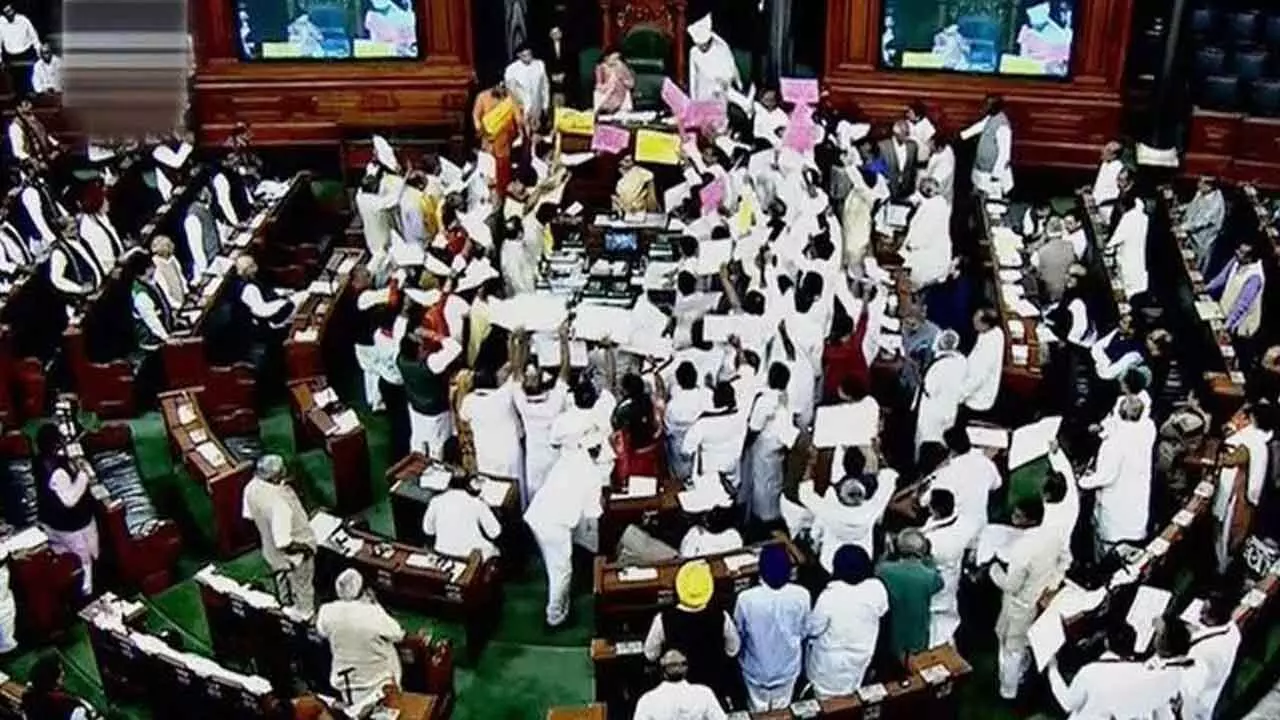
Instead of taking this constructive route, many opposition leaders prefer shouting matches and dramatic walkouts in Parliament.
Leaders such as Rahul Gandhi frequently complain that they are not allowed to speak in Parliament. Yet when the opportunity arises, meaningful policy ideas are rarely presented. What the country hears instead is repetitive rhetoric designed for television clips rather than serious parliamentary debate.
The deeper problem is that large sections of the political class appear unwilling to learn from global developments. While many countries are rapidly adopting innovative technologies and forward-looking policies, our debates often remain trapped in obsolete frameworks shaped by colonial-era thinking.
The current energy crisis triggered by the Iran conflict is not of India’s making. It is a consequence of complex geopolitical developments. In such a situation, the opposition should certainly highlight ground realities, while at the same time, demonstrate maturity by proposing solutions and studying global best practices that could help India manage similar crises in the future.
Take for instance, the example of innovative energy solutions emerging in countries like Japan. Instead of spending endless hours in Parliament shouting slogans, political leaders could discuss how such technologies might be adapted in India.
Japan, a densely populated nation where millions commute daily through busy train stations and urban centres, has experimented with generating electricity from human footsteps. The idea is based on the scientific principle known as the Piezoelectric Effect.
Engineers in Japan installed special piezoelectric materials beneath floor tiles in crowded areas such as metro stations, bus terminals, shopping malls and exhibition centres. Whenever a person steps on these tiles, pressure is applied to the material, generating a small electrical charge. This electricity is then stored in batteries and used to power LED lights, information displays and sensors.
While a single step produces only a tiny amount of energy—typically between 0.1 and 7 watts for a brief moment—the cumulative impact of thousands of footsteps can be significant. In a busy station where over one lakh people pass through daily, the collective energy generated can power numerous low-energy devices.
Beyond the electricity produced, such projects also serve an important educational purpose. When citizens see lights powered by their own footsteps, it creates awareness about energy conservation and sustainability.
The technology is also environment-friendly. It produces electricity without burning fossil fuels or emitting carbon. In the long run, such innovations could become part of smart city infrastructure, powering sensors, lighting systems and other urban utilities.
The only major limitation at present is the relatively high installation cost because specialised flooring systems and electronic infrastructure are required. However, as with most technologies, costs are likely to decline as adoption increases.
Imagine if Indian political leaders were to seriously discuss how such innovations could be integrated into our metro networks, railway stations and large public spaces. The country could generate supplementary electricity while simultaneously promoting environmental consciousness. It can also be a stand by system in times of energy crisis.
Unfortunately, instead of such forward-looking discussions, Parliament often becomes a stage for theatrics.
This is deeply unfair to taxpayers. Each working day in the Parliament costs the nation more than Rs nine crore. When sessions are repeatedly disrupted by slogan-shouting and forced adjournments, it is public money that goes to waste.
Accountability must therefore become part of parliamentary culture. One possible reform could be linking the salaries and allowances of legislators to their performance in Parliament. If members repeatedly disrupt proceedings and force adjournments, their salaries should face proportional deductions. Such measures might finally discourage habitual disruption.
India deserves a political culture where leaders compete through ideas rather than noise. The country needs representatives who read widely, understand global innovations and present constructive solutions.
Until that happens, parliamentary theatrics will continue to dominate—and the real business of nation-building will remain postponed.
(The author is former Chief Editor of The Hans India)


