
Confluence of Sanatana wisdom and a living tradition

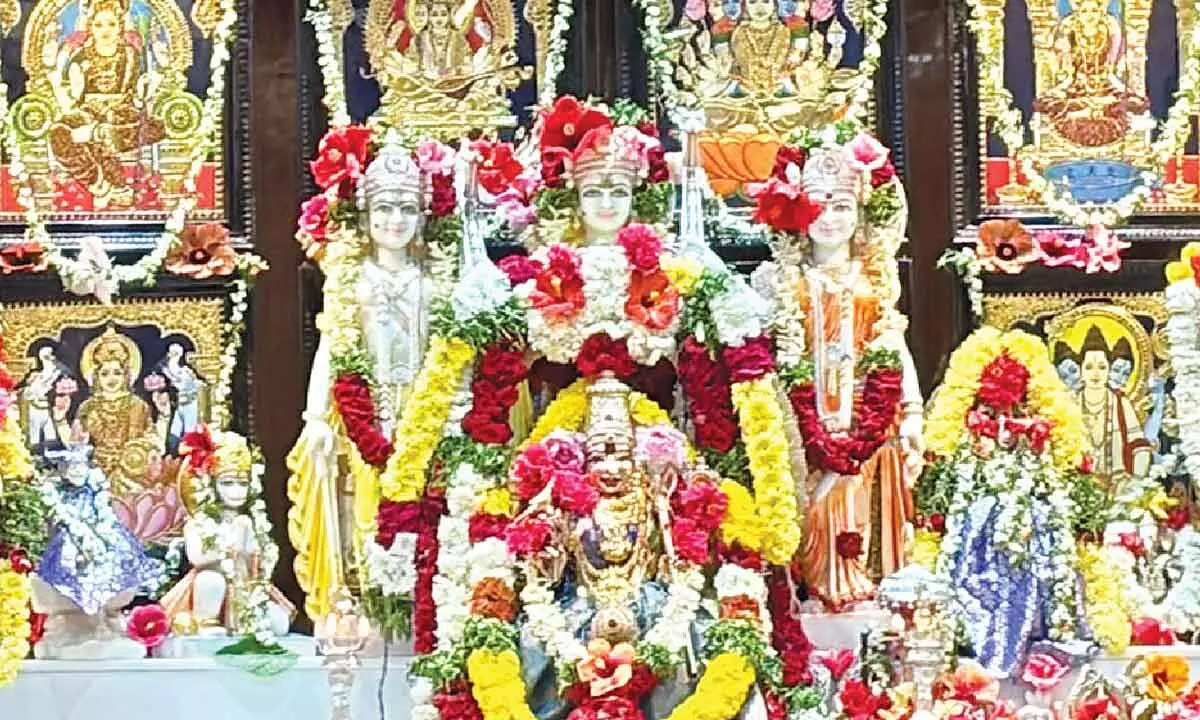
MahaShivaratri, the sacred night of spiritual awakening, assumes deeper meaning only when devotion transcends ritual and transforms into lived experience. This year’s Maha Shivaratri evening was celebrated by our family members at the residence of a ‘Chakra Siddh holistic healing tradition’ practitioner on the outskirts of Hyderabad. It unfolded a religious ritual observance, and a profound coming together of an intimate, meaningful, and spiritually elevating gathering that blended philosophy, devotion, scholarship, science, culture, affection, and the collective divine elevation.
Dr Satya Sindhuja, a popular exponent of the ‘Chakra Siddh holistic healing tradition’ facilitated the confluence. The ambience reflected the architecture of her creative house itself, which deserves exclusive mention. Constructed in alignment with traditional architectural principles, it allows the rays of sun and moon to enter at specific ordained angles while remaining protected from natural disturbances. There was an unmistakable harmony between structure and spirit: an environment that subtly prepared the mind for reflection even before the rituals commenced, and they were comfortably aligned with contemporary sensibilities.
Chakra Siddh healing is an ancient Indian therapeutic tradition rooted in Sanatana Dharma. It represents far more than a system of medical intervention. It is a comprehensive philosophy of life that harmonizes body, mind, breath, and vital energy. In the continuum of India’s timeless knowledge traditions, this healing approach occupies a distinct and esteemed place. It seeks not merely to treat symptoms but to restore balance within the subtle energy centres: the chakras and thereby enabling the body’s innate intelligence to reclaim its natural state of equilibrium.
Among the foremost contemporary exponents of this rare and lineage-based healing tradition is Dr Satya Sindhuja, founder of the ‘Chakra Siddh Healing Centre.’
Belonging to what she describes as the 36th generation of an inherited knowledge stream, she represents a living bridge between scriptural wisdom and practical application. Her training reflects the classical Indian Guru-Parampara.
The participation of our family gradually unfolded into an immersive journey through Maha Nyasa, Rudra Abhisheka, reflective dialogue, philosophical exploration, and heartfelt human bonding. The 50 invitees included Vedic priests, musicians, singers, film directors, medical practitioners and beneficiaries of healing p. It was a circle brought together by shared reverence for ‘Sanatana Dharma’. Soon, attention shifted to the revered scholar Vishvanath, affectionately addressed as Guruji, on his arrival.
The commencement of Maha Nyasa signalled the true spiritual threshold of the night. The rhythmic intonations of the Vedic priests began to fill the hall, their voices neither hurried nor ornamental, but measured and resonant. The syllables of the Rudram reverberated through the space with a cadence that seemed to transcend mere sound. The gathering instinctively grew silent.
Maha Nyasa is a profound internal purification, and a process by which the aspirant symbolically consecrates the body as the abode of the Divine before invoking Shiva through Rudra Abhisheka. When the Rudra Abhishekam commenced, the Shiva Lingam became the focal point of collective attention. Offerings of water, milk, curd, honey, sandal paste, Bilva leaves, and sacred ash were poured in sequence, each accompanied by precise Vedic mantras.
Subsequently, Guruji steered the gathering into a more nuanced philosophical reflection and shared his insights on subjects ranging from Quantum Physics to Advaita, Visistadvaita, Dvaita philosophies, Sanatana Dharma, Upanishads, and the Vedas. The subjects transformed into a lucid and easily understandable manner, only when it became participatory and as an interactive session lasting about 45 minutes.
The earlier explanations regarding symbolism now deepened into the heart of Advaita, the non-dual vision that underlies the very conception of Shiva. The Guru Parampara of Adi Shankara and ancient institutions such as the Kanchi Matha at Srisailam were aptly referred.
Misconceptions about Adi Shankara, that, he was opposed to Buddhism in hostility, instead of his corrected philosophical deviations were also addressed. It was also clarified that Shankara did not preach rejection of wealth, but detachment from greed. An elaborate discussion followed on harmonizing modern science with ancient philosophical thought. Metaphysics with physics were connected and was explained as to how Upanishadic wisdom underlies much of later philosophical development. It was observed that the three great Indian philosophical systems: Advaita, Visistadvaita, and Dvaita, evolved as complementary from Vedas.
Even the Bhagavad Gita was described as having its roots in Upanishadic Thought. Further references included Brahma Sutras, Veda Vyasa’s division of the Vedas, karma, and jnana doctrines, Bhaja Govindam, and the encounter between Adi Shankara and the Chandala interpreted as a moment of spiritual awakening. The interactive session observed that modern physics increasingly recognizes the primacy of energy over matter.
It was during this contemplative exchange that two timeless verses of Bummera Potanna were recalled. The first verse affirmed the omnipresence of the Divine, while the second was a poetic expression dissolving the sense of separation between the individual and the universal.
Parallels were drawn between Newton’s laws of motion and Upanishadic insights, suggesting that many aspects of modern science trace their conceptual origins to the Vedas. It concluded with the striking observation that even NASA’s conceptual foundation could be linked symbolically to Vedic Sutras.
Hours had passed, yet there was no fatigue. Instead, there was a sense of inward steadiness, as though time itself had softened its pace. A rare intellectual serenity prevailed. What was striking was not merely the erudition of the discourse but its accessibility. Complex metaphysical ideas were discussed without obscurity.
Gradually, the formal deliberations softened into informal conversations. Groups formed organically, with some discussing scripture, others exchanging personal experiences, still others reflecting on the evening’s insights. The sacred and the social blended seamlessly. It was nearing the early hours of the morning, yet the atmosphere retained a freshness that belied the time. The night had by then transcended its designation as a ritual event. It had become a shared exploration.
As the sacred chants subsided and philosophical deliberations gently dissolved into informal exchanges, the night seemed reluctant to conclude. The Abhishek waters had sanctified the Shiva Lingam, but more significantly, the shared reflections had stirred minds and hearts alike. Ancient wisdom met modern inquiry; metaphysics conversed with physics; devotion embraced reason. The two timeless verses of Bummera Potanna echoed as silent anchors to the evening’s essence, affirming the omnipresence of the Divine and dissolving doubts about separation.
A shared humanity beyond distinctions of status, scholarship, age, or achievement remained for a while in that sacred space.


