






How Gulf War 2026 left US weaker, Iran stronger

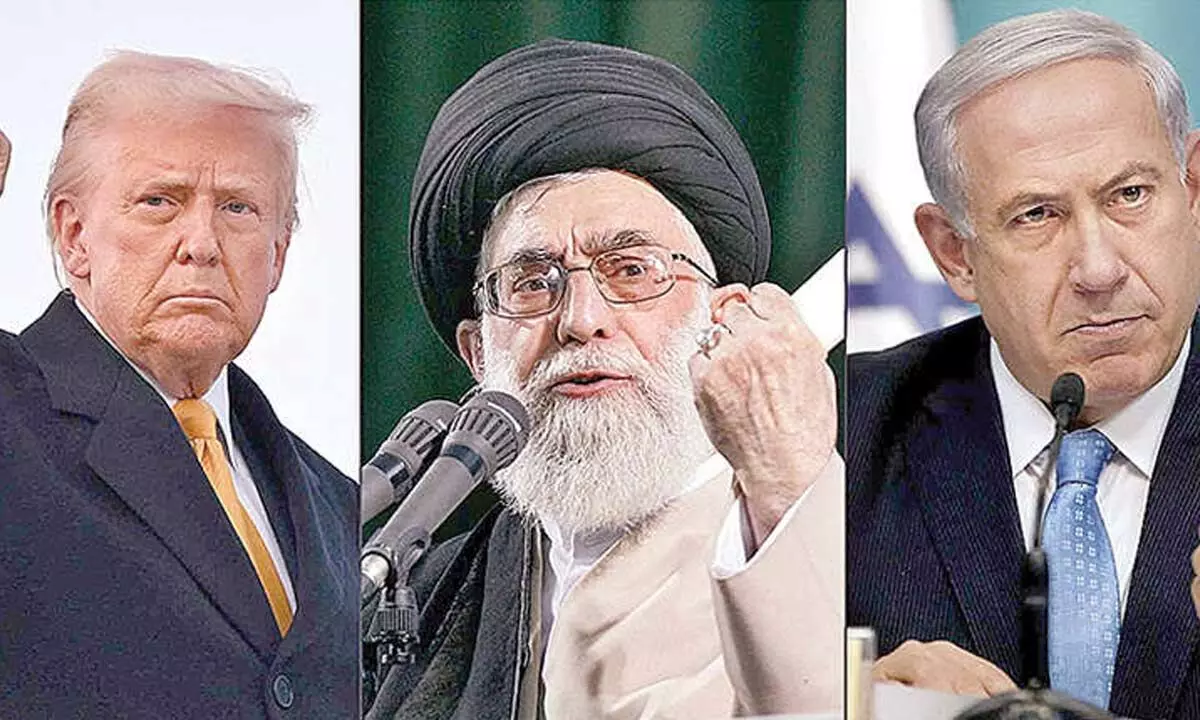
The Trump-led US lets Iran find a stronger weapon in Strait of Hormuz, which has played crucial role in the West Asia conflict
The unprovoked war on Iran has larger implications for the world. Such military actions don’t augur well for humanity. It’s the right time for the world to have a democratic order wherein every sovereign country enjoys equal rights, irrespective of their size and without any hindrance. For its part, India should also condemn such unilateral attacks if it wants to elevate its position globally
It is often said that it is very easy to start a fight or war. But it’s not so easy to finish it. For that matter, the endgame is always complex in every conflicting situation. And the person who starts a fight without an endgame in mind always pays a heavy price. This also applies to a country. Of course, persons get involved in fights – small or big - while countries get themselves bogged down in wars. But prices paid in both cases are proportionately higher if there is no proper exit strategy. Do these few sentences tell us something?
A high-profile delegation from the United States headed by its Vice-President James David Vance left Islamabad, the capital of the economically-bankrupt Pakistan, empty-handed on Sunday morning after 21-hour intense talks with an Iranian delegation to put an end to the West Asia war 2026 that the US and its Middle East ally Israel foisted on the world on February 28. Vance was accompanied by the US special envoy to West Asia Steve Witkoff and Trump’s son-in-law and White House advisor Jared Kushner. On the Iranian side, Parliament Speaker Mohammad Bagher Ghalibaf led the team. Talks failed as both sides were stuck to their positions. Before leaving the Pakistani capital, Vance sounded a warning to Iran, saying no agreement was reached and that was bad news for Iran, not for the US. On its part, Iran blamed the US for the collapse of the talks. Ghalibaf said that the US side had put forth excessive and illegal demands and that it was up to Washington to decide whether it could earn Iran’s trust or not.
The outcome of Islamabad talks was on expected lines. It was Donald Trump who started the war (named Operation Epic Fury) against Iran along with Israel on February 28, demanding unconditional surrender of Iran. It was Trump who paused strikes for two days on March 21 and himself extended the pause thrice till April 8, hoping for a ceasefire agreement. Of course, he threatened to obliterate Iran many times while extending the pauses. Finally, the US and Iran agreed for a two-week ceasefire on April 8 and talks between Iran and the US were held on Saturday in Pakistan, which mediated the ceasefire. Interestingly, Israel, which played a major role in the war, was not part of the talks.
All the developments from the West Asia warfront from March 21 indicate that the US went to the talks on a weak note. Thus far, it left the US weaker and Iran stronger. So, expecting Iran to accept all terms of the US is rather far-fetched.
Nevertheless, it is not yet clear why Trump started this war in the first place. Apparently, he went into the war after Israeli and American intelligence agencies located the whereabouts of Ayatollah Ali Hosseini Khamenei, the Iran supreme leader who was on the US hit list for many years. That was the reason why the US and Israel could kill him on the first day of the war itself. The US claimed a couple of days after the war started that over 40 top leaders of Iran were killed in the first few days. That was the time when the US and Israel should have stopped the war as their key objective of going for a regime change in Iran was achieved. Last year, these two countries attacked Iran’s nuclear facilities for a few days and then stopped them, saying they achieved their goal of hitting nuclear facilities deep inside Iran. But this time, the two countries prolonged the war with an intention of crippling Iran on the nuclear weapon front.
There has been talk of the US losing superpower status and a new world order for the last couple of years. This might have also prompted the US to go after Iran to reinforce its superpower status. But Iran retaliated strongly through guerilla warfare and expanded the war theatre to other Middle East countries, including UAE and Saudi Arabia, Iran’s archrivals in the region. Further, Iran also turned the Strait of Hormuz as its biggest economic weapon, which pushed crude prices up and crippled the world. Nearly 20 per cent of global oil and gas supplies pass through this strait. Iran’s Hormuz blockade forced Trump to desperately try for an early exit from the war zone.
So, it is no surprise that the United States reached such a low point in geopolitics that it had to literally beg a small country like Pakistan to broker a peace deal with Iran.
The US Vice-President Vance travelled all the way from Washington to Islamabad to participate in talks with Iran! Incidentally, this is Vance’s first visit to Pakistan. Some months ago, he visited India. But he did not go to Pakistan that time. Trump’s desperation was clearly visible while Russia, China and India, key players in global politics, watched the developments in West Asia carefully.
Anyway, with talks between the US and Iran failing, the endgame for the West Asia war 2026 is simple and clear now. Like his country, Trump wants Iran to discard its nuclear weapon ambitions and open the Strait of Hormuz unconditionally. Iran’s nuclear ambition was the key reason cited by Trump for attacking Iran this time. However, he could not achieve it when the war was on. At present, Iran feels it has an upper hand in the conflict. So, it is very unlikely that it will agree to Trump’s terms on the nuclear issue during the talks. Similar is the case with the key Hormuz Strait, Iran’s newly found potent economic weapon. So, it is more likely that the US will have no other option except declaring war on Iran again to achieve its goals.
But war has its own downsides for the US, given its economic cost as happened in the last 40 days. Any loss of US military personnel in the Iran war will have adverse implications for him back home. That way, Trump seems to be caught in a Catch-22 situation. That’s the reason why he is relying on war rhetoric of the highest order. But such rhetoric is unlikely to make Iran to fall in line.
However, if the US doesn’t win the war convincingly, its superpower status will be at stake. If that happens, the war will turn out to be its epic mistake. Anyway, this unprovoked war on Iran has larger implications for the world as the aggressive attacks of the US on Iran is clear indication that military might is the right. Sadly, that’s a very bad omen for the world as the US or any other superpower can attack any sovereign country as per its whims and fancies while the world looks hapless. Such military actions don’t augur well for the world. It’s the right time for the world to have a democratic order wherein every sovereign country enjoys equal rights irrespective of their size and without any hindrance. For its part, India should also condemn such unilateral attacks if it wants to elevate its position globally.
Sunetra Pawar warns leaders against ‘unnecessary interference’, hints at tough decisions
NCW summons comedians More, Jangra over Rs 370 biryani row
CM Fadnavis outlines ‘Viksit Maharashtra 2047', sets target for $5 trillion economy
Pakistan trying to reshape authority through 28th Constitutional Amendment: Report
Mir, Shah knocks help Afghanistan A get four-run win over India A via DLS method
Pro-Khalistan groups continue to provoke youth, advance own political agendas: Report


