
Prioritise rejuvenation of ‘Buckingham Canal’

The rapidity of transformation of human civilization increased manifold ever since inventions were made in transportation modes. Even in India, beginning with the colonial period and after independence, continuous efforts are made to improve the transportation networks in the country connecting the length and breadth of the subcontinent.
Presently, governments are developing road networks, highways, bullet trains, national and international flights. Because of their ease and swiftness, the preceding modes of transport overpowered waterways, which used to play a key role in the economy by providing transportation to goods and services, and people across regions. An outcome of this transformation, coupled with rapid urbanisation, encroachment of water bodies and pollution is the neglect of the several water canals in India which became victims of modernisation. It is the responsibility of the government to promote the waterways through the revival of the canals. One such canal whose plight calls for immediate attention and action by the government is ‘Buckingham Canal’.
Designed by Western engineers, this 19th-century navigation canal passes parallel through the Coromandel coast and connects Andhra Pradesh and Tamil Nadu. Its construction was taken up in several phases. This is a private waterway that was planned and executed based on the ‘design-build-operate’, project delivery system. This was the predecessor of the present day much-acclaimed Build-Own-Operate-Transfer Model).
The construction of the canal began in 1806. Initially, the 16.5 km stretch of the canal from Madras Port to Ennore was built by the Basil Cochrane company. In remembrance of this contribution, this canal was called the ‘Cochrane Canal’ in 1806. Later, the British government took interest in extending this canal by stretching it northwards to Madras.
By connecting Kakinada Port via Vijayawada, the canal enabled continuous activity between Madras and Kakinada port. For a while, it was also called Lord Clive’s canal. When the Great Famine hit this region during 1876-78, the British government provided relief for the people through the extension works of this canal. This canal was renamed as Buckingham Canal, after the Duke of Buckingham and Chandos, who was governor of Madras presidency at that time.
The 796-km long water navigation canal extending parallel to the Coromandel Coast, one kilometre from the coast, is extended till Villupuram in Tamil Nadu. It also connects with Pulicat Lake and at Chennai, it intersects through the city’s three major rivers- Kosasthalaiyar, Cooum and Adyar. All these aspects make this canal a marvellous engineering creation and multipurpose project.
This canal was initially used for transportation of commodities, people and later, for fishing. Settlements cropped up on the banks for this canal. Many communities formed their livelihood by depending on this canal.
In his work ‘History of the Buckingham Canal Project’ (1898), A S Russell writes that the construction of the canal has placed erstwhile Madras Presidency “in cheap and easy communication with no less than five districts, and with the large and important towns of Cocanada, Bezwada, Masulipatam, Ongole and Nellore”.
This canal earlier was “a dreary waste of sand, but much of this barren and arid country has been greatly developed and improved owing to the remarkably cheap means of communication afforded by the canal; cultivation has been brought into existence or extended, owing to the facilities given by the canal for the drainage of low-lying land; numerous casuarina and other plantations have been formed along its entire length; a great increase in the wealth and prosperity of the population has taken place”.
Beyond bringing prosperity for the people in the region, this canal has the potential to protect people against natural disasters like floods and tsunamis. The canal has mitigated the effects of the 2004 Tsunami by acting as a buffer zone for 310-km long coastal regions from Pedaganjam in Prakasam district to Chennai, saving the lives of hundreds of fishermen and coastal villages.
Scientists believe the canal has the potential to act as a barrier to allow tidal waves to merge into the ocean in ten minutes.
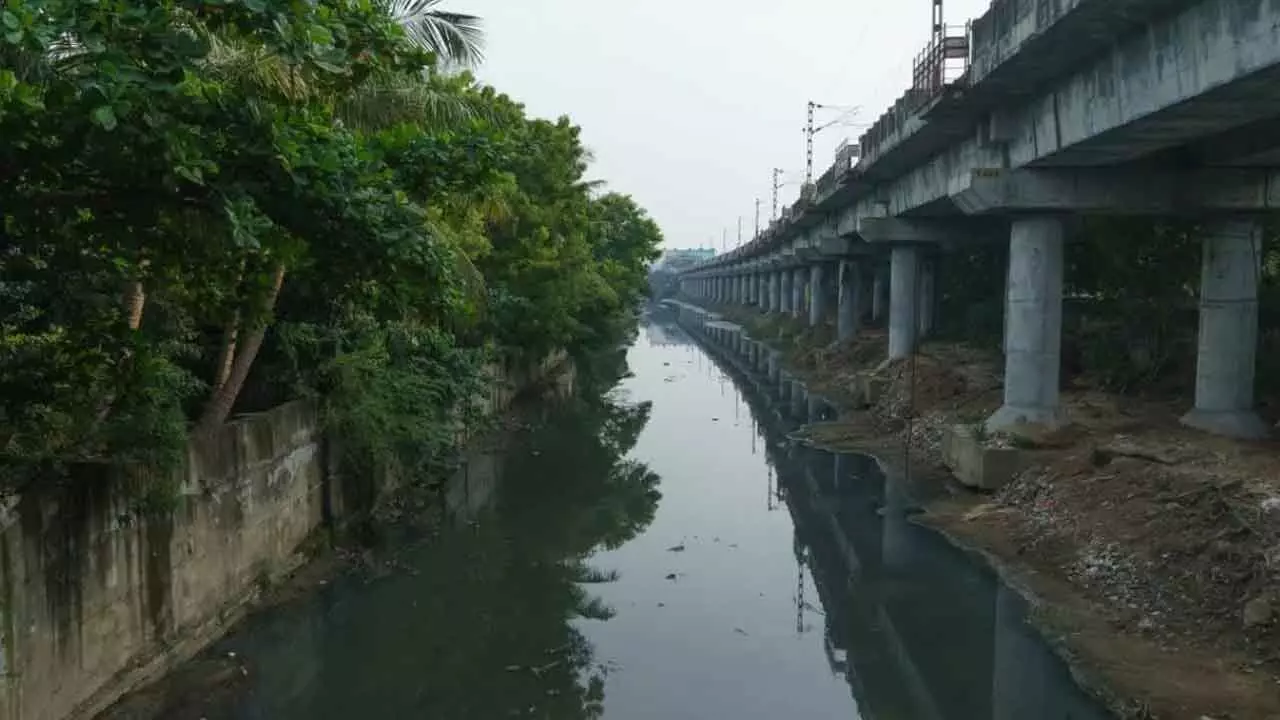
This historic canal, which used to be bustling with activity, is now ravaged with multiple problems like emitting untreated wastes by the industries and urban populates, encroachment of the canal land, siltation, and damage caused by natural disasters like floods. The mega prawn farms situated at the banks of this waterway dump their diseased and dead stock directly into the canal. Cyclones, against which this canal acted as a buffer zone, have damaged the canal and only a few attempts have been made towards the reconstruction and maintenance of the canal.
The advent of faster modes of transportation contributed to the deterioration of the canal. In some areas, the canal is filled with filth and debris, while at some places, it completely disappears and will be visible after some distance. The need of the hour is the immediate restoration of this age-old canal. Whenever a huge hurricane or flood hits any region, the government releases millions of rupees in the form of relief.
But if steps were taken to develop infrastructure to mitigate these disasters, loss of people and property could be easily mitigated. This canal offers an opportunity in that direction, and to provide for the livelihoods of many communities living across the canal. The restoration of the canal with medium- and long-term plans should be the priority of the governments of Andhra Pradesh and Tamil Nadu, along with the Union government.
It is a matter of great relief and hope that the Inland Waterways Authority of India (IWAI) has announced its intention for the revival of the Buckingham canal by declaring it as National Waterways 4 (NW-4). Established in 1986, IWAI aims at the development, maintenance and restoration of Inland Water transportation on national waterways. Rejuvenation of Buckingham canal is placed under NW-4, which covers waterways from Kakinada to Kalapet in Pondicherry in three phases. But the rejuvenation plans under NW-4 are jeopardized due to the shifting of survey works in Phase-1 to Phase-2 and Phase-3. Despite the ambitious plan, the implementation works are going at a snail’s pace. Governments have a responsibility to change the order of priority and expedite the work on this national canal waterway in the first place. The role of the State Water Resources Department is crucial for this.
Reviving Buckingham canal requires a concrete and swift plan of action, which involves dredging, removal of numerous bridges that were built on the route of the canal, recovering the encroached lands, and reconstruction of the walls wherever required. It is also necessary to check on the pollutants and untreated wastes that are being released into the canal throughout its stretch.
Rejuvenation of the multipurpose canal would ease the environment-friendly transportation of commodities and people between states, reduce traffic woes, irrigation, provide for the livelihood for millions of people, fishing, and boating. It can also open the opportunity for developing more cordial relationships between Andhra Pradesh and Tamil Nadu, which can share the benefits of this project by recognising dual responsibility for the states to protect this national heritage. A relentless resolve by the governments can ensure that the otherwise ‘forlorn’ Buckingham canal will start bustling with activity, like in the good old days.
(The writer is a retired IAS Officer)


