
Reform or repackaging? Need to rethink TG’s education policy

The TEP’s push for English-medium instruction from the earliest years raises another concern. While it reflects parental aspirations, it overlooks a well-established pedagogical principle—that early learning in the mother tongue is essential for conceptual understanding. Making English the default medium can deepen linguistic and social inequalities.
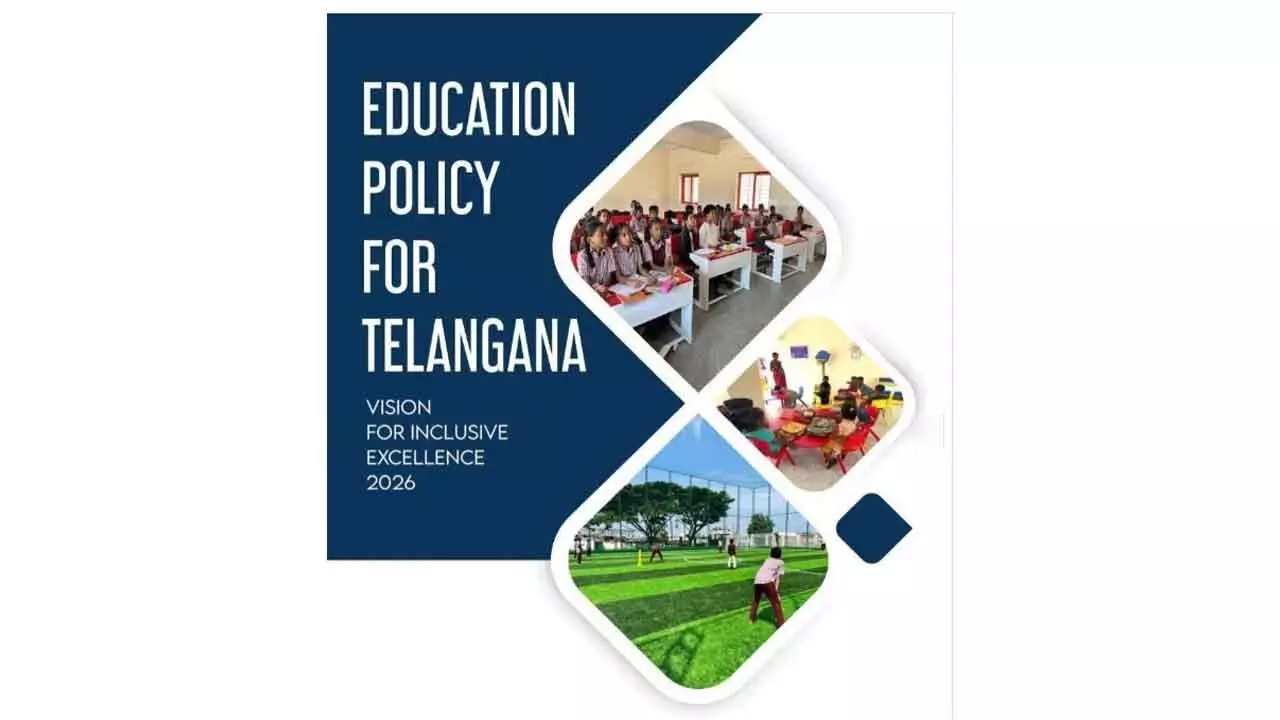
The Telangana Education Policy (TEP) presents itself as a bold step toward “inclusive excellence” and holistic education. It draws rhetorical legitimacy from global frameworks like the Delors report, signalling a progressive vision. Yet, a closer reading reveals a troubling contradiction: the policy appears less concerned about rebuilding public education as a democratic space and more with reshaping it along market-driven lines.
At the heart of the policy lies an unexamined assumption—that private schooling signifies quality. Over the past decades, public education has been weakened through underfunding, administrative neglect and a steady erosion of public trust. This has pushed middle-class families toward private schools. Instead of reversing this trend, the TEP interprets it as a reflection of “people’s aspirations” and seeks to align government schools with private models. In doing so, it risks legitimising a hierarchy that it ought to dismantle.
The proposed Telangana Public Schools (TPS) system exemplifies this shift. The policy envisions that, over time, schooling will be organised into three categories-small government schools, TPS institutions and private schools. Parents, it is argued, will make informed choices, with TPS emerging as the preferred option. This is presented as a move toward a common school system.
But this is a rhetorical stretch. A genuine common school system is built on neighbourhood schools where children from diverse backgrounds learn together, fostering equality and social cohesion. What the TEP proposes, instead, is a layered system in which schools compete and parents choose—essentially a quasi-market in education. In this framework, TPS becomes a state-managed competitor rather than a vehicle of social integration.
The contradiction deepens when we consider developments on the ground. While the TEP itself advises the government against further expansion of residential schools and colleges, the state is simultaneously moving in the opposite direction—establishing over 100 new “Young India” residential schools and opening the doors to foreign private institutions. This divergence between policy recommendation and governmental action points toward increasing stratification rather than integration. Public education, instead of being strengthened as a universal right rooted in neighbourhood schooling, risks becoming a differentiated system catering to distinct social segments.
Equally concerning is the proposal to establish a standards authority to measure the performance of students and teachers. While accountability is necessary, international experience offers a cautionary tale. Reforms such as the No Child Left Behind Act and Race to the Top in the United States, as well as similar policies in England, led to teaching being narrowly focused on test performance, shrinking the curriculum and eroding teacher autonomy.
In contrast, high-performing systems such as Finland and Canada follow a different path. They ensure teacher quality through rigorous preparation and professional licensing at the entry stage, and then rely on trust, peer collaboration and continuous development—not constant surveillance through tests. The lesson is clear: accountability built on measurement alone weakens education; accountability grounded in professionalism strengthens it.
The TEP’s push for English-medium instruction from the earliest years raises another concern. While it reflects parental aspirations, it overlooks a well-established pedagogical principle—that early learning in the mother tongue is essential for conceptual understanding. Making English the default medium can deepen linguistic and social inequalities.
Taken together, these elements point to a deeper shift in the role of the state—from a provider of equitable public education to a regulator of a competitive education market. This is not merely a technical change; it is a redefinition of what education is meant to be.
If Telangana is serious about inclusive excellence, it must move in a different direction. Strengthening neighbourhood public schools, ensuring equitable resource allocation, respecting linguistic diversity, and treating teachers as professionals rather than subjects of constant measurement is essential. Accountability must be rooted in trust, peer engagement and institutional reflection—not in narrow metrics and rankings.
Education cannot be reduced to numbers, targets and consumer choice. It is, fundamentally, a good public space where democratic values are nurtured and social divisions are bridged. Any reform that loses sight of these, can deepen the very inequalities it seeks to overcome.
(The writer is a faculty member at Kakatiya Government College (Autonomous), Hanumakonda)


