
‘Surgical strikes’ turn into strategic disaster, Trump faces checkmate

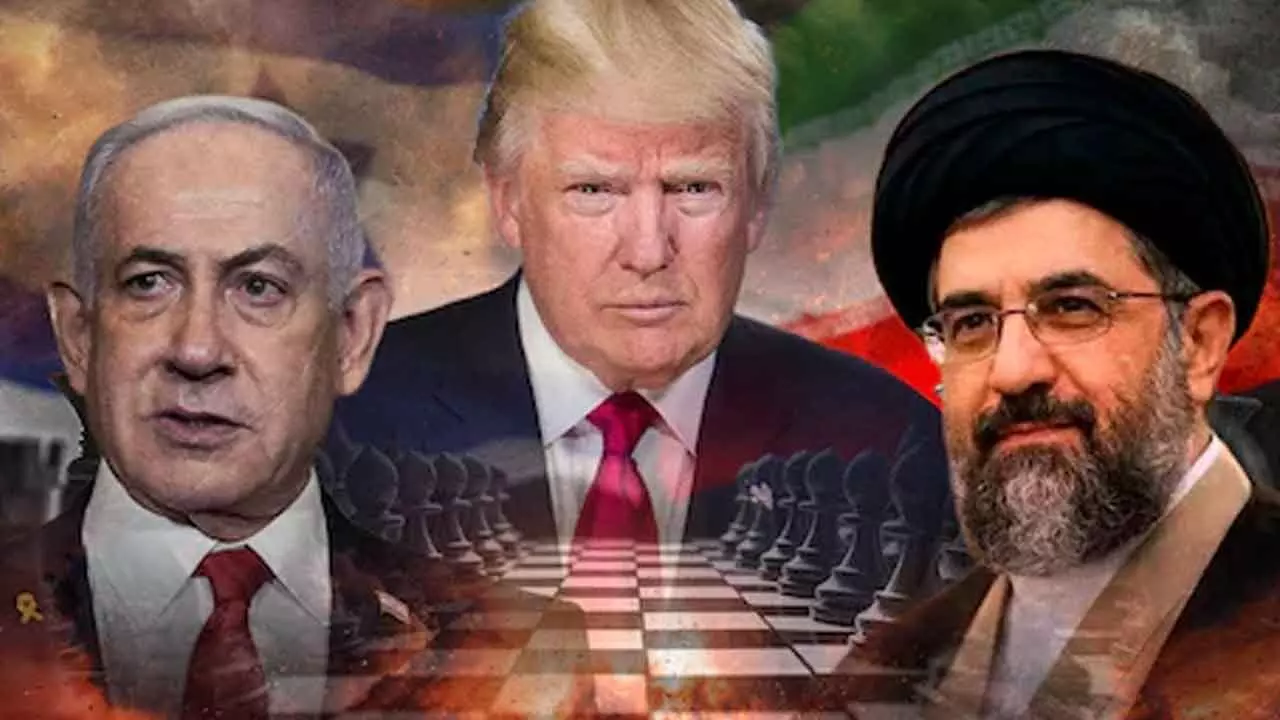
Something extraordinary seems to be happening in the Middle East this week that ordinary Indians cannot afford to ignore. There were unconfirmed reports a couple of days back that Iran’s new Supreme Leader, Moshtaba Khamenei, stood before his nation and the world and delivered a blunt 12-minute message. He did not beg. He did not plead. He gave the United States three clear demands and a 30-day deadline: pull out all American troops from Iraq, Syria, and the Gulf kingdoms; lift every single sanction on Iran; and pay $500 billion in reparations for decades of economic blockade.
This was followed by reports on Thursday that the Iranian President Masoud Pezeshkian, in a post on social media platform X, made it clear that the only way to end this war, ‘ignited by the Zionist regime and US’, is recognizing Iran’s legitimate rights, payment of reparations, and firm international guarantees against future aggression.
If America refuses, Iran warned it will close the Strait of Hormuz — the narrow sea passage through which nearly 20 million barrels of oil flow every day. It will invite Russian and Chinese military help. And it will openly build a nuclear deterrent. Within hours, oil prices jumped above $100 a barrel. Global markets trembled. And Washington went completely silent.
For most Indians, these names and places feel far away. But they are not. India imports 85 per cent of its crude oil, and a huge chunk of that oil passes straight through the Strait of Hormuz. When prices cross $100, the pain reaches your doorstep within weeks.
Let us be clear. The United States and Israel launched “Operation Epic Fury” just 12 days ago, hoping to finish Iran’s nuclear programme and topple its government in one swift strike. They killed the old Supreme Leader Ali Khamenei. They bombed military bases and nuclear sites. They expected chaos and surrender. Instead, the Iranian Revolutionary Guards quickly installed his son Moshtaba — younger, harder, and backed fully by the military. There was no power struggle. There was only a stronger, more determined Iran.
Now Moshtaba appears to have turned the tables. His three reported demands are not vague slogans. They are precise: troops out in 30 days, sanctions gone in 60 days, and cash compensation spread over 10 years. If ignored, he will shut the world’s most important oil artery, call in Russia and China, and go nuclear. A leaked Pentagon report — purportedly written before this speech of Moshtaba — admitted the war cannot be won without sending 200,000 American soldiers for 18 months at a cost of three trillion dollars and thousands of American lives. Congress will never approve that. So America is trapped: it cannot win on the battlefield, and it cannot easily accept Iran’s terms without looking defeated.
This is why oil shot up nearly 20 per cent in hours. This is why gold prices hit record highs and stock markets fell. Every extra dollar on a barrel of oil adds roughly ₹8-10 to the price of a litre of petrol or diesel in India within a month. Cooking gas cylinders will become costlier. Truck and train fares will rise. Vegetables, milk, and bread will follow. Families already struggling with 5-6 per cent inflation will feel the pinch again. The rupee, which has already touched the all-time low against the US dollar at 92.27 on Thursday, will weaken further, making every imported item — from phones to medicines — more expensive.
Eight million Indians work in the Gulf countries. Many send money home every month. If the war drags on or the Strait closes even briefly, jobs and remittances will suffer. Our engineering and textile exports to West Asia — already under pressure — could shrink. Small businesses and daily-wage workers will be hit hardest.
What makes this moment truly historic is the power shift. For 45 years America dictated terms to Iran — sanctions, isolation, threats. Today a regional country backed by Russia and China is dictating terms to America. The Pentagon itself says the war is unwinnable without boots on the ground. European allies are quietly calling for talks. China is offering itself as a peacemaker. This is not just another Middle East crisis. It is proof that the era of one superpower deciding everything is ending.
America wanted to show strength. Instead it has shown the limits of military power in today’s world. Iran has shown that a determined nation with strong friends can force even a superpower to the table. For India, the lesson is simple: in a changing world, self-reliance and smart diplomacy are our best shields.
The world stands at a dangerous crossroads
What began as America’s attempt to reassert dominance in the Middle East has instead exposed the fragility of the entire global economic order. If the next few days end in genuine talks, oil prices may stabilize and a deeper crisis may be averted. But if Iran follows through — closing the Strait of Hormuz even for a few weeks — the consequences will ripple far beyond the Gulf.
Brent crude at over $100 is already sending shockwaves. Europe, which still relies on Middle Eastern energy for winter heating and industry, faces the real risk of factories shutting down and households choosing between heat and food. China and India, the two largest importers after the United States, will see their import bills balloon by tens of billions of dollars, weakening their currencies and pushing up inflation for ordinary families from Shanghai to Mumbai. Shipping costs will surge, supply chains for everything from mobile phones to medicines will snarl, and developing nations already struggling with debt will slide closer to default.
More than money is at stake. This moment marks the visible cracking of the old unipolar world. For the first time since 1979, a regional power backed by Russia and China is forcing a superpower to the negotiating table on its own terms. The petrodollar system — the quiet foundation of American financial power — is being openly challenged. If sanctions are lifted and reparations discussed, the era of one country writing the rules for global energy and finance begins to end. Multi-polarity is no longer a slogan; it is arriving in real time at the mouth of the Strait of Hormuz.
For India this is both a warning and opportunity. Every extra rupee at the petrol pump reminds us that depending on imported oil is no longer just an economic risk — it is a strategic vulnerability in a world that can be upended overnight. The crisis accelerates the urgent need for solar, wind, electric mobility and domestic exploration, not as green dreams but as national insurance.
The next few days will decide whether this becomes a short, painful price spike or the trigger for a global slowdown that lasts years. Ordinary citizens everywhere — the shopkeeper in Mumbai, the factory worker in Guangzhou, the driver in Lagos — now share the same quiet fear: distant wars no longer stay distant. Their cost lands straight on the kitchen table, the school fee, and the monthly budget of every family on the planet. History is now being written in the language of oil prices — and every one of us is trapped inside the chapter, whether we like it or not.
(The writer is with Cholleti BlackRobe Chambers, Hyderabad)


