
The silken soul of a century: A requiem for Asha Bhosle

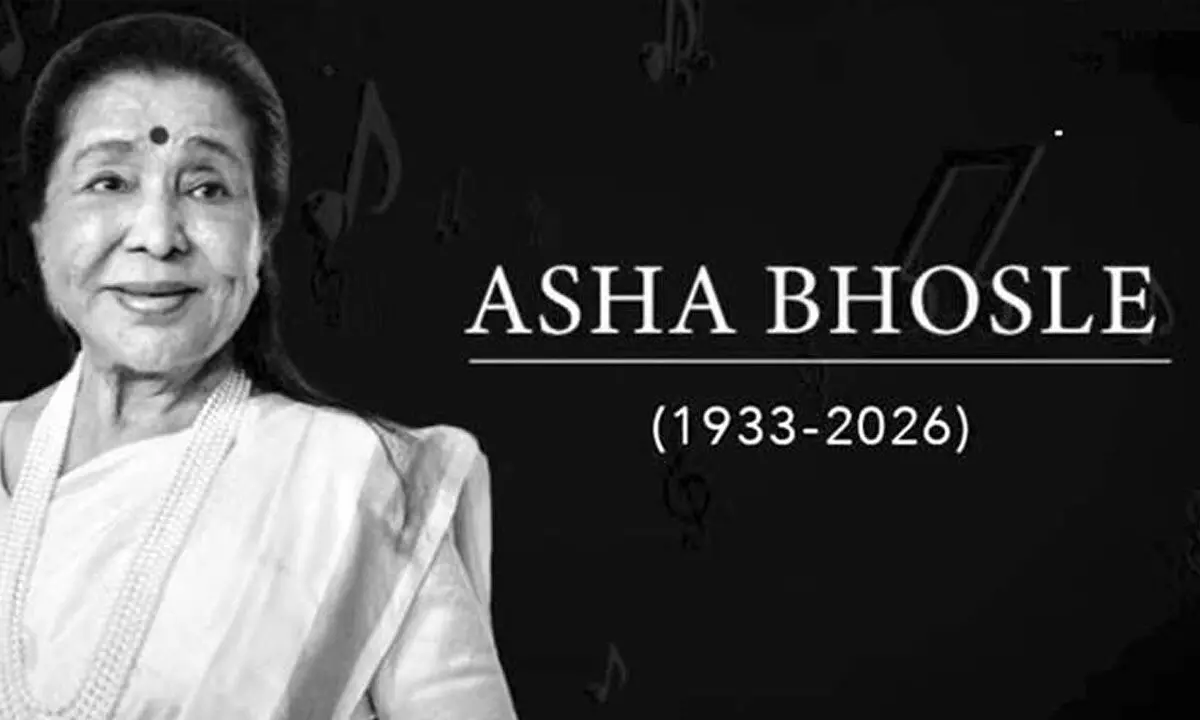
“Abhina jao chhod kar, ke dil abhi bhara nahi...”
(Do not leave just yet, for the heart is not yet satiated...)
Indian melody has lost its most vibrant hue. With the passing of Asha Bhosle ((1933–2026) at the age of 92, an epoch of Indian consciousness has shifted into the realm of the eternal. To call her a “playback singer” is to describe the sun merely as a “light source.”
Asha Tai was the heartbeat of a nation, the rebellious spirit of the Indian woman, and the versatile voice that taught a billion souls how to flirt with life, weep in solitude, and dance in the rain.
The shadow and the sun:
Born in 1933 in Sangli, Asha’s journey was never destined to be easy. For decades, she walked in the towering shadow of her elder sister, Lata Mangeshkar. While Lata was the “Ganges”—pure, ethereal, and divine—Asha became the “Ocean”—vast, turbulent, and encompassing everything from the salt of struggle to the treasures of deep emotion.
In her early years, she was often handed the songs that others refused—the songs of the “vamp,” the cabaret, or the supporting actress. Yet, it was here that her genius caught fire. She didn’t just sing; she inhabited the skin of the characters. When she sang “Aage Bhi Jaane Na Tu” from ‘Waqt’, she wasn’t just providing a soundtrack for a party; she was delivering a philosophical treatise on the transience of time.
“Beet gaya jo usse bhool ja, jo gaya usse bhool ja...”
(Forget what has passed, forget what is gone...)
These words, once a cinematic melody, now serve as a haunting reminder of her own departure. She taught us that the only moment that truly belongs to us is the present.
The alchemist of genre:
Asha Bhosle’s greatest gift was her refusal to be categorized. She was the muse of O P Nayyar’s rhythmic tongas, the soul of R D Burman’s psychedelic revolutions, and the classical devotee of Khayyam’s ghazals. Her collaboration with Pancham changed Indian music forever. In “Dum Maro Dum,” she captured the angst of a counter-culture generation. But then, with a breathtaking pivot, she gave us the searing vulnerability of ‘Umrao Jaan’. In *”In Aankhon Ki Masti Ke,” her voice didn’t just travel through the air; it hung like incense in a royal court, heavy with longing and sophisticated grace.
She proved that a woman’s voice could be sensual without being carnal, and powerful without losing its softness. She was the voice of the village girl swinging on a peepal tree and the sophisticated city woman sipping tea in a high-rise. Her range was not just musical; it was existential.
The resilience of a Phoenix:
Behind the “Chura Liya” sparkle was a woman of immense grit. Asha Tai’s personal life was marked by storms that would have silenced a lesser spirit. From a troubled early marriage to the devastating loss of her children and her partner, Pancham, she faced the vacuum of grief with a spatula in one hand and a microphone in the other.
She found solace in cooking, in laughter, and in the relentless pursuit of “newness.” Even in her 80s, she collaborated with boy bands and international artists, proving that while the body ages, the “Sur” (note) remains immortal. She remained the eternal “youth” of the Mangeshkar family, always ready with a witty retort and a twinkle in her eye.
The final bow:
As we stand today at the crossroads of silence and memory, the void seems insurmountable. Who will now tell us that “Parda hai parda”? Who will remind us that “Raat akeli hai”?
Asha Bhosle didn’t just sing for the movies; she sang for the milestones of our lives. She was there when we fell in love for the first time, she was there when we nursed our first heartbreak, and she was there in the quiet kitchen mornings of our mothers. Her voice is woven into the very DNA of the Indian household.
92 years is a long life, but for those who lived by her cadence, it feels like a song cut short in the middle of a bridge. However, a voice like hers doesn’t die; it simply changes its frequency. It enters the wind, the rustle of leaves, and the quiet hum of the radio in a lonely room.
She leaves behind a legacy that is not just a discography of 12,000 songs, but a blueprint for how to live life with zest, despite the scars. She was the ultimate ‘Asha’—the Hope—that even after the darkest night, the morning will bring a new melody.
The stage is dark. The microphone stands alone. But somewhere in the celestial heavens, a mischievous, silken voice is beginning a new riyaaz, and the angels are finally learning how to swing.
“Mera kuch saamaan tumhare paas pada hai...
Saawan ke kuch bheege bheege din rakhe hain,
Aur mere ek khat mein lipti raat padi hai...
Woh raat bujha do, mera woh saamaan lauta do.”
(Some of my belongings remain with you... some rain-soaked days of autumn, and a night wrapped in one of my letters... extinguish that night and return my belongings to me.)
Rest in Melody, Asha Tai. You have left your “belongings” with us, and we shall never return them.
(The writer is a former OSD to Union Civil Aviation Minister)


