






The Cartoonist Who Saw It All Coming: The Art of Courage Resurrects a Forgotten Cold War Voice

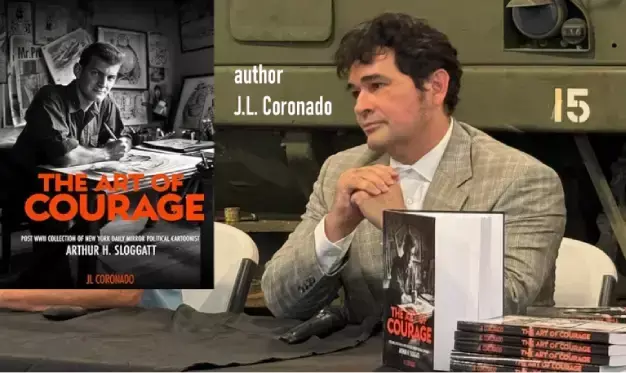
Discover how a forgotten Cold War-era cartoonist used bold satire and fearless artistic expression to challenge power, predict political shifts, and leave a lasting legacy of courage and truth.
There are two ways to disappear from history.
The first is never to matter very much in the first place. The second is to matter at exactly the wrong moment.
The late political cartoonist Arthur H. Sloggatt appears to have suffered the second fate.
Before reading J.L. Coronado’s The Art of Courage: Post WWII Collection of NY Daily Mirror Political Cartoonist- Arthur H. Sloggatt (published through Six14 Productions), I knew nothing about Sloggatt. That ignorance turns out not to be unusual. Sloggatt spent much of the late 1950s and early 1960s drawing syndicated editorial cartoons for the New York Daily Mirror, one of the country's most widely read newspapers. His work appeared in more than thirty newspapers through the Universal Press Syndicate and Hearst Headline Service. One cartoon, "Another Moon Shot?" from January 1959, found its way into the archives of the John F. Kennedy Presidential Library. He had credentials, audience, and reach.
Then the Mirror folded.
The 1960s arrived in full force. The culture moved on. So did history.
What author Coronado has assembled here is partly an art collection, partly an act of historical recovery, and partly a lengthy argument that America would have benefited from paying closer attention to Sloggatt while he was alive. Readers can decide for themselves whether that argument succeeds. By the final chapter, I found it difficult not to think it does.
Coronado is a first-time author, though not a newcomer to political storytelling. A Los Angeles native whose career has moved between government public affairs, political communications, and entertainment industry public relations, he brings an unusual mix of experiences to the project. His background includes formal training at the U.S. Department of Defense Public Information School, a degree in Political Science from UCLA, speechwriting work for political candidates, celebrities, and senior military leaders, and freelance publication in the Los Angeles Times. None of that makes him a historian in the conventional academic sense. It does help explain why the book often reads less like a museum exhibit and more like a communications professional examining how political narratives are created, sold, resisted, and eventually forgotten.
The book is built around Sloggatt's surviving cartoons, but the larger subject is the political atmosphere that produced them. Coronado is less interested in nostalgia than in continuity. Again and again he asks the reader to look at a cartoon drawn sixty years ago and then look at today's headlines.
The uncomfortable part is how often the comparison works.
Coronado spent years digging through archives and assembling a body of work that had largely vanished from public memory. The result is a sprawling, argumentative, frequently fascinating volume that uses Sloggatt's cartoons to revisit the Cold War, the growth of federal power, the national debt, labor politics, civil rights, taxation, and the uneasy relationship between media and political narratives.
The book's central claim is hardly subtle. Coronado believes Sloggatt saw important things before many of his contemporaries did. He believes history has been kinder to those observations than the cartoonist's critics would have expected.
That is a bold claim.
It's also harder to dismiss than one might assume going in.
Sloggatt- The Man Behind the Ink
What separates Sloggatt from many editorial cartoonists of his era is that his work rarely feels manufactured by committee. The cartoons come across as the product of a specific person with specific convictions, which sounds obvious until you remember how much political commentary today feels reverse-engineered from audience expectations.
Sloggatt had been a tank commander during World War II. He raised nine children. He worried about taxes, government spending, communism, bureaucracies, and cultural drift. Those concerns are visible everywhere in the work.
Whether one agrees with him is almost secondary.
You never doubt that he believed what he was drawing.
That quality has become surprisingly rare.
Coronado captures this side of Sloggatt with genuine affection, though rarely with sentimentality. At one point he describes him as "a true revolutionary" who never lost faith in either his country or his fellow citizens. Less charitable writers might have portrayed him as merely stubborn. Coronado sees conviction instead.
The distinction matters.
The cartoons on taxation and public spending gain additional weight once Coronado connects them to the practical realities of supporting a family of eleven in postwar New York. They stop feeling like abstract ideological statements and start feeling like the frustrations of a man who actually had to balance a household budget.
Many political artists claim to speak for ordinary citizens.
Sloggatt often seems to have been one.
A Visual Vocabulary That Refuses to Age Quietly
The cartoons themselves are the book's greatest strength, and Coronado wisely keeps them at the center of the project.
Sloggatt worked within the tradition established by giants such as Thomas Nast, Bill Mauldin, and Herblock, but his style is unmistakably his own. His caricatures exaggerate without descending into cartoonish chaos. Most importantly, he understood how to reduce complicated geopolitical arguments into a single image that remained instantly understandable.
A boot crushing a figure carrying a "Peace" banner tells the viewer everything Sloggatt wanted to say about Soviet intentions.
No essay required.
An image of Eisenhower walking toward "Peace With Justice" while danger lurks in the shadows behind him condenses an entire Cold War worldview into a single frame.
The best editorial cartoonists compress arguments and clearly, Sloggatt was very good at it.
One of the most striking works in the collection depicts Birmingham's segregation laws as a massive institutional structure literally breaking apart under social pressure. The image manages to be politically pointed, emotionally effective, and visually elegant all at once. Another standout, titled "Frankly Boys, I'm Suspicious," shows military officials attempting to squeeze themselves into a reducing salon before a defense budget meeting. The joke still lands.
That is not always true of political humor from the Eisenhower era.
Toward this point, Coronado organizes the cartoons thematically rather than chronologically, grouping them into sections focused on Eisenhower, Khrushchev, Cuba, China, taxation, labor unions, civil rights, and the United Nations. It proves to be one of the book's smartest editorial decisions.
The arrangement creates unexpected conversations across decades.
A cartoon about Soviet freeloading at the United Nations suddenly feels connected to modern arguments about international institutions. A cartoon showing taxpayers trapped inside a Form 1040 unexpectedly anticipates later debates over tax revolts, Proposition 13, and tax cuts.
At times the effect is unsettling.
The faces change but often the arguments have not.
Coronado's Voice: A Feature, Not Always a Bug
The commentary will likely determine whether readers love the book or merely admire it.
Coronado writes in a style that feels increasingly uncommon in contemporary nonfiction. He is unapologetically opinionated, frequently funny, and almost never interested in hiding where he stands politically.
That directness is not surprising given his professional background. Before writing this book, Coronado spent years working in military public affairs and entertainment industry public relations, fields where messaging is rarely accidental and where political narratives are often treated as contested terrain rather than settled fact. Readers familiar with government communications or strategic communications will recognize that sensibility immediately. He approaches Sloggatt's cartoons not simply as historical artifacts but as interventions in ongoing political arguments.
To this end, Coronado’s description of Khrushchev as someone who sold peaceful coexistence "like a used-car salesman" works because it captures both the theatricality of the Soviet leader and the author's skepticism.
The downside is that Coronado’s commentary occasionally threatens to overwhelm the subject.
At times, Coronado's instincts become visible beneath the historical analysis. He appears deeply interested in the mechanics of persuasion itself, perhaps a consequence of spending much of his career around speechwriting, media strategy, and public affairs. Whether discussing Cold War diplomacy, taxation, civil rights, labor politics, or the United Nations, Coronado tends to view the cartoons through the lens of competing narratives and public perception as much as through their historical context.
Some of the book's longer discussions of taxation, Ukraine, labor politics, and party realignment stretch beyond the immediate needs of the cartoons that inspired them. Readers looking for a tightly focused study of Sloggatt may occasionally find themselves on detours through modern political debates.
Indeed, some of those detours were engaging and others unnecessary.
And if we're being honest, Sloggatt himself was not known for moderation.
A Visual Crash Course in an Unfinished Political Story
The book's promotional description calls it "a visual crash course" that provides an origin story for many of the political and cultural conflicts that followed in the 1960s.
That characterization turns out to be fairly accurate.
Though not academic scholarship in the conventional sense. Coronado’s book is not attempting to construct a peer-reviewed historical thesis. He is making an argument. The cartoons are his evidence and his main contention is that the ideological battles of the Eisenhower and early Kennedy years did not disappear. They simply evolved.
Reading the collection straight through, that idea becomes difficult to ignore.
Indeed, the ongoing debates over federal spending, national debt, international institutions, military preparedness, taxation, labor power, and media influence feel remarkably familiar.
More than once I found myself looking at a cartoon drawn before many Americans alive today were born and thinking it could run beside a modern opinion column with almost no explanation.
That realization may be the book's strongest point.
Not that Sloggatt was always right.
Not that history vindicated every prediction.
But that many of the underlying tensions he identified never really went away.
A Worthwhile Rescue Mission
The book is not without flaws.
Coronado occasionally becomes so fascinated by the modern implications of a cartoon that the cartoon itself recedes into the background. Entire discussions of taxation, foreign policy, labor politics, and contemporary conservatism sometimes expand beyond what the immediate artwork requires. Readers seeking a concise biography should look elsewhere.
Then again, the author's background offers context: Coronado comes from worlds where ideas are expected to compete openly for public support. He has worked in politics, government communications, military public affairs, and entertainment publicity, professions built around persuasion. That experience occasionally pushes the book toward advocacy, but it also supplies much of its energy. One never gets the impression that Coronado stumbled across Sloggatt accidentally. The book feels more like the product of someone who recognized a forgotten communicator and immediately understood why his work mattered.
Coronado clearly believes Arthur H. Sloggatt deserved a larger place in American cultural memory than he ultimately received. After spending several hundred pages with the cartoons, I found myself increasingly persuaded.
Not because every prediction proved correct, but because the work still feels alive.
The best editorial cartoons compress complicated ideas into images that remain understandable decades later- Sloggatt possessed that gift.
In total, The Art of Courage succeeds on its most important level. It brings a forgotten voice back into the conversation and makes a credible case that the voice is still worth hearing. Sixty years after many of these cartoons first appeared in print, Arthur Sloggatt remains provocative, perceptive, and occasionally startling.
Historical recovery projects often feel dutiful. This one feels necessary.
India's bowling combination, not batting, the real concern heading into Women's T20 WC, says Nasser Hussain
Omar meets PM Modi in Delhi, presses for early restoration of J&K statehood
Air India denies putting pressure on families of AI-171 Boeing crash victims
India Finland Relations, S Jaishankar, Digitalisation, Sustainability, Strategic Partnership
DK Shivakumar meets PM Modi in Delhi, seeks support for Karnataka's development priorities
Siddaramaiah accuses Zameer Khan of betrayal in Davanagere bypolls


