
Farm loan waiver an albatross around neck of Telangana that yields no political dividends

Hyderabad: WhenTelangana was carved out as a new state in 2014, its leadership promised a fresh start for farmers taking advantage of the “Farm Loan Waiver Scheme”. The flagship scheme was pitched as a bold step toward debt-free farming, meant to rescue cultivators from the clutches of moneylenders and banks. However, a decade later, the scheme has become an albatross around the state’s neck — draining finances, distorting credit culture, and delivering little political dividend.
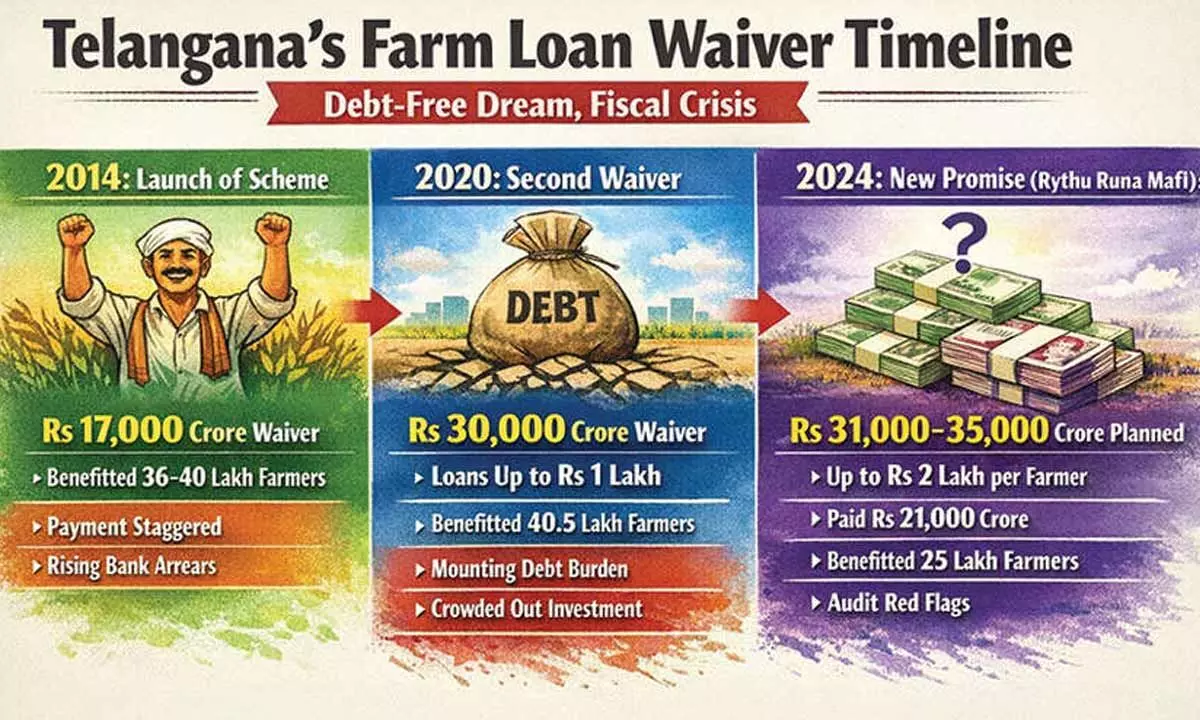
The first waiver, announced in 2014–15 by the then Telangana Rashtra Samithi government, covered short-term crop loans worth Rs 17,000–17,500 crore for nearly 40 lakh farmers. Payments were made to banks in instalments. A side-effect was that the state’s fragile coffers quickly showed strain. Banks received partial payments, arrears mounted, and the government was forced into staggered settlements. What began as a welfare promise soon exposed the limits of fiscal capacity.
The cycle repeated in 2020, when the government announced a waiver of all crop loans up to Rs one lakh, covering 40.5 lakh farmers at an estimated cost of Rs 30,000 crore plus interest. By 2025, reports indicated that Telangana owed nearly Rs 21,000 crore to public-sector and regional rural banks for waivers notified since 2014.
These obligations resulted in fresh borrowing and higher interest burdens, squeezing out funds for irrigation projects, rural roads, and welfare commitments like fee reimbursements and pensions. Economists and banking analysts warn that repeated waivers discourage repayment discipline among farmers. The expectation of future waivers has led to persistently high non-performing assets (NPAs) in agricultural portfolios. Banks, wary of defaults, tighten credit conditions, leaving genuine borrowers struggling to access fresh loans. The result is a vicious cycle: farmers wait for waivers, banks hesitate to lend, and the government borrows more to fund promises.
The Comptroller and Auditor General (CAG), in its 2016 report, flagged systemic flaws in Telangana’s waiver schemes. Some banks claimed excess interest beyond permissible limits, while others failed to claim entitled amounts, depriving farmers of full relief. The report also highlighted delays in reimbursements and poor identification of beneficiaries. These findings reinforced the view that waivers are short-term “firefights” and not a part of a structured credit-reform strategy.
Despite fiscal strain, successive governments have continued to announce fresh waivers. In 2024, the Congress-led government promised relief of up to Rs two lakh per farmer, against a projected cost of Rs 31,000–35,000 crore. Yet, political dividends have been elusive for parties in Andhra Pradesh and Telangana.
Farmers remain uncertain about eligibility and timelines, while the state struggles to meet obligations. What was meant to be a vote-winning welfare measure has instead become a fiscal liability, eroding trust in governance.
Over a decade, the farm loan waiver scheme has delivered short-term relief but left long-term scars on Telangana’s finances. Experts argue that structural reforms — crop insurance, irrigation modernisation, and affordable credit — are the real solutions to farm distress. Without them, the state risks remaining trapped in a cycle where every election results in a new waiver, while the balance sheet presents a bleak picture.
The farm loan waiver scheme stands as a cautionary narrative-a populist promise that won applause but left Telangana debt-ridden, weakened the credit culture, and shrank fiscal space.


