
My government would not just build roads, but build the aspirations of a new Bihar

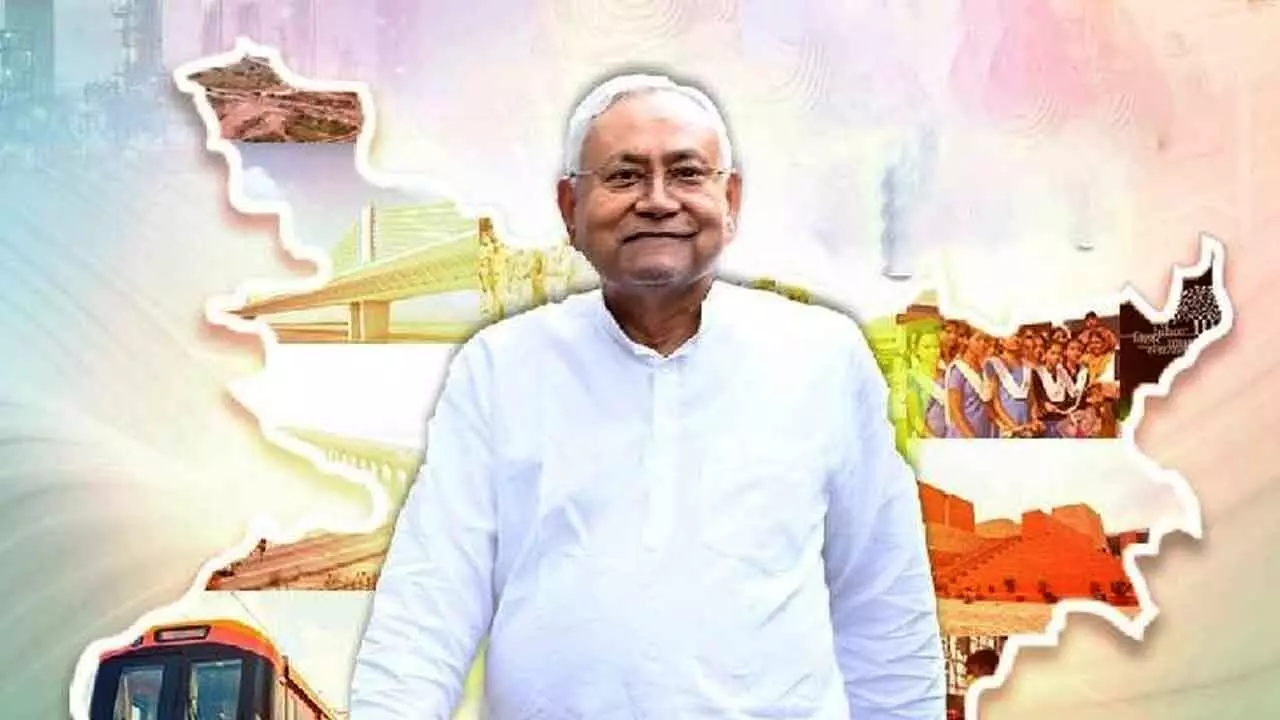
Nitish Kumar’s oratory is characterized by its grounded, data-driven, yet deeply principled nature. Throughout his career, certain speeches have stood as pillars of his political philosophy:
1. The Principle of Accountability (1999)
Perhaps his most famous moment of integrity was his resignation as Railway Minister following the Gaisal train disaster in 1999. Though urged to stay, he insisted on taking moral responsibility. His speech regarding this decision in Parliament remains a benchmark for political ethics, where he argued that leadership is meaningless without accountability to the common citizen.
2. The "Bihar at a Crossroads" Speech
In the Bihar Assembly, during his early years as CM, he delivered a stirring address on "Development with Justice." He argued that growth meant nothing if it didn't reach the "Mahadalits" and the women in remote villages. He famously stated that his government would not just build roads, but build the aspirations of a new Bihar.
3. The Vision for Federalism
In various Inter-State Council meetings and Parliament sessions, Kumar has been a vocal advocate for Special Category Status for Bihar. His speeches on this topic are often masterclasses in economics and federal relations, detailing how regional development is the only way to achieve a "Viksit Bharat" (Developed India).
His tenure is often cited by economists and historians as the period that laid the foundation for the "turnaround" of the Indian Railways.
The Architect of Railway Reforms
Nitish Kumar approached the Railways with the precision of the engineer he is. He famously took over during a time of financial crisis and safety concerns, steering the organization toward a more efficient and safety-first future.
* The Special Railway Safety Fund (SRSF): In 2001, he made a bold move by creating a non-lapsable fund of ₹17,000 crore specifically dedicated to clearing the backlog of overaged assets like old tracks, distressed bridges, and outdated signaling systems. This was a critical "safety shelter" that significantly reduced accidents.
* The Anti-Collision Device (ACD): He was a pioneer in adopting technology for safety, pushing for the indigenous development and pilot testing of the "Raksha Kavach" (Anti-Collision Device), a precursor to the modern Kavach system used today.
* The "Tatkal" and Internet Revolution: Under his watch, the Indian Railway Catering and Tourism Corporation (IRCTC) was nurtured, and internet ticketing was launched in 2002, moving the Indian Railways from long physical queues to the digital age.
* Rationalizing Freight: He realized that high freight rates were driving business away to roads. He initiated the "Turnaround Strategy" by rationalizing freight structures, which helped the Railways regain its competitive edge and eventually record massive surpluses in the years that followed.
Beyond the numbers and the timelines, the true essence of Nitish Kumar’s leadership lies in his unwavering belief that governance is a tool for social dignity. He didn't just build roads; he built a sense of possibility for a state that many had written off. His journey from an engineer in a small town to a record-breaking statesman serves as an inspiring blueprint: that with technical precision, political grit, and a deep-seated commitment to the marginalized, one can indeed move mountains—or in his case, transform the destiny of over 100 million people.
Major Railway Projects in Bihar (2001–2004)
During his transformative years as Union Railway Minister, Nitish Kumar prioritized Bihar’s connectivity, treating it as the backbone of the state's future economic rise.
* Digha–Sonepur Rail-cum-Road Bridge: One of his most ambitious "dream projects," this massive 4.5 km bridge over the Ganges was sanctioned and fast-tracked under his leadership. It finally connected North and South Bihar, drastically reducing travel time and unifying the state's economy.
* Hajipur Zonal Headquarters: In 2002, he successfully established the East Central Railway (ECR) zone with its headquarters in Hajipur. This was a massive administrative win, bringing railway management closer to the people of Bihar and creating thousands of local jobs.
* Patna–Gaya Line Doubling: Recognizing the heavy traffic on this crucial corridor, he initiated the doubling and electrification of the Patna–Gaya line, turning it into a modern, high-speed lifeline for students and commuters.
* Mega Bridge over the Kosi: He laid the foundation for the Kosi Rail Mahasetu, a project designed to reconnect the Mithila and Kosi regions after nearly 80 years of isolation caused by the 1934 earthquake.
* Modernization of Stations: Major stations like Patna Junction, Gaya, and Bhagalpur saw significant upgrades in passenger amenities, signaling systems, and computerized ticketing during his tenure.
An Enduring Legacy
As Nitish Kumar moves to the Rajya Sabha, he leaves behind a state that is unrecognizable from the one he took over in 2005. His legacy is etched in the smooth highways that crisscross the plains, the bicycles ridden by confident schoolgirls, and the glowing bulbs in every rural household. He proved that "Sushasan" (Good Governance) is not just a slogan but a measurable reality. Bihar today stands as a testament to his two decades of tireless service—a journey that redefined the very meaning of progress in India.


