





Google Launches Gemini 4 Argon, Its Most Powerful AI Model to Date
In Short
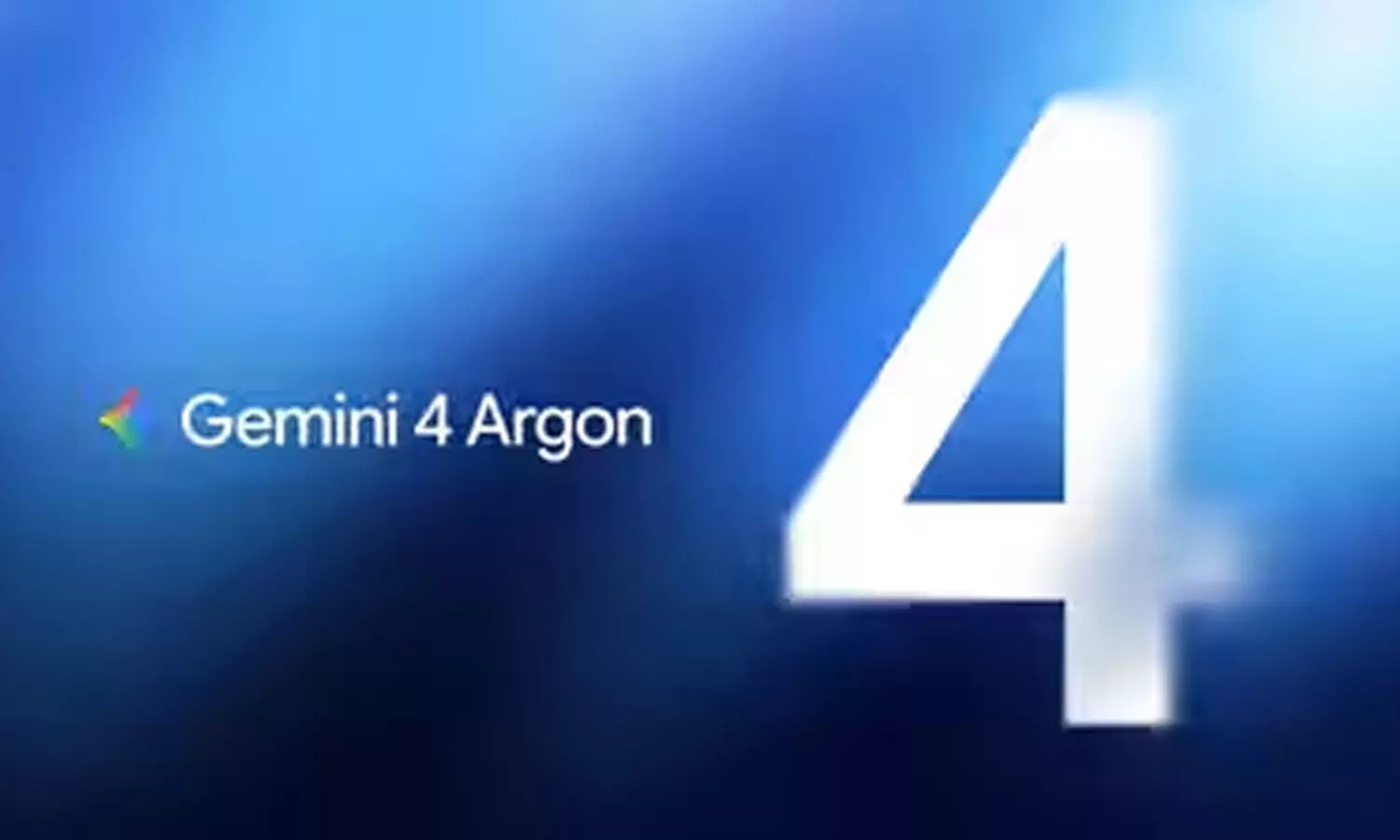
Google has finally launched its next-generation, state-of-the-art AI model: Gemini 4 Argon. The company describes it as its most powerful AI model yet, and for now, it is available via a limited release.

Share :
Google Launches Gemini 4 Argon, Its Most Powerful AI Model to Date
Google has finally released its next-generation, state-of-the-art AI model, dubbed Gemini 4 Argon. According to the company, Argon delivers significant improvements across various tasks-such as programming, professional work, and cybersecurity-compared to its previous AI models.
The launch of Gemini 4 Argon comes amidst rumours that Google was falling behind rivals like OpenAI and Anthropic in the AI race, following the alleged delay of Gemini 3.5 Pro. Google CEO Sundar Pichai addressed this speculation on X: "There’s a lot of chatter about our next model (!), so I wanted to share a preview as soon as possible," he wrote. "Introducing Gemini 4 Argon! It delivers state-of-the-art performance in complex workflows, cyber defense, and software engineering."
Sundar Pichai added that Google teams were already using Gemini 4 Argon for various tasks, including programming and quantum computing. This also marks the first time Google has used the term "Argon" for an AI model.
How good is Gemini 4 Argon?
Google describes Gemini 4 Argon as a state-of-the-art AI model designed for deep reasoning within complex workflows. Argon’s output token limit stands at one million tokens; according to Google, this enables it to reason more deeply and generate hundreds of thousands of tokens in a single sequence for more extensive and complex use cases.
The company claims that Argon can match or outperform some of the most advanced AI models-such as GPT-6 Astra or Claude Fable 5.1-in specific tasks. In the benchmark scores published by the company, Gemini 4 Argon outperforms others in multiple tests. On the Vals benchmark for knowledge-based tasks, Google's model scores 68.9 per cent, compared to 63.1 per cent for GPT-6 Astra and 65.8 per cent for Fable 5.1.
Gemini 4 Argon also surpasses its competitors in programming tasks. On the Vibe Code Bench, Argon achieved a score of 91.9 per cent, while Claude Fable 5.1 stood at 90.3 per cent and GPT-6 Astra scored 89.6 per cent; however, in certain instances-such as Terminal-bench 4.0-Argon lagged slightly behind other models.
Gemini 4 Argon’s cybersecurity capabilities
As a next-generation frontier model, Gemini 4 Argon boasts advanced cybersecurity capabilities. Google states that Argon was trained to be "highly capable in cybersecurity defense" and can autonomously find, validate, and fix critical software vulnerabilities.
Wiz, a cybersecurity company owned by Google, is already using Argon through its "Scan for Good" initiative. In an initial demonstration at Wiz, Argon detected a critical vulnerability—which exposed sensitive personal information in healthcare software used by hospitals worldwide-that previous frontier models had overlooked.
Limited launch of Gemini 4 Argon for now
Argon’s launch comes amidst growing debate regarding AI safety. Google indicates that, for the time being, it is releasing the model to a select group of trusted cybersecurity defenders via its Fairwind program and to the US government-an initiative similar to OpenAI’s "Daybreak" or Anthropic’s "Project Glasswing."
"Importantly, Argon features state-of-the-art safeguards, and we are deploying it responsibly: as of today, it is in the hands of the US government and reaching a group of trusted cybersecurity defenders through our Fairwind program," Sundar Pichai wrote on X. "We will make it available to the public as soon and as safely as possible. So, stay tuned: there is much more to come, and you will see us iterate rapidly." Google is one of the major tech companies that signed the AI agreements under US President Donald Trump.
Broader access to Argon will begin with paying API customers and Google AI Ultra subscribers, following feedback from evaluators and trusted cybersecurity defenders. Google announces that Argon will launch with an introductory price of $2 per million input tokens and $10 per million output tokens, with a 95 per cent discount for cached input tokens. Following the launch period, the price will be $4 per million input tokens and $20 per million output tokens.


