
‘Cocktail’ of nighttime particles behind North India fog: IITM

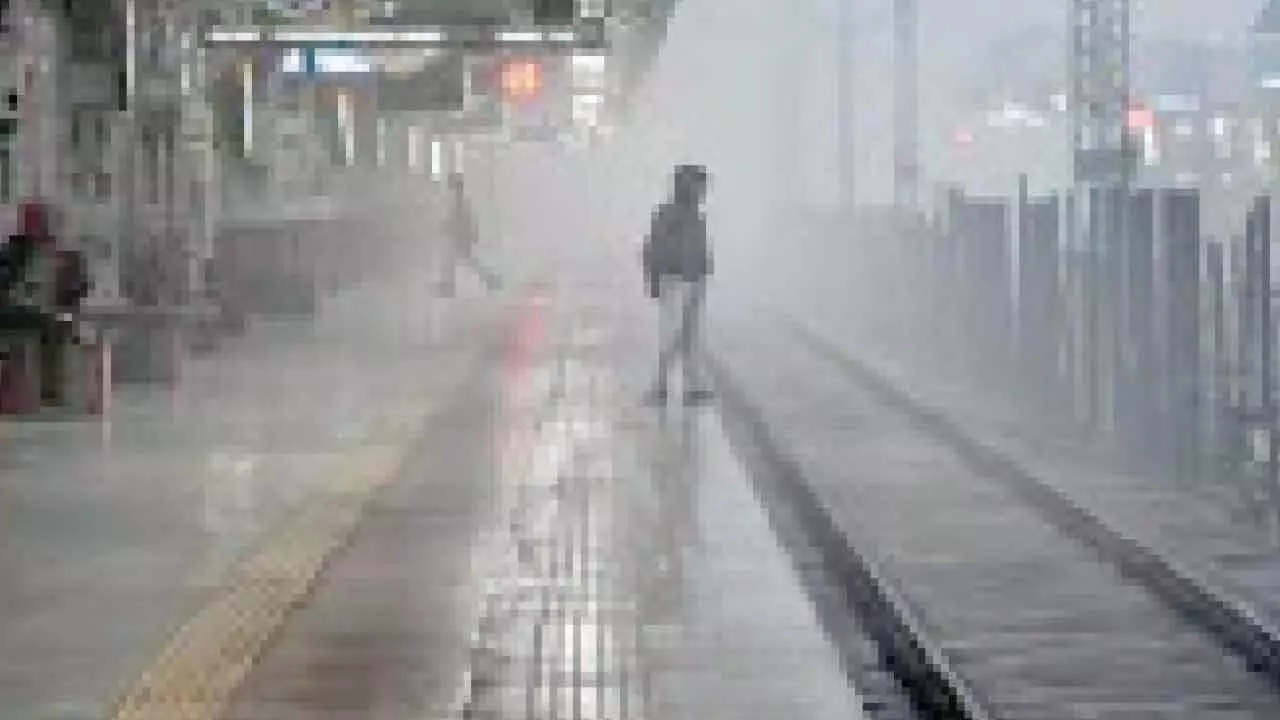
Hyderabad: Are you currently stuck at airports in New Delhi, Chandigarh, Bhopal, or other North Indian states, slogging in lounges because dense fog has caused flight delays and traffic disruptions? Are you perhaps someone in AC First Class on a superfast train, only to find yourself stranded in the middle of nowhere as the locomotive pilot halted the journey due to poor visibility in the thick sheet of fog?
Are you cursing the fog for all these troubled moments? Then, you may need to think twice before blaming nature alone. The reason is that it is not only people who party at night; particles too are having their own cocktail parties on winter nights in North India, according to researchers at the Indian Institute of Technology Madras.
According to a study led by Arun and Chandan Sarangi of the Civil Engineering Department at IIT Madras, in collaboration with international experts, a cocktail of nighttime particles favours the intensification and duration of fog events over North India. The calm winter nights over the region favour the accumulation of pollutants near the ground. As the air temperature drops, water vapour quickly condenses on these particles, resulting in the formation of water droplets that are typically a few micrometres in size.
This massive number of droplets, typically between one and fifty million per cubic metre, obstructs light and drastically reduces visibility. As these droplets form, they release latent heat, which is a form of hidden energy. This heat, in turn, causes the fog to grow vertically, reaching heights of nearly 600 to 800 metres. This is significantly higher than previously expected by the scientific community.
The next morning, this thick layer acts as a massive shield, blocking the sun. Because solar energy does not reach the surface, natural heating of the ground is reduced, slowing down the evaporation of fog from the surface. This leads to dull sky conditions that ground flights and delay trains for hours.
Arun, a doctoral scholar at the Department of Civil Engineering, explained that if the fog layer persists, then the solar heating of the surface is further dampened, leading to more favourable conditions for condensation to occur the next night. Previously, scientists believed that the root cause behind increasing fog frequency was wind circulation changes over North India associated with global warming. However, researchers are now understanding that regional pollution can also play an equally important role in prolonging fog events.
Chandan Sarangi, Associate Professor at IIT Madras, noted that these findings provide a better understanding of how pollution impacts fog intensity. This understanding is critical for improving fog forecasting, which can help pilots and airports provide better and informed decisions for passengers. Against this backdrop, the research offers a glimmer of hope, as fog is closely tied to particulate pollution levels. Improving air quality can directly reduce the frequency and severity of fog events during winter days.
The research involved lead authors Arun and Chandan Sarangi from IIT Madras, with co-authors Vijay P Kanawade from the Cyprus Institute, Ritesh Gautam from the Environmental Defence Fund, Manoj K Singh from Bennett University, and Yun Qian from the Pacific Northwest National Laboratory. By addressing the root cause of these particle cocktail parties, the region can potentially clear the skies and restore normalcy to winter travel schedules across the vast North Indian plains.


