
Skills for the market; values for society: Prof Haragopal decodes TGEC report

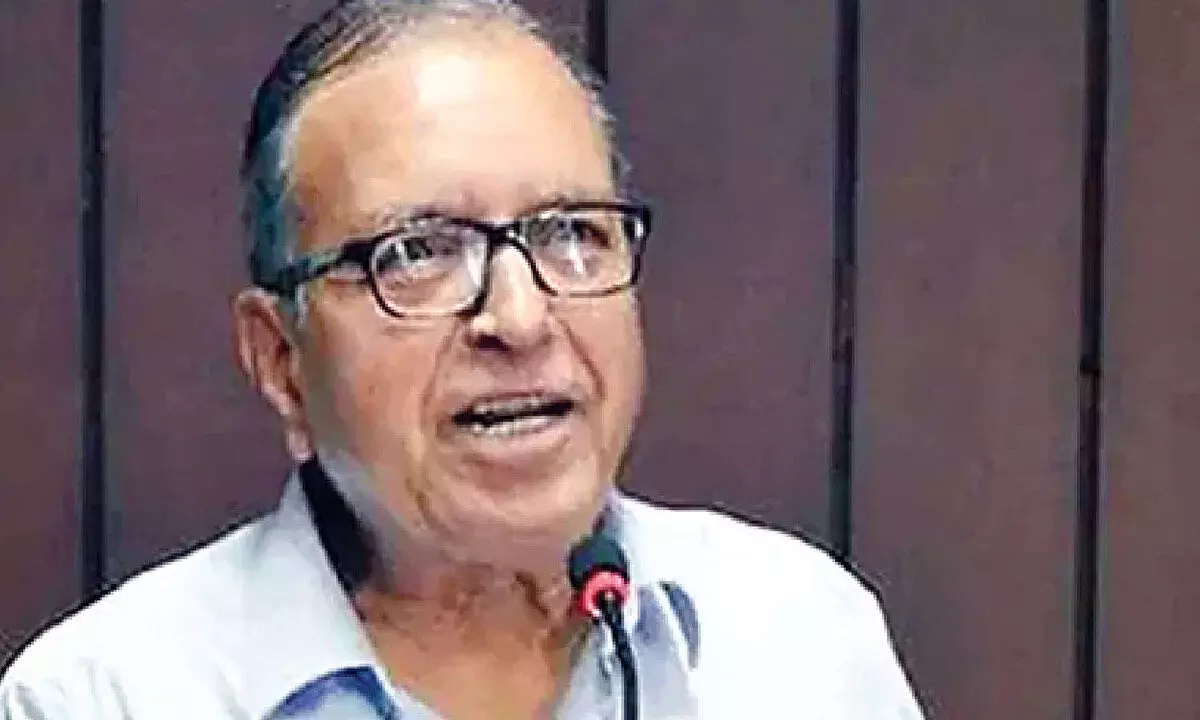
Inthe wake of the Telangana Education Commission’s report submitted to the State government, offering a slew of recommendations for reforms in the education sector from early childhood to university education, and stirring several debates, prominent social scientist Prof Haragopal, in a freewheeling interview with The Hans India, shared his reflections.
Q. The TGEC report covers everything from primary to university education. A lot of stress is given to emerging courses, skilling, and market-demand programs. What would be the fate of a student who pursues a market-demand course that becomes obsolete in five to ten years?
A. What has happened is that the commission was driven largely by populist demands such as English-medium education, technical skills, and market-oriented courses. While the final outcomes of the National Education Policy (NEP-2020) are not entirely agreeable, the KasturiRangan Report emphasised that broad-based knowledge should be the anchoring factor. Even if someone chooses specialisation at a later stage, the primary idea must focus on empowering human beings in multidimensional ways. One or two chapters of NEP-2020 are indeed fascinating in this regard. On the other hand, the report appears more like a techno-managerial document rather than one that investigates the broad spectrum of knowledge systems and the deeper philosophical dimensions of education.
Q. What is missing in the TGEC report?
A. It has not addressed broad-based issues such as human values, which invariably is its fundamental problem. The approach is market-driven and not society-driven. While the market is indeed part of society and skills are necessary, education should encompass a much wider spectrum. Let me give you an example: BalaGopal was a doctoral holder in mathematics. However, he ventured into literary criticism in Telugu literature, later wrote extensively on critical analysis with a social sciences perspective, and published 17 books. In addition, he became a first-rate lawyer. This demonstrates that when one has a complete understanding, training, and mastery of the fundamentals of their respective discipline, they can seamlessly move into other branches of knowledge. Education should empower the human mind with such training.
In contrast, the TGEC was driven by current demands, urgency, and contemporary market needs. Rather than focusing on epistemology, larger knowledge systems, and the roots of knowledge—which are the cornerstones of education—they unfortunately ignored these deeper dimensions.
Q. Broadly speaking, the previous United Andhra Pradesh tilted its education policy towards information technology, even at the cost of neglecting fundamental sciences. In the case of IT, it failed to encourage engineering students to study Artificial Intelligence (AI) by introducing it at the right time. As a result, after 20 long years, students are now struggling to cope with AI courses. AI has existed since the 1950s. However, even a fundamental understanding of it was not introduced along with IT. It led to the loss of 20 precious years. How do you view this?
A. At that time, the then United AP’s Chief Minister N Chandrababu Naidu initially declared that social sciences were irrelevant. In response, we launched a major movement. Within 15 days, “we travelled to different places, wrote numerous articles, held seminars, and engaged with universities”. Under this pressure, Naidu eventually withdrew his statement. It was even suggested that social sciences should be introduced in medical and engineering colleges.
This tells the danger of dismissing disciplines like history and social sciences. Those who disregard history are themselves deprived of it. Ironically, Naidu himself was a student of social sciences, not technology, and he continued to encourage social sciences.
Q. How does one view the TGEC report?
A. It is not that the report is totally bad, but it aims at only correcting the shortcomings in the existing system and meeting the demands on hand. What are the shortcomings in the existing education system? They have not challenged the system or on how to broaden it. What kind of direction should it have? The report says, “Inclusive excellence.” But what is needed is social change and justice. We hear of children killing their parents. murders and suicides. We should ponder over “where have we failed? We need markets and technology to create wealth. However, primarily we need a ‘human being’ for sustaining all those things.” Further, I had a discussion with a top person in the corridors of power after the current state government assumed office who stressed on skills. However, “I told them that without an enlightened citizen, without being socially aware, though we might have great technology, the society would be prone to the growth of dictatorial tendencies. We should have “Skills for the market and values for the society”
Q. Should we look at several shortcomings, while plugging the TGEC report on education reforms?
A. Kothari Commission’s report is still relevant because it talks about the purpose of education and nation-building. The TGEC report focused on the shortcomings in the current system. Like infrastructure, school buildings, skills and so on. It is more like a techno-managerial manual rather than one that talks about how to bring positive changes through education. They did not touch the fundamental issues that the current education system is facing. They restricted themselves to how to repair the existing system. A similar issue was faced earlier when SyamPitroda headed the Knowledge Commission. And, I had to personally attack him through my writings, questioning shortcomings in his recommendations.
Q. Where then does the crux of the matter lie and what is the way forward?
A. The current TGEC report holds good “to the extent of their framework. However, the real issue and broader aspect of education is with the very framework on which they relied.
Q. The TGEC report prescribes English as the primary medium of learning and instruction. Their approach to Sanskrit is also dismissive. Considering that less than one per cent of the Telugu population in both states goes abroad for studies or employment, how justified is it to tilt the entire education system toward English-medium instruction?
A. We need to promote every language. The issue with Sanskrit arises only when its introduction is tilted toward traditionalising it. Otherwise, Sanskrit contains immense knowledge. Nobel Laureate AmartyaSen, who is well-versed in Sanskrit, has written extensively about the scientific knowledge embedded in the language. We should emulate that aspect of Sanskrit rather than falling back on the Brahmanical tradition that restricted its spread.


