






A group of M.Sc students invent ‘IVD’ to offer relief to migraine patients

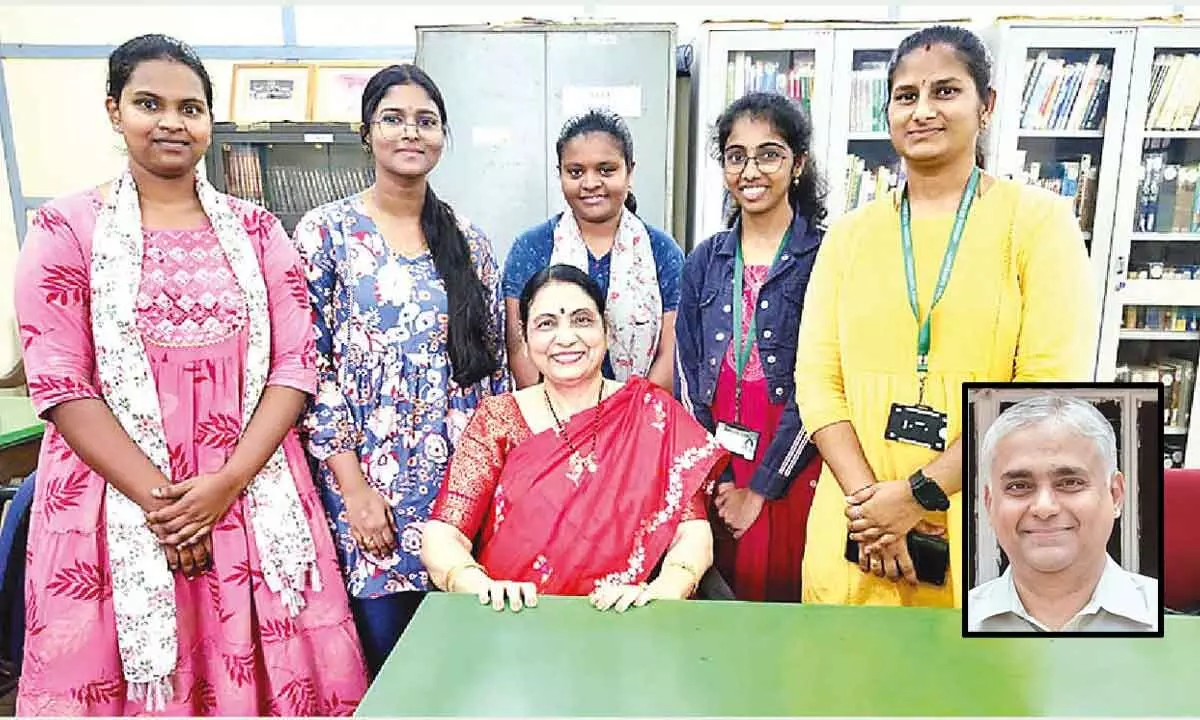
- A team of M.Sc Zoology students crafted a device to detect migraine attacks
- Say that the invention would be effective in spotting the symptoms early
- The researchers mention that many assume migraine to be a normal headache
Visakhapatnam: Not many could differentiate between a common headache and a migraine attack because the initial symptoms appear almost similar. It is the same challenge that nudged Sowjanya Tanguturi, Divyasai Patri, Madhuri Chavala, Kalyani Janjam and Sravani Pondreti, who recently completed M.Sc. Zoology in Andhra University, to work on designing an invitro diagnostic (IVD) kit for effective migraine diagnosis.
As it largely depends on detailed symptom tracking, the M.Sc. Zoology students noticed that even their classmates could not spot a migraine attack as they rely on over-the-counter pain relievers to soothe the pounding discomfort as they often assume the condition as a regular headache. “This is one of the prime reasons why we decided to research more into the condition, the triggers, symptoms and the need to detect them early for effective medical intervention,” reasons Srikakulam-based Pondreti Sravani.
Guided by Emeritus Professor of Zoology B. Bharatha Lakshmi and founder and principal scientist ofTCABSE Laboratories, a startup company incubated in the department of Zoology, Andhra University, Ravikiran Yedidi and Biophysics programme manager at TCABSE Lab S. Manikanta, the team took more than six months to design IVD to diagnose migraine.
Sharing details with The Hans India, Ravikiran informed, “Currently, we applied for the patent. We are also working to obtain more clinical collaborations in hospitals to further validate the IVD.” Elaborating about the research, Prof B Bharatha Lakshmi mentioned that a lot of teamwork has gone into the device-making. “Our research to craft a kit that would recognise the neurological disorder yielded encouraging results.
Once the diagnostic kit gets into the market, millions of people would benefit from it,” she exuded confidence.
Most of the PG students involved in the research are from rural backgrounds. “It took a while for us to collect blood samples of the patients, study the activity of biomarkers as it is comparatively less in non-migraine persons,” the researchers mentioned.
As prolonged intake of painkillers would further worsen the neurological condition, the researchers stated that the device comes in handy in diagnosing the condition accurately based on studying blood and urine samples collected from the patients. The team’s exercise of migraine detection stared last year. While a few of them worked on designing the invitro diagnostic kit, the rest focused on testing the device.
With a list of biomarkers, the data derived from their experiments turned out to be effective as the team was able to spot inflammatory biomarkers in blood and metabolites of neurotransmitters in urine samples.
Emphasising the advantages of the device, they exuded confidence that their kit would significantly aid in early neurological condition analysis and accurate patient treatment.
Sunetra Pawar warns leaders against ‘unnecessary interference’, hints at tough decisions
NCW summons comedians More, Jangra over Rs 370 biryani row
CM Fadnavis outlines ‘Viksit Maharashtra 2047', sets target for $5 trillion economy
Pakistan trying to reshape authority through 28th Constitutional Amendment: Report
Mir, Shah knocks help Afghanistan A get four-run win over India A via DLS method
Pro-Khalistan groups continue to provoke youth, advance own political agendas: Report


