






Modi emerges India’s longest-serving continuously elected Prime Minister

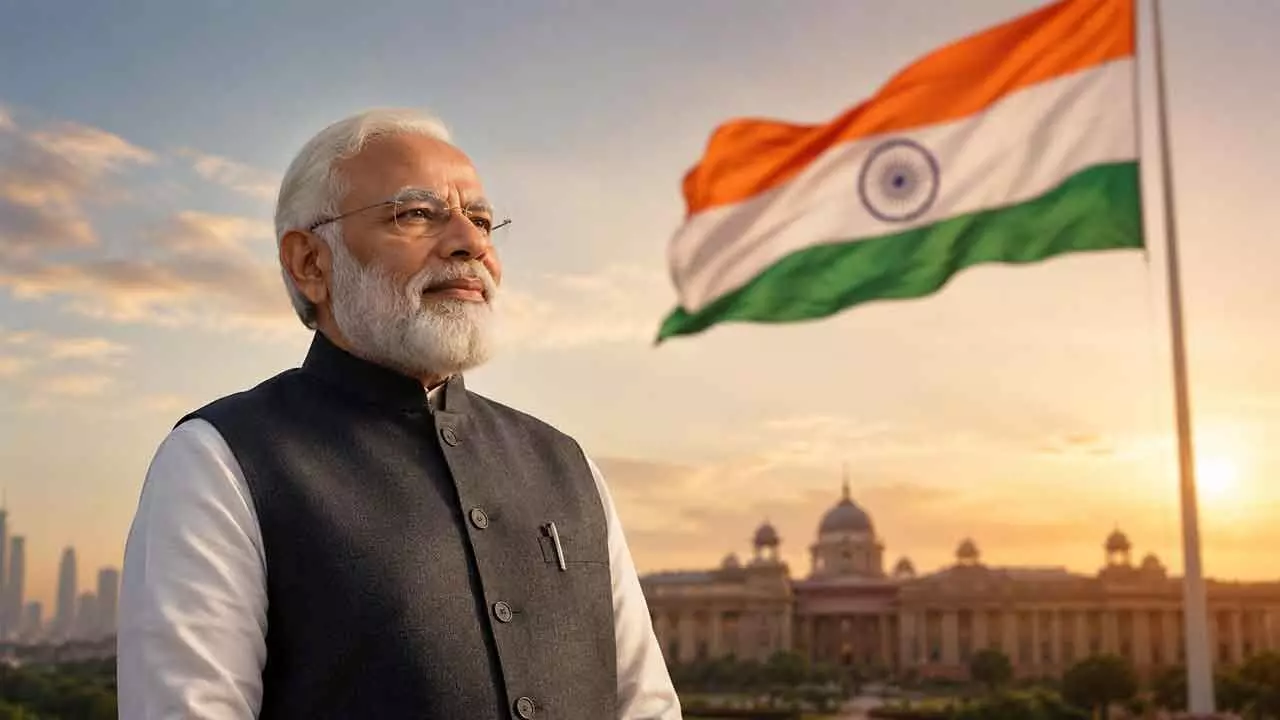
As Narendra Modi becomes India’s longest-serving continuously elected Prime Minister, we analyze 12 years of his administration. Explore the balance between significant economic gains and infrastructure growth against growing concerns regarding civil liberties and political polarization.
Narendra Modi surpassed Jawaharlal Nehru as India’s longest-serving continuously elected Prime Minister on June 10 of this year. Nehru, the first Prime Minister, was at the helm of affairs for 17 years overall, but his government got elected for the first time in 1952, when general elections were held. More important than the duration is the fact that the Modi regime is fundamentally different not just from the Nehruvian one but also those which followed it. Let’s begin the scrutiny of the last 12 years with the good.
It’s in the economy that the Modi government’s performance is best—that is, when compared with its own in other domains like social and civil liberties. In this period, the size of the economy has doubled, from around $ two trillion to $4.1-4.2 trillion. Infrastructure spending has soared, something which is visible all around. What is impressive is that this has not been done at the expense of fiscal discipline, which has improved, with the fiscal deficit coming down from 4.5 per cent in 2013-14 to 4.4 per cent in 2025-26 and, more importantly, revenue deficit from 3.2 per cent to 1.5 per cent during the period under review.
Non-performing assets (NPAs) of banks also decreased dramatically, thus ending the twin-balance-sheet problem—sick, debt-ridden companies taking their lenders down with them. Forex reserves zoomed from $313 billion to $688 billion in the last 12 years. In terms of welfare, too, there has been marked improvement, which has also brought electoral dividends for the Modi government. Under the Ujjwala scheme, there have been about 10 crore new LPG connections. Also, tap water has reached 15.7 crore more households. Ayushman Bharat cards number 44 crore. Around 2.82 crore rural houses have been built. All these are solid achievements.
However, the bad ones have accompanied the good. The political arena, where corruption and cynicism were already rife, has become far dirtier than it was in 2014. Quite apart from encouraging vile practices like horse-trading, the Central government has deployed its agencies like the Enforcement Directorate (ED) and the Central Bureau of Investigation (CBI) to serve political interests. Equally, if not more, depressing are the ugly aspects: attacks on individual liberty and civil liberties; promotion of obscurantism and excessive religiosity.
The space for dissent has shrunk. Governments are entitled to seek electoral mandates for their policies, but democracies flourish only when criticism is treated as a legitimate right, not as treason.
In the last 12 years, journalists, academics, activists, and civil society organisations have often complained of an increasingly intimidating environment. Public debate has become sharply polarised, with disagreement frequently portrayed not as a difference of opinion but as a lack of patriotism. Social media has amplified these tendencies, rewarding outrage and tribal loyalties over reasoned discussion. This has had religio-cultural consequences. Promotion of obscurantism and excessive religiosity has entered public life.
Faith has always occupied an important place in Indian society, but the distinction between personal belief and statecraft has become blurred. Scientific temper, which the Constitution enjoins citizens to develop, has been overshadowed by uncritical celebration of mythological or pseudoscientific claims. Public institutions and official platforms have lent legitimacy to ideas that were once confined to the fringes. In the overall analysis, while India has become richer and more connected under Modi, it has also suffered setbacks in several areas.
Bihar: EOU raids Hajipur Municipal Council Accountant’s premises, Rs 2 crore cash recovered
PM Modi delivering corruption-free governance: K’taka BJP
Delhi L-G orders repair of rainwater harvesting systems ahead of monsoon
World Bank lifts India growth outlook despite Gulf war
WHO releases updated heat-health action plans guidance
SC to hear Meenakshi Natarajan's plea against Rajya Sabha nomination rejection tomorrow


