






- 'Is democracy in India being undermined like China, Russia and North Korea': Gehlot on FIR against Rahul, Priyanka Gandhi
- Delhi Seemapuri Building Collapse: Several Feared Trapped As Rescue Operation Underway
- Claude Users Can Work Across Google Docs, Sheets and Slides In-App
- Rapido Ride Turns Into Nightmare After Captain Flees With Injured Passenger
- 7 Must-Watch OTT Releases For Your Dussehra Holidays
- ‘His Lips Turned Blue’: Dentist Recalls 45-Minute Effort To Save Flydubai Pilot Smit Machchhar
- Airtel Postpaid Plans Bring Free International Roaming From Rs 499
- 'Politics means nation building to him': Rajnath Singh on PM Modi's 25 years in public service
An Indian traveller holding up a national mirror
In Short
One of the book’s most effective devices is its treatment of behaviour as an academic discipline.

Share :
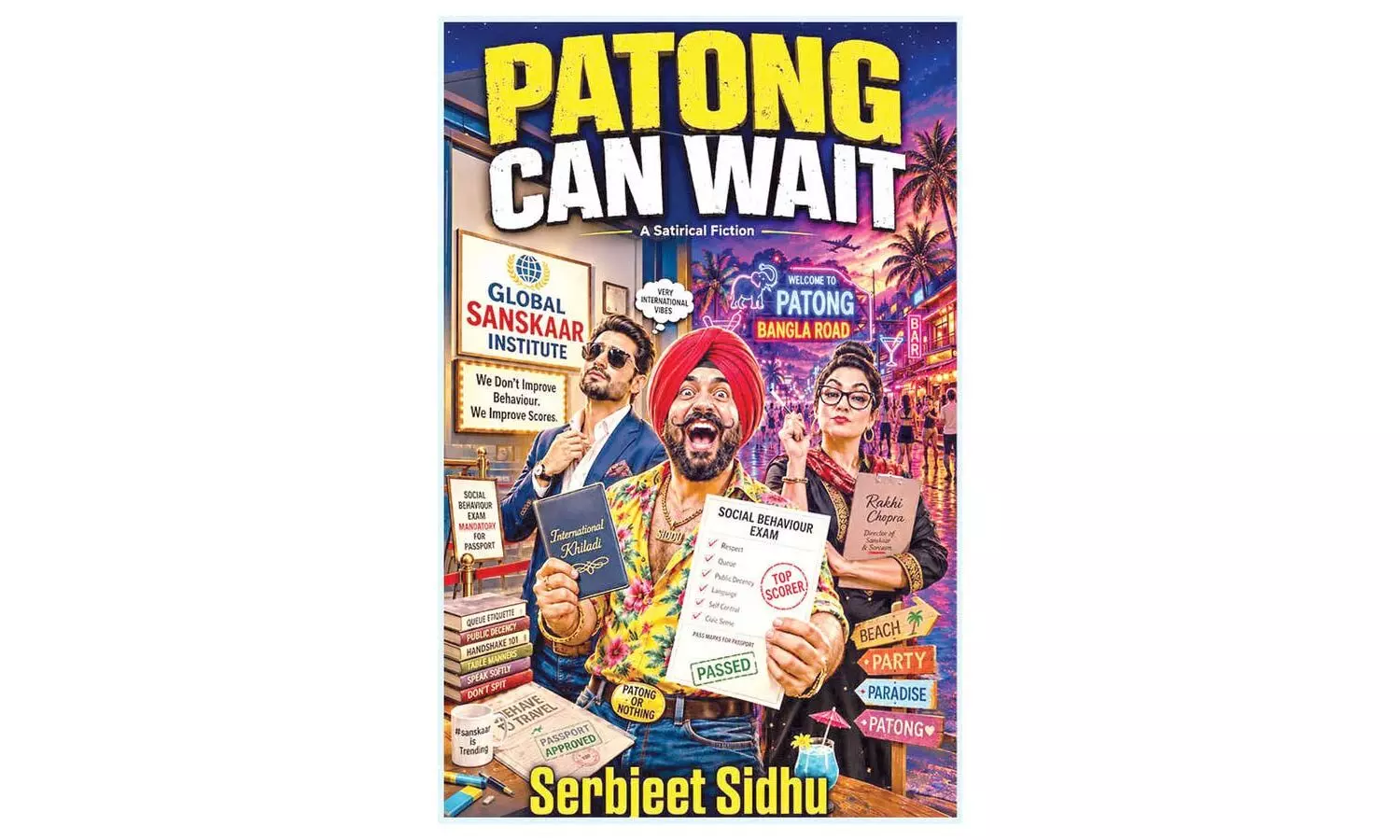
An Indian traveller holding up a national mirror
‘Patong Can Wait’ is an engaging work of social satire by eminent author Serbjeet Sidhu. The book turns an apparently absurd premise into a sharp commentary on contemporary Indian social behaviour. The book imagines a world where an Indian traveller must clear an “International Social Behaviour Qualification Examination” before being permitted to obtain a passport. At the centre of this unusual narrative are childhood friends Siddu and Dudee, whose dream of reaching Patong is temporarily interrupted by the requirement to prove that they are socially equipped to travel abroad. Their journey takes them to the Global Sanskaar Institute, whose wonderfully ironic motto, “We Don’t Improve Behaviour. We Improve Scores”, immediately establishes the book’s comic tone. Through this fictional institution, the author cleverly brings together two familiar Indian obsessions, examinations and international travel, and uses their collision to create humour with a serious social purpose.
One of the book’s most effective devices is its treatment of behaviour as an academic discipline. Crash courses, mock examinations, scoring bands, preparation strategies and performance-oriented learning are presented as though basic courtesy were another competitive examination to be conquered. The irony is both entertaining and revealing. Candidates learn the correct answers without necessarily understanding the values behind them. The book therefore extends its satire beyond tourism and touches upon an education culture where obtaining a certificate can sometimes overshadow acquiring genuine understanding. Situations involving queue discipline, appropriate public volume, buffet etiquette, hotel behaviour, respect for service staff and responsible conduct after drinking are transformed into examination subjects. The fictional mock airport is particularly effective because it exaggerates something that remains recognisable. Why should basic consideration for others require formal training? By asking this question through humour rather than moral instruction, the author keeps the narrative accessible while allowing the reader to recognise uncomfortable truths.
The book also acquires contemporary relevance from the growing visibility of Indian travellers across international destinations. Social media regularly circulates videos and commentary involving tourists behaving inconsiderately abroad. Some incidents raise legitimate questions about public conduct and cultural sensitivity, while the digital ecosystem can also amplify exceptional incidents until they appear representative of an entire population. The book negotiates this distinction reasonably well. Its satire acknowledges behaviours that deserve criticism without reducing Indian travellers to a stereotype. Its underlying concern is not that Indians should travel less, but that increasing international mobility should be accompanied by increasing social awareness. This makes the humour more constructive than condemnatory. The book invites Indian readers to laugh at familiar habits, but also to examine them. The strongest comic moments emerge when exaggerated situations remain only a step away from reality, whether it is treating a public space as personal property, approaching a buffet competitively, bargaining where it is inappropriate, or assuming that payment entitles one to discourtesy.
As a work of social satire, the book is light, brisk and deliberately exaggerated, and its character’s function more as comic representations than as deeply developed psychological figures. Readers seeking subtle humour may find some situations broad, but that broadness is also part of the book’s method. By magnifying everyday behaviour, the author makes it difficult to overlook. Ultimately, the book is less about Patong than about the traveller who wishes to reach it. It suggests that international travel should involve more than passports, tickets, photographs and shopping. Awareness of local customs, public spaces, service workers and fellow travellers is equally important. The title therefore acquires a larger meaning. Patong can wait if the traveller first learns how to arrive with greater awareness and responsibility. Beneath its comic premise, the book offers a timely reminder that the most valuable journey is sometimes the one that teaches us something about ourselves. International travel may take us across borders, but good behaviour determines how we are received when we arrive.
India condemns attacks on commercial vessels in Black Sea, reiterates call for dialogue and diplomacy
'Is democracy in India being undermined like China, Russia and North Korea': Gehlot on FIR against Rahul, Priyanka Gandhi
SSB pays tribute to bravehearts killed in Maoist attack 15 years ago
SSB pays tribute to bravehearts killed in Maoist attack 15 years ago
Pixel Moments to Politics For Cong As BJP Celebrates Modi@25
Dramatic face-off near Jantar Mantar. Rahul and Priyanka sit on the road
MPs vs Police. Chaos and High Drama Unfold on Delhi Roads
Henri Kagan, Kenso Soai Win 2026 Nobel Chemistry Prize for Autocatalysis
AP cabinet approves 12 agenda items
High Courts should not suggest custodial interrogation of accused, says Supreme Court


