






- 'Is democracy in India being undermined like China, Russia and North Korea': Gehlot on FIR against Rahul, Priyanka Gandhi
- Delhi Seemapuri Building Collapse: Several Feared Trapped As Rescue Operation Underway
- Claude Users Can Work Across Google Docs, Sheets and Slides In-App
- Rapido Ride Turns Into Nightmare After Captain Flees With Injured Passenger
- 7 Must-Watch OTT Releases For Your Dussehra Holidays
- ‘His Lips Turned Blue’: Dentist Recalls 45-Minute Effort To Save Flydubai Pilot Smit Machchhar
- Airtel Postpaid Plans Bring Free International Roaming From Rs 499
- 'Politics means nation building to him': Rajnath Singh on PM Modi's 25 years in public service
Demographic change and the creative economy
In Short
Preserving the Knowledge Base of Viksit Bharat

Share :
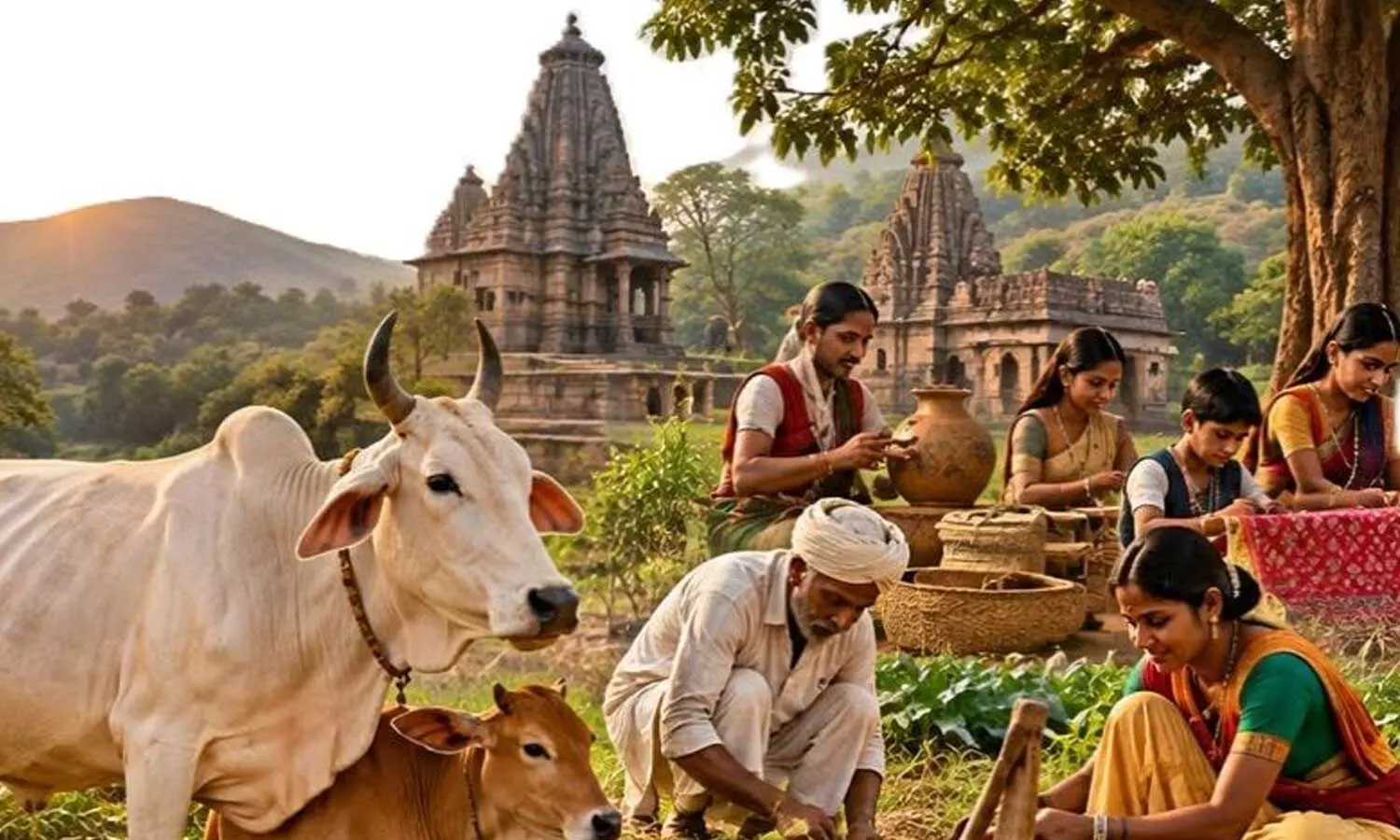
Demographic change and the creative economy
The creative economy is increasingly recognised as an important component of economic growth. It includes design, crafts, fashion, architecture, publishing, music, films, digital content, tourism, gaming, cultural experiences and other activities in which creativity, knowledge and intellectual property generate economic value. UN Trade and Development estimates that global exports of creative services reached US$1.7 trillion in 2024, while Bharat’s creative-services exports were approximately US$102 billion. The Economic Survey 2025–26 has also recognised the growing importance of the Orange Economy.
For Bharat, however, the creative economy has a deeper foundation. A significant part of its creative potential originates in traditional knowledge accumulated and transmitted through communities over generations. Therefore, demographic change is not merely a population issue. It can directly influence the knowledge base from which creative products and services emerge.
Demographic Change and Knowledge Transmission
The National Statistical Office estimated that Bharat had approximately 371.4 million people aged 15–29 in 2021, representing 27.2 per cent of the population. This proportion is projected to decline to 24.1 per cent in 2031 and 22.7 per cent in 2036, although the absolute youth population will remain very large. This changing age structure has implications for traditional knowledge. Such knowledge is generally transmitted through participation: artisans train apprentices, farmers teach agricultural practices, communities transmit food traditions, and knowledge of plants, animals, water, architecture, textiles and local ecology moves from one generation to another.
Migration, urbanisation, occupational mobility, modern education and changes in cultural identity can alter this transmission process. When younger generations leave traditional occupations or communities, the knowledge may survive as an object of heritage but become disconnected from the living system that created it.
That distinction is crucial for the creative economy. The value of a traditional creative product lies not only in the finished product but also in the knowledge, skill, cultural context and ecological understanding embedded within it.
Demographic and Cultural Change
Bharat’s religious composition has also changed over successive Census periods. The 2011 Census recorded Hindus at 79.8 per cent, Muslims at 14.2 per cent, Christians at 2.3 per cent, Sikhs at 1.7 per cent, Buddhists at 0.7 per cent and Jains at 0.4 per cent. Between 1951 and 2011, the proportion of Hindus declined while that of Muslims increased.
These figures establish demographic change but do not establish the number of religious conversions. Census data record reported religious affiliation and cannot separately quantify the effects of conversion, fertility, age structure, mortality, migration and other factors.
The relevant question for the creative economy is how demographic and cultural change affects the continuity of traditional practices. This can be examined through changes in language, festivals, food systems, agricultural practices, cattle management, ecological knowledge, occupations and community institutions.
This is particularly significant for Janjati communities, whose knowledge systems have historically been closely associated with land, forests, biodiversity and local resources. The Forest Rights Act recognises community rights concerning biodiversity, traditional knowledge and community intellectual property.
The Changing Cattle Economy
The transformation of the cattle economy illustrates how economic and demographic changes can affect a traditional knowledge system. The 20th Livestock Census recorded a marginal increase in total cattle from 190.90 million in 2012 to 193.46 million in 2019. However, indigenous and non-descript cattle declined from 151.17 million to 142.11 million, while exotic and crossbred cattle increased from 39.73 million to 51.36 million. Government data identify mechanisation and farmers’ preference for productive animals among the factors behind this transformation.
The significance extends beyond livestock statistics. In traditional agricultural systems, the cow was part of a wider production cycle involving agriculture, manure, soil, cultivation and household economy. The modern dairy economy places greater emphasis on milk productivity. These are different ways of valuing the same animal.
Cow dung illustrates the wider traditional system. It was treated as a productive agricultural resource. Contemporary ICAR research on natural farming examines the use of indigenous cow dung and urine in formulations such as Beejamrit and Jivamrit, alongside other practices related to soil health and agro-biodiversity.
The economic opportunity lies in understanding, documenting and developing this knowledge rather than allowing it to disappear from practice.
Sanatan Knowledge and Creative Enterprise
A substantial body of Bharat’s traditional knowledge developed within the Sanatan civilisational framework, in which relationships among prakriti, society, agriculture, animals, water, forests, food and health were interconnected.
This provides an important foundation for a traditional-knowledge-based creative economy.
Traditional textiles can become contemporary design products. Janjati ecological knowledge can support educational and cultural experiences. Traditional food systems can generate new enterprises. Indigenous agricultural knowledge can support research and training. Cattle-based knowledge can contribute to natural-farming products and education. Folk traditions can develop through publishing, animation, film and digital media.
The essential principle is continuity with contemporary application.
Building Viksit Bharat Through Creative Continuity
Demographic change makes this task urgent. A declining proportion of young people, migration from traditional occupations and changing cultural practices can weaken intergenerational transmission. At the same time, Bharat possesses a large young population capable of taking this knowledge into new markets.
Technology can become the bridge between these generations. Digital platforms can connect artisans with consumers. Artificial intelligence can support documentation and translation. Scientific research can examine traditional practices. Contemporary design can create new applications. Intellectual-property mechanisms can protect community knowledge.
The creative economy should therefore be understood not merely as an industry of contemporary content, but also as an economic mechanism for converting living heritage into contemporary value without severing it from its source.
For Viksit Bharat, the objective is neither to freeze tradition in the past nor to replace it with modernity. It is to ensure that traditional knowledge remains alive, economically relevant and capable of evolving.
A strong creative economy requires a strong knowledge base. Bharat’s demographic transition makes the preservation and transmission of that knowledge an economic priority as well as a cultural one.
(The writer is a Creative Economy Expert)
India condemns attacks on commercial vessels in Black Sea, reiterates call for dialogue and diplomacy
'Is democracy in India being undermined like China, Russia and North Korea': Gehlot on FIR against Rahul, Priyanka Gandhi
SSB pays tribute to bravehearts killed in Maoist attack 15 years ago
SSB pays tribute to bravehearts killed in Maoist attack 15 years ago
Pixel Moments to Politics For Cong As BJP Celebrates Modi@25
Dramatic face-off near Jantar Mantar. Rahul and Priyanka sit on the road
MPs vs Police. Chaos and High Drama Unfold on Delhi Roads
Henri Kagan, Kenso Soai Win 2026 Nobel Chemistry Prize for Autocatalysis
AP cabinet approves 12 agenda items
High Courts should not suggest custodial interrogation of accused, says Supreme Court


