






- 'Is democracy in India being undermined like China, Russia and North Korea': Gehlot on FIR against Rahul, Priyanka Gandhi
- Delhi Seemapuri Building Collapse: Several Feared Trapped As Rescue Operation Underway
- Claude Users Can Work Across Google Docs, Sheets and Slides In-App
- Rapido Ride Turns Into Nightmare After Captain Flees With Injured Passenger
- 7 Must-Watch OTT Releases For Your Dussehra Holidays
- ‘His Lips Turned Blue’: Dentist Recalls 45-Minute Effort To Save Flydubai Pilot Smit Machchhar
- Airtel Postpaid Plans Bring Free International Roaming From Rs 499
- 'Politics means nation building to him': Rajnath Singh on PM Modi's 25 years in public service
From the library to the living room
In Short
Anand’s central diagnosis is stark: modernity suffers from an “ethical blank.” Technology, corporate culture, and market-driven education have expanded human power but shrunk human dignity.
Share :
From the library to the living room
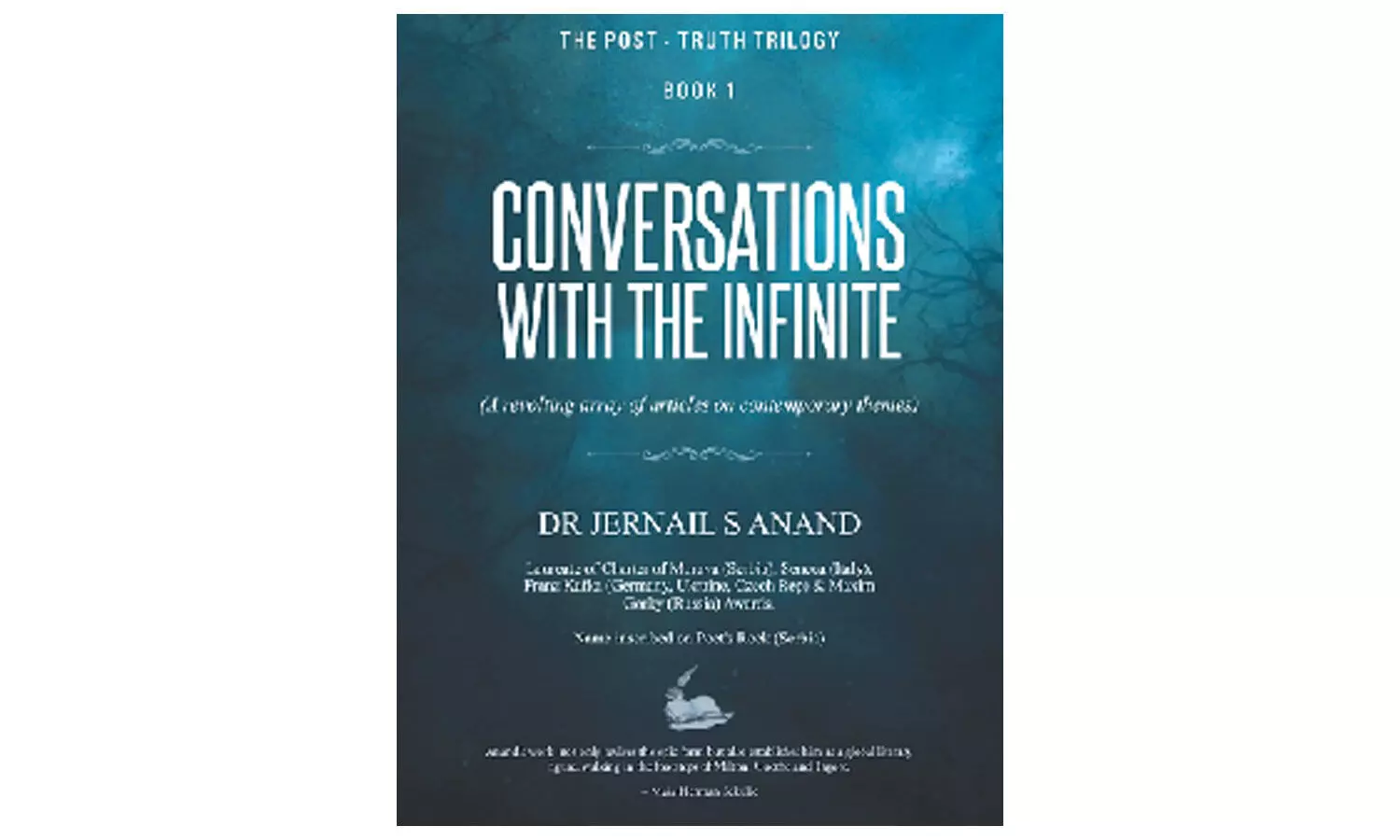
Dr. Jernail Singh Anand is a polymath, adorned with awards like the Charter of Morava and Seneca, who challenges the moral complacency of contemporary times. “Conversations with the Infinite” – [Book I of the Post-Truth Trilogy], is a collection of essays, articles and reflections on contemporary life which arrives not as a scholarly monograph but as “a conversation over evening tea’. Anand, a prolific philosopher-poet with over 200 titles to his name, attempts something increasingly rare: to drag big ideas out of the library and into the living room.
Anand’s central diagnosis is stark: modernity suffers from an “ethical blank.” Technology, corporate culture, and market-driven education have expanded human power but shrunk human dignity. In “The Technological Invasion,” he coins the term “laptopicarians”—the new digital labour class of teachers, IT workers, and gig professionals who have bartered the eight-hour day for 24/7 servitude without rights, healthcare, or self-respect. In “Ethical Neutrality & the Fall from Human Graces,” he indicts literature itself for its moral ambiguity, claiming that art’s refusal to take a stand has helped usher in “moral anarchy.” Elsewhere he meditates on Kaal and Mahakaal—Time and the Timeless—invoking Sikh and Indian metaphysics to frame mortality against a cosmic ethical spread. Anand unequivocally suggests that knowledge without wisdom is dangerous; progress without restraint is self-defeating. Anand calls for “ethiquettes” in writing, a parallel ethical education system, and a return to character-building over rote, job-oriented learning. His remedy is a “Spiritual-Ethical Dialectic” and a global humanism anchored in Sarbat da Bhala—welfare of all.
What stands out as a prolific asset is the book’s voice. Philosophy for Anand is not a seminar-room exercise. He deliberately shuns academic jargon, and the prose is lucid, aphoristic, often lyrical. Complex critiques of AI surveillance, ecological violence, and the erosion of teacher dignity are rendered in plain language a lay reader can absorb.
What lends moral urgency to the work is its proximity to existential reality. His portrait of the “laptopicarian” will resonate with anyone who has answered work emails at 11 p.m. or watched school teachers lost in WhatsApp groups. When he writes that “technology is now seated in the chair of the boss, and men are sitting around it with laptops in their hands,” he is describing a corrosive, lived reality for India’s expanding lower-middle-class workforce.
Anand critiques nostalgia, but acknowledges science’s gifts while warning of its hubris, and gives credit to modernity for freeing us from “superstition and the stranglehold of religion”, at the same time, mourning its ethical drift. Anand wants literature to declare “what moral purpose it serves” and demands “ethiquettes” in every creative work.
“Conversations with the Infinite” does not claim to be, “final wisdom”. What it offers instead is a moral provocation in plainclothes. Anand’s achievement is to make ethics feel like common sense again, and to remind a digitized, distracted populace that “survival with dignity” is the real question challenging modern man. Finally, the book succeeds in starting an argument for a culture debating AI, burnout, and the soul of education, around the evening tea. Section II of the book throws light on author’s achievements in the continuum of great western masters like Milton, Dante, Defoe and, back home, poet-philosophers Aurobindo and Tagore.
India condemns attacks on commercial vessels in Black Sea, reiterates call for dialogue and diplomacy
'Is democracy in India being undermined like China, Russia and North Korea': Gehlot on FIR against Rahul, Priyanka Gandhi
SSB pays tribute to bravehearts killed in Maoist attack 15 years ago
SSB pays tribute to bravehearts killed in Maoist attack 15 years ago
Pixel Moments to Politics For Cong As BJP Celebrates Modi@25
Dramatic face-off near Jantar Mantar. Rahul and Priyanka sit on the road
MPs vs Police. Chaos and High Drama Unfold on Delhi Roads
Henri Kagan, Kenso Soai Win 2026 Nobel Chemistry Prize for Autocatalysis
AP cabinet approves 12 agenda items
High Courts should not suggest custodial interrogation of accused, says Supreme Court


