






Grace, devotion and precision mark Induvadana’s Bharatanatyam arangetram

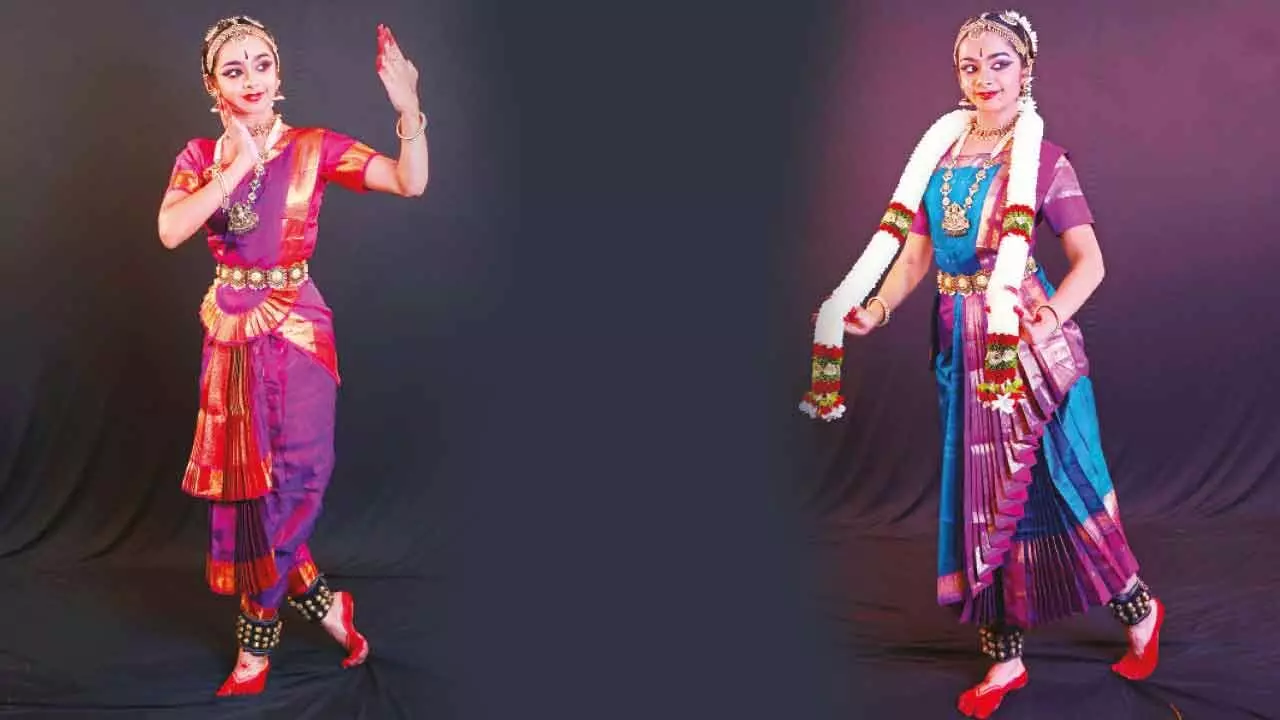
Witness the debut Bharatanatyam arangetram of Chirumamilla Induvadana. From intricate rhythmic patterns to expressive storytelling, read a detailed review of her graceful performance at Ravindra Bharathi, guided by the esteemed Dr. Rajeswari Sainath
Chirumamilla Induvadana recently presented her debut Bharatanatyam arangetram at Ravindra Bharathi under the aegis of her guru, senior Bharatanatyam artiste Dr. Rajeswari Sainath, a dynamic leader and powerful practitioner in the field of art with decades of experience in moulding young students to achieve great proficiency. Her speciality, having been mentored under Karaikkudi Mani, lies in the layered complexities of laya embedded with mathematically precise patterns of sound — concepts often difficult to grasp for the uninitiated.
Induvadana, the artiste of the day, has recently completed college and is set to pursue a degree in Psychology and Performing Arts. A dedicated and deeply expressive dancer, she has also briefly learnt Odissi. Blossoming into a profound passion, her strong connection to Bharatanatyam has become her sanctuary, where silence breathes, emotion takes form, and every movement turns into an intimate language of the soul.
Her slender form suited an elegantly expressive style filled with grace. A series of colourful costumes was used to complement the mood of the items performed. The exceptional orchestra, under the meticulous guidance of Dr. Rajeswari Sainath on nattuvangam, featured the standout baritone voice of Sriram, dynamic percussion by Chandrakant, mellifluous violin by Chander Rao, trilling flute by Venkatesh, and staccato tabla by Srikanth. Their support elevated the programme, creating an aura of a high-quality soundscape.
Lighting by Surabhi Kishore was proficient, focusing attention on the artiste, who stood out against the minimalist stage décor. Induvadana’s definition and presentation of rasa evoked a high degree of artistic quality as she navigated the culture, traditions, and stories contained in her art, bringing out her guru’s interpretation with fidelity.
Lord Ganesha was invoked in a shlokam as the ‘Pushpanjali’ heralded the recital by offering floral tributes to the deity while describing him as the embodiment of the Universe. The lyrics in raga Janasamodini, vividly depicting his glory, were imbued with deep reverence.
‘Alarippu’, the inaugural piece symbolising a blossoming flower, accompanied by the resonant beats of the mridangam, provided an opportunity for the dancer to showcase her aptitude for appropriate stances and precise movements in this rhythmic prelude. Her skill was displayed from the very outset.
The ‘Jatiswaram’ was performed clearly and lucidly. Presented in the early part of the recital, it blended jatis — drum syllables — with melodic swaras or musical notes set to a specific raga and tala, focusing on intricate footwork and geometric patterns. The clean clarity of poses was appreciated by the audience.
The demanding centrepiece, the ‘Varnam’, combined the three principal aspects of Bharatanatyam — bhaavam, ragam, and talam. Literally meaning a range of shades, the lyrics and swara passages gave Induvadana ample scope to delineate her expertise in facial expression or abhinaya, imagination, and nritta or footwork in all their variegated complexity. Memory and stamina were thoroughly tested, and the dancer’s competence was vividly elucidated.
This composition of the Tanjore Quartet in Kamas was a plaintive appeal of the nayika heroine longing for her beloved Lord and pleading with her dear friend to bring him to her. The desired one was no ordinary person, but Lord Shiva — draped in tiger skin, bearing the sacred Ganga on his head, adorned with serpent garlands, and smeared with sacred ash. As Brihadeeswara, he resides in the magnificent temple town of Tanjore.
Fragrant blossoms decorated the nayika’s home, carefully lit with rows of glowing diyas, as she awaited the arrival of her beloved with heartfelt yearning. This sense of longing was beautifully emoted by Induvadana.
Complementary items, ‘Aigiri Nandini’ and ‘Shiva Tandava Stotram’, followed. In Punnagavarali, Durga was exquisitely imagined by the dancer as the glorious Goddess — daughter of the Himalayas, mother of all, slayer of Mahisha, and adorned with braided hair. She was portrayed as both compassionate and relentless, nourishing the three worlds, removing sins, and remaining ever victorious.
The cosmic dance of Shiva was majestic, with all the elements incorporated into his dance — space as the stage, stars providing illumination, thunder as the sound effects, the Vedas as the music, and his feet dictating the pace of the cosmos. It was a thrilling presentation in Gowri ragam.
A fast-paced and crisply euphonious ‘Thillana’ in Dhanashree was invigoratingly rendered. The melodious strains of the ‘Mangalam’ brought the recital to a soothing conclusion as Ramadasa’s composition eulogised Lord Rama in lyrical stanzas — the enchanter of Sita, fulfiller of all desires, Lord of Bhadragiri, nurturer of devotees, wearer of earrings and garlands, the matchless moon-faced and lotus-eyed Lord — all these features charmingly brought out by the dancer.
Sunetra Pawar warns leaders against ‘unnecessary interference’, hints at tough decisions
NCW summons comedians More, Jangra over Rs 370 biryani row
CM Fadnavis outlines ‘Viksit Maharashtra 2047', sets target for $5 trillion economy
Pakistan trying to reshape authority through 28th Constitutional Amendment: Report
Mir, Shah knocks help Afghanistan A get four-run win over India A via DLS method
Pro-Khalistan groups continue to provoke youth, advance own political agendas: Report


