






A garden inside and atop every residential complex can help one breathe fresh air

There is no better joyous and natural stress-buster than gardening
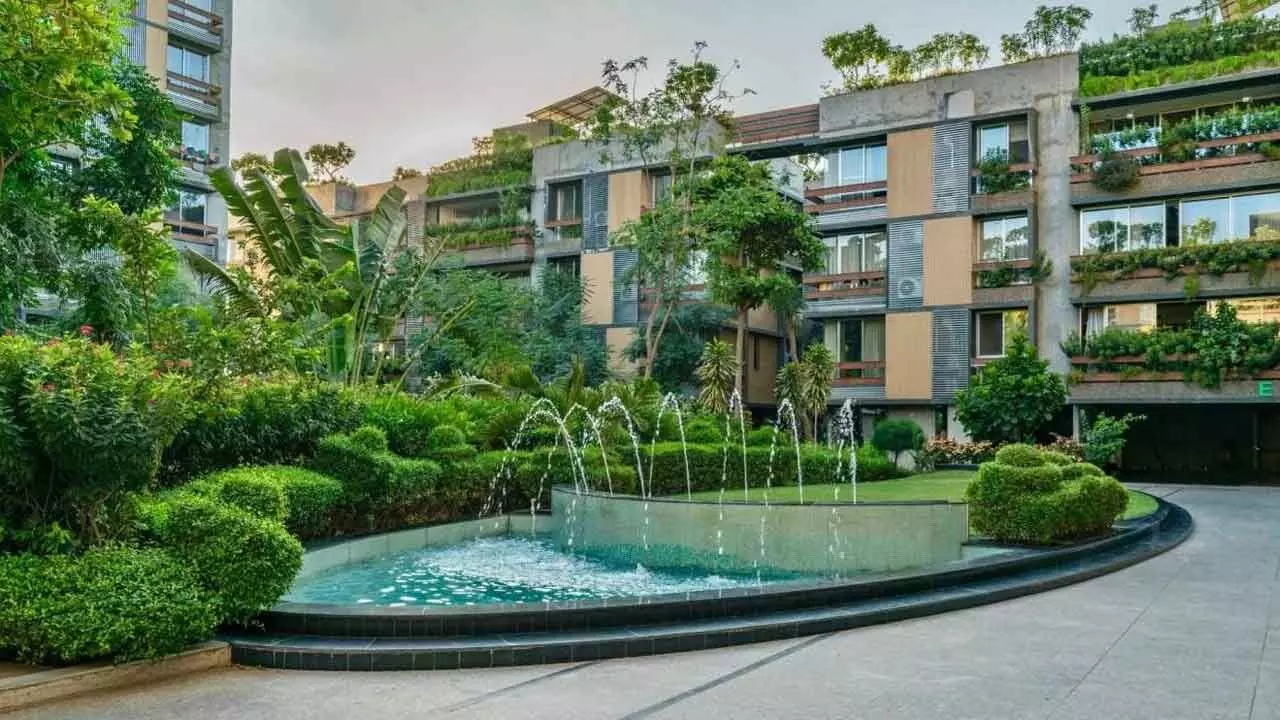
I always felt that growing gardens inside, and on the roofs, of multi-storied apartments should be encouraged. In fact, building bylaws of cities in the country ought to make such gardening a compulsory condition for granting building permission for new complexes.
My introduction to gardening began as an activity when my father was appointed as a judge of the High Court of the newly formed Andhra state (after the separation of the Telugu speaking parts of erstwhile Madras state) with Kurnool as its capital and Guntur as the headquarters of the new High Court. We lived in a big bungalow on a plot of land with a lot of scope for gardening both in the front and the backyard.
I was literally obsessed with gardening as a hobby as a nine-year-old boy. I began to plant seeds of vegetables such as beans, carrots, onions and brinjals, and flowering plants like phlox, African marigold, apart from various types of exotic grasses. It was indeed a most fulfilling and exciting experience to watch the seeds sprout and become saplings, growing into plants over a period of time.
Usha, my wife, has been endowed with ‘green fingers’, so to say, and everything she plants blossoms and blooms be it flowers, creepers, or trees. When I was working as joint secretary in the in the Union Ministry of Agriculture she became the secretary of the All India Kitchen Garden Association and made a contribution that drew appreciation for its quality and her dedication.
Gardening is an excellent hobby to take up, especially for the elderly. It offers significant mental and physical health benefits, including reduced stress, anxiety, and depression, while also acting as a moderate, full-body workout. Exposure to soil microbes boosts the immune system and Vitamin D levels, and improves heart health. It is helpful in reducing the risk of depression, as it is an activity that brings joy.
A forest-based food production system, forest gardening is the world’s oldest form of gardening. After the emergence of the first civilizations, wealthy individuals began to create gardens for aesthetic purposes. Ancient Egyptian tomb paintings provide the earliest physical evidence of ornamental horticulture and landscape design, depicting lotus ponds surrounded by symmetrical rows of acacias and palms.
A notable example of ancient ornamental gardens was the Hanging Gardens of Babylon. One of the most exciting and memorable events during my trips abroad was the visit to that place, while on an official visit to an exhibition on agriculture at Baghdad.
In ancient India, patterns from sacred geometry and mandalas were used to design gardens. Distinct mandala patterns denoted specific deities, planets, or even constellations. Such gardens were also referred to as a ‘Mandala vaatikas’, meaning gardens or plantations.
A not very happy recollection from my school days in Guntur is of succumbing to the temptation to pluck brinjals from a garden along with a few friends. The owner of the garden caught us red-handed and whacked us on our bare backs with the very plants which we had uprooted!
In due course Usha became an expert in the art of Bonsai during our years in Delhi, where our residence was dotted with many of her creations, including an incredible looking banyan tree, together with hanging prop roots.
Our abode in Hyderabad’s Stone Valley is one of very few in that colony which has a patch of lawn attached to it and houses a variety of flowers, fruits, and vegetable plants, stepping into which is almost like entering a jungle!
Many cities in India have sprawling and wonderfully nurtured gardens. My first visit to the ‘Garden City’ Bangalore was when I was stripling of a boy, accompanying my parents when my father, an advocate practising in the Madras High Court, would enjoy a holiday during the court’s summer vacation.
I remember the beautiful walks at Lal Bagh and Cubbon Park, so full of greenery and vegetation, trees, flowers, and fruits. In later years, Usha and I spent several hours gaping in awe at the most stunning variety of plants and trees they offered to visitors. We often also went to Mysore when one had a similar experience at Brindavan Gardens. Years later, it was at the botanical gardens in Madras, which I often went to, to have a snack and a cup of coffee, in the Woodlands’ drive-in restaurant that was located inside there.
Back home in Hyderabad, it was the Baagh-e-Aam or the Public Gardens where I often warmed up before heading to the Nizam Club for a workout in the gym. At New Delhi, I was enlivened inside the Mughal Gardens in Rashtrapati Bhavan, a silver lining in the otherwise dark cloud!
I always felt that growing gardens inside, and on the roofs, of multi storied apartments should be encouraged. In fact, building bylaws of cities in the country ought to make such gardening a compulsory condition for granting building permission for new complexes.
The word gardening lends itself to some interesting types of usage. ‘Kindergarten’, for instance, is a foundational educational stage. It was in the ‘baby class’, as it was called those days, of one such school, namely the Children’s Garden school, in the then Madras, that I began my school education.
Similarly, ‘gardening’ in cricket refers to the action of a batter using their bat or feet to flatten the pitch, remove debris, or repair damaged areas of the pitch, particularly around their guard position, before or between deliveries. While on gardens, one cannot afford to miss mentioning Eden Gardens in Kolkata, especially if one is a cricket aficionado. Eden Gardens, often referred to as home of Indian cricket, has been described as “cricket’s answer to the Colosseum”.
There is this story about an octogenarian Japanese gardener, diligently and patiently working away in his garden in a village near Tokyo. A passer-by, out of sheer curiosity, asks him how long it would take for the garden to be in full bloom. With an indulgent smile, the gardener says, “about 25 years.’’
Rather surprised, the passer by says, “Are you sure you’ll be able to enjoy the fruits of your labour”? Smiling again, but this time with a mischievous twinkle in his eyes, the gardener replies, “if my forefathers had also wanted the same thing this garden wouldn’t have reached even this stage!”
(The writer was formerly Chief Secretary, Government of Andhra Pradesh)
Sunetra Pawar warns leaders against ‘unnecessary interference’, hints at tough decisions
NCW summons comedians More, Jangra over Rs 370 biryani row
CM Fadnavis outlines ‘Viksit Maharashtra 2047', sets target for $5 trillion economy
Pakistan trying to reshape authority through 28th Constitutional Amendment: Report
Mir, Shah knocks help Afghanistan A get four-run win over India A via DLS method
Pro-Khalistan groups continue to provoke youth, advance own political agendas: Report


