






- 'Is democracy in India being undermined like China, Russia and North Korea': Gehlot on FIR against Rahul, Priyanka Gandhi
- Delhi Seemapuri Building Collapse: Several Feared Trapped As Rescue Operation Underway
- Claude Users Can Work Across Google Docs, Sheets and Slides In-App
- Rapido Ride Turns Into Nightmare After Captain Flees With Injured Passenger
- 7 Must-Watch OTT Releases For Your Dussehra Holidays
- ‘His Lips Turned Blue’: Dentist Recalls 45-Minute Effort To Save Flydubai Pilot Smit Machchhar
- Airtel Postpaid Plans Bring Free International Roaming From Rs 499
- 'Politics means nation building to him': Rajnath Singh on PM Modi's 25 years in public service
How Hanuman foiled Ravana’s effective crisis management serves as an invaluable lesson
In Short
True strategic supremacy is never decided by the scale of an empire’s arsenal

Share :
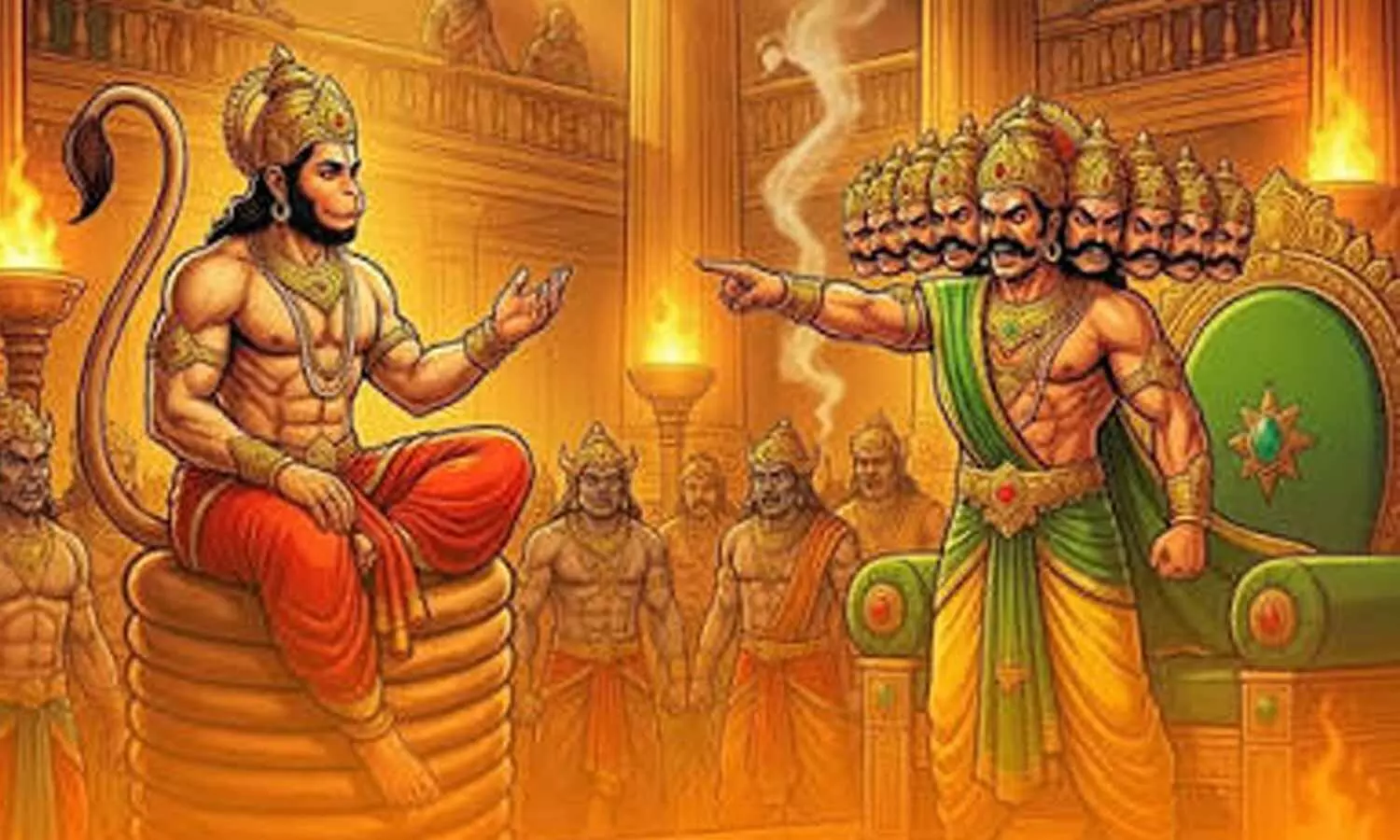
TheValmiki (and Andhra Valmiki Ramayana) Sundara and Yuddha Kandas unveil a fascinating study in ancient statecraft and warfare. While Ravana’s systematic response to unprecedented chaos showcases advanced strategic crisis management, his brilliant battlefield blueprints turned futile when pitted against a higher, divine power. This strategic chess match in Sundara Kanda begins after Hanuman locates Sita Devi, and resolves to assess Lanka’s military strengths and weaknesses in an impending future war.
He destroys the Pramada Vanam (Ashoka Grove), provoking Ravana into revealing his military might. What follows in the episode is an extraordinary succession of battles that highlights Ravana’s highly organized and crisis management skills. Hanuman kills the top aides of Ravana, including seven sons of ministers, five army commanders, exposing Lanka’s vulnerability. In a change of strategy, Ravana asks his younger son, Aksha Kumara to join the war. By doing so, Ravana elevated the conflict from a routine defence operation into a deeply personal, high-stakes military escalation. Hanuman resolved that the young warrior had to be killed and executed his decision.
Utterly shaken, Ravana summoned his formidable eldest son, Indrajit. This was no ordinary military dispatch, but a calculated counter-offensive to manage an existential crisis. He urged Indrajit to employ every available asset to overcome Hanuman, specifically advising him to utilize mystical tricks.: ‘Carefully evaluate this creature’s (Hanuman) deceptive agility, and unleash your matchless valour accordingly. Utilizing your highest celestial weapons, destroy him before Lanka suffers further humiliation. Do not underestimate his unconventional strength.’ Was the father’s advice to Indrajit.
Ravana further cautioned: ‘Do not waste precious time shooting ordinary arrows. Gauge your mutual capabilities carefully, and do not rely upon surrounding troops; even devastating fist blows will prove ineffective. Upon reaching him, execute whatever strategy matches the circumstances. Employ your ultimate celestial weapons, including Brahmastra.’
‘I know sending the young into battle while experienced elders are present violates social propriety. Yet, we are kings bound strictly to the sacred duty of Kshatriyas. We cannot disregard Kshatriya Dharma, which dictates that a monarch must never be the first to enter the fray. Consequently, as a matter of geopolitical necessity, I deploy you.’
Swelling with enthusiasm, Indrajit approached Hanuman, who rejoiced that a truly worthy adversary had arrived and let out a deafening lion’s roar. The two unmatched champions locked in fierce combat, fighting with boundless valour. No distinct advantage could be seen between them, making it initially impossible for either warrior to discover any vulnerability in his opponent. As specialized arrows proved utterly ineffective, a perplexed Indrajit invoked the absolute power of the supreme Brahmastra.
However, Hanuman wisely chose to temporarily yield his immense physical prowess rather than disrespect the Creator’s cosmic weapon. He knew that, under strict protocol, the rakshasas could never harm him without Ravana’s explicit strategic command. The moment rakshasas bound Hanuman with ordinary ropes, the sacred bonds of the Brahmastra instantly dissolved.
According to scriptural laws, when this supreme weapon’s restraint is combined with mundane bindings, its divine energy becomes completely ineffective.
This was a brilliant, calculated strategic victory that initiated the next phase of Rama’s mission. This exhibits Ravana’s war strategy as a masterful yet flawed study in crisis management and systematic escalation. Facing unprecedented chaos inside the Ashoka Grove, the king of Lanka did not panic; instead, he followed a strict, layered doctrine of military progression. He initially treated Hanuman as a manageable, localized threat, deploying forces in a careful, sequential order.
Ravana explicitly counselled his son to adapt dynamically to time, place, and circumstance: a command mirroring modern asymmetric warfare training and highlighting Lanka’s highly advanced martial intelligence. However, Ravana’s strategies backfired and led to fatal psychological blindness.
His entire empire operated on a transactional paradigm restricted to material superiority, raw physical power, and terror. Consequently, Ravana cannot comprehend an adversary existing completely outside self-preservation or political ambition. This fundamental disconnect leads to a profound paradox at the conflict’s climax.
When Indrajit successfully binds Hanuman with the supreme celestial weapon, that physical victory instantly triggers Lanka’s strategic undoing. The ordinary rakshasa soldiers, lacking the sophisticated discrimination of their elite commanders, hastily add crude worldly ropes to secure the prisoner.
By doing so, they instantly dissolved the Brahmastra’s divine energy, rendering their ultimate deterrence entirely useless and plunging Indrajit into deep despair. This tactical failure seamlessly bridges the gap between ancient military narrative and profound philosophy. Hanuman’s subsequent choice to feign helplessness and submit to the rakshasas’ crude bonds was not a defeat, but a brilliant display of deceptive compliance. By relinquishing physical resistance, the erudite Hanuman transformed apparent captivity into strategic triumph, turning himself into a living Trojan horse. Ultimately, this episode demonstrates that true strategic supremacy is never decided by the scale of an empire’s arsenal, but by the clarity of one’s higher purpose and the depth of inner spiritual alignment.
Even during the final Rama-Ravana war, as the tactical crisis escalated, Ravana systematically deployed his generals. To ensure absolute loyalty and ironclad trust, the demon king deliberately relied on his closest maternal uncles, all sons of the ancient king Sumali. Then Ravana deployed Indrajit, another formidable son, whose bow flashed with the multi-hued splendour of a rainbow and whose chariot proudly bore a lion emblem.
In sequence: the towering Atikaya, an extraordinary colossus capable of astonishing, supernatural feats of arms
India condemns attacks on commercial vessels in Black Sea, reiterates call for dialogue and diplomacy
'Is democracy in India being undermined like China, Russia and North Korea': Gehlot on FIR against Rahul, Priyanka Gandhi
SSB pays tribute to bravehearts killed in Maoist attack 15 years ago
SSB pays tribute to bravehearts killed in Maoist attack 15 years ago
Pixel Moments to Politics For Cong As BJP Celebrates Modi@25
Dramatic face-off near Jantar Mantar. Rahul and Priyanka sit on the road
MPs vs Police. Chaos and High Drama Unfold on Delhi Roads
Henri Kagan, Kenso Soai Win 2026 Nobel Chemistry Prize for Autocatalysis
AP cabinet approves 12 agenda items
High Courts should not suggest custodial interrogation of accused, says Supreme Court


