






- 'Is democracy in India being undermined like China, Russia and North Korea': Gehlot on FIR against Rahul, Priyanka Gandhi
- Delhi Seemapuri Building Collapse: Several Feared Trapped As Rescue Operation Underway
- Claude Users Can Work Across Google Docs, Sheets and Slides In-App
- Rapido Ride Turns Into Nightmare After Captain Flees With Injured Passenger
- 7 Must-Watch OTT Releases For Your Dussehra Holidays
- ‘His Lips Turned Blue’: Dentist Recalls 45-Minute Effort To Save Flydubai Pilot Smit Machchhar
- Airtel Postpaid Plans Bring Free International Roaming From Rs 499
- 'Politics means nation building to him': Rajnath Singh on PM Modi's 25 years in public service
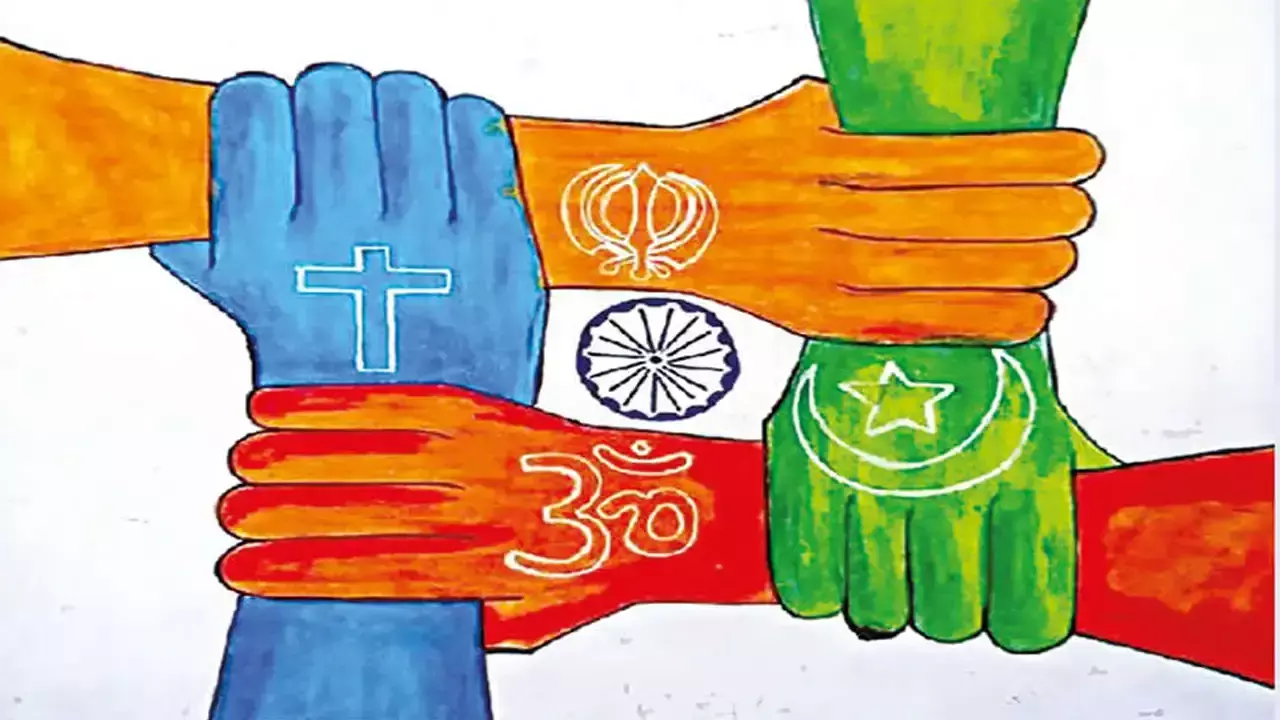
India indeed is a model of unity in diversity
In Short
Discover the essence of India’s 'unity in diversity,' exploring its rich linguistic tapestry, cultural harmony, and the enduring strength of its national identity.
Share :
With July 4, the American Independence Day fast approaching, one cannot help contemplating on the mind-boggling diversity of ethnic backgrounds, cultures, religions, and languages of the people of that wonderful country. From China to Great Britain and Spain, and from Ethiopia to Sri Lanka, there is hardly a country in the world, which does not proudly boast of its diaspora constituting an important and influential force in America. Still, all citizens of that great nation, irrespective of whether they are Christians, Jews, Muslims, Buddhists or Hindus, all proudly call themselves Americans.
From the snow-clad slopes of the mountains of Alaska, to the parched Death Valley in the deserts of California, from the Great Lakes in the north to the dizzying depths of the Grand Canyon in Arizona in the southwest and the deltas of the great rivers such as Mississippi, Missouri and Colorado, every known ecosystem of the world can be found in the country. That, however, is not the raison d’être for this piece.
The fact of the matter is that India, that is Bharat, is not only like the USA in each of those aspects but, as a matter of fact, very much more so. From the commanding heights of the Everest and the Kanchenjunga in the Himalayas, through the vast deltas of the mighty Brahmaputra, Ganges in the north, to the Godavari and Krishna rivers in the South, the 10,000 km long coastal strip, the forests of Bastar and Gir to the Thar desert, the ecosystems of India present a picture of a mini world in themselves. The proud nation has, for centuries, also been home to people subscribing to all major faiths of the world, living in perfect harmony and brotherhood. Little wonder, then, that India is often referred to as a model of unity in diversity, an expression so apt and fitting, that it is in danger of becoming a cliché.
The expression ‘unity in diversity’ was popularised by the country’s first Prime Minister, Jawaharlal Nehru, to describe the country’s harmonious coexistence of immense cultural, linguistic, religious, and ethnic difference; also, the philosophical and social concepts of cohesion among diverse groups, including references to how Indian society blends distinct traditions into a national identity.
To circumnavigate the country starting from, say, Kanyakumari at the southernmost tip of the Peninsula and start a journey to the east and the northeast to begin a series of encounters with a dazzling variety not only of these features, but other interesting cultural attributes such as cuisines and art forms. Typically, one would start in Tamil Nadu travel through Kerala, Goa, Maharashtra, Gujarat, Rajasthan, Haryana, Punjab, Jammu and Kashmir, the Northeast states, West Bengal, Odisha, Andhra Pradesh, and return to where one started. That would leave the northern states of Chhattisgarh, Madhya Pradesh, Bihar, Jharkhand, Uttarakhand, and Uttar Pradesh still awaiting exploration.
Over 500 erstwhile Princely States were integrated into the Indian Union soon after independence in 1947, an exercise led by the then Union Home Minister Sardar Vallabhbhai Patel, popularly known as the ‘Iron Man of India.’
The National Unity Day of Ekta Diwas is celebrated annually on October 31 to commemorate Patel’s birth anniversary and honour his pivotal role in uniting the nation. The concept of unity and diversity reflects the harmony in which people from distinct groups, characterised by varying languages, religions, and cultures, enrich the social fabric of the nation rather than fragmenting it. In other words, as someone put it in clever English, it is really a question of ‘unity without uniformity’, in respect of several significant strands of the fabric of the society.
One factor that contributes to the people of the country, enjoying the feeling of oneness is that the Constitution of India guarantees fundamental rights, equality, and secularism, providing equal status to all citizens.
Another important and unique aspect that brings people together, irrespective of their differences, is their sharing of national events, festivals, and most importantly, a common approach to responding to crises. The interconnections in the scripts and spoken versions of the languages of the country also present a very intriguing and interesting picture.
Consider, for instance, a journey starting from the central coastal Andhra Pradesh district Vijayawada, in whose neighbouring Krishna district lies Srikakulam village, abode of Lord Andhra Maha Vishnu, the God of which place, Krishna Devaraya wrote his Magnum Opus, ‘Amukta Malyada’’. As one travels southwards, Telugu begins to woo Tamil, which, further south, does the same with Malayalam. Turning north westwards at the cusp of the peninsula one witnesses Tamil and Kannada having a passionate affair, with Kannada and Marathi in a romantic relationship soon, with Marathi gaining the upper hand until it, in turn, suffers the same fate with Gujarati later. Rajasthani, Haryanvi, Punjabi, Kashmiri join the act soon. Next, it is the turn of Hindi, Bhojpuri, Kadi Boli and Maithili, the same experience awaits Bengali, Assamese and the other northeast tongues. It is after Bengali merges seamlessly into Odia that once again, after the Kannada-Marathi intersection, the transition occurs, from the Dev Nagari to the Dravidian script once again. Back to square one!
The languages of western India, Kannada, Tulu, Marathi, Gujarati and Kutchi and north India, Hindi, Punjabi belong to the same Indo-Aryan branch of the Indo-European language family. They are deeply connected through shared grammar, vocabulary roots, and writing systems. Nearly all of them are descendants of Sanskrit and its older Vedic forms.
South Indian languages, Tamil, Telugu, Kannada, and Malayalam, on the other hand, are deeply interconnected through the ancient Dravidian family tree. They share structural and grammatical DNA and evolved directly from early ancestors. Malayalam is considered the youngest daughter language of Tamil, resulting in highly similar core vocabularies and sentences.
Travellers choosing different realms of such absorbing features, such as, for instance, defining arts or cuisines can also be sure of the most enjoyable and thoroughly stimulating experience.
And that is what makes this great country what it is, like the ‘Khichdi’ of the north, or the ‘Avial’ of the South, comprising distinctly different ingredients, but producing a most luscious amalgam!
(The writer was formerly Chief Secretary, Government of Andhra Pradesh)
India condemns attacks on commercial vessels in Black Sea, reiterates call for dialogue and diplomacy
'Is democracy in India being undermined like China, Russia and North Korea': Gehlot on FIR against Rahul, Priyanka Gandhi
SSB pays tribute to bravehearts killed in Maoist attack 15 years ago
SSB pays tribute to bravehearts killed in Maoist attack 15 years ago
Pixel Moments to Politics For Cong As BJP Celebrates Modi@25
Dramatic face-off near Jantar Mantar. Rahul and Priyanka sit on the road
MPs vs Police. Chaos and High Drama Unfold on Delhi Roads
Henri Kagan, Kenso Soai Win 2026 Nobel Chemistry Prize for Autocatalysis
AP cabinet approves 12 agenda items
High Courts should not suggest custodial interrogation of accused, says Supreme Court


