






Indian agriculture’s dilemma: Imported fertilizer and costly soil health

Theentire world is facing challenges due to the Us-Iran tensions and blockade of Strait of Hormuz. Between 35 and 50 per cent of the world’s urea exports come from this region. The naval blockade presents a serious and urgent risk to India’s food security, fiscal stability, and agricultural sector. It has caused a double-edged supply and price shock because India is the world’s biggest importer of urea and depends on the Persian Gulf for both energy feedstock and finished crop nutrients.
The green revolution. which was spearheaded by scientist Norman Borlaug around 1950, helped nations avert food shortage and food crises when the countries transitioned from heavy food imports to becoming self-sufficient. The revolution which was driven by shifts in primarily the areas of
High yielding varieties (HYV) of seeds designed towards output maximization
Modern irrigation systems:
These technological shifts have paved way to present day long-term challenges, including loss of biodiversity where local crops are replaced by genetically modified seeds and ecological degradation by depleting and polluting the water table, due to heavy usage of chemical inputs and increased soil toxicity.
The new seed crop varieties require huge amounts of NPK (nitrogen, phosphorus and potassium) where we stand grossly inadequate in these resources. India majorly imports three types of fertilizers.
1. Urea:Consumption of urea in India rose exponentially in the past decade as this highly concentrated synthetic nitrogen fertilizer drastically increased crop yields. Despite domestic manufacturing, we still import up to 20 per cent to meet our demands.
2 DAP (Di ammonium Phosphate:We import 50-90 per cent of our consumption needs from west Asia and North America as there is a huge scarcity of rock phosphate in India.
3 MoP (Muriate of Potash):We import 100 per cent of our consumption needs from Russia and Belarus as there is complete absence of mineable potash reserves.
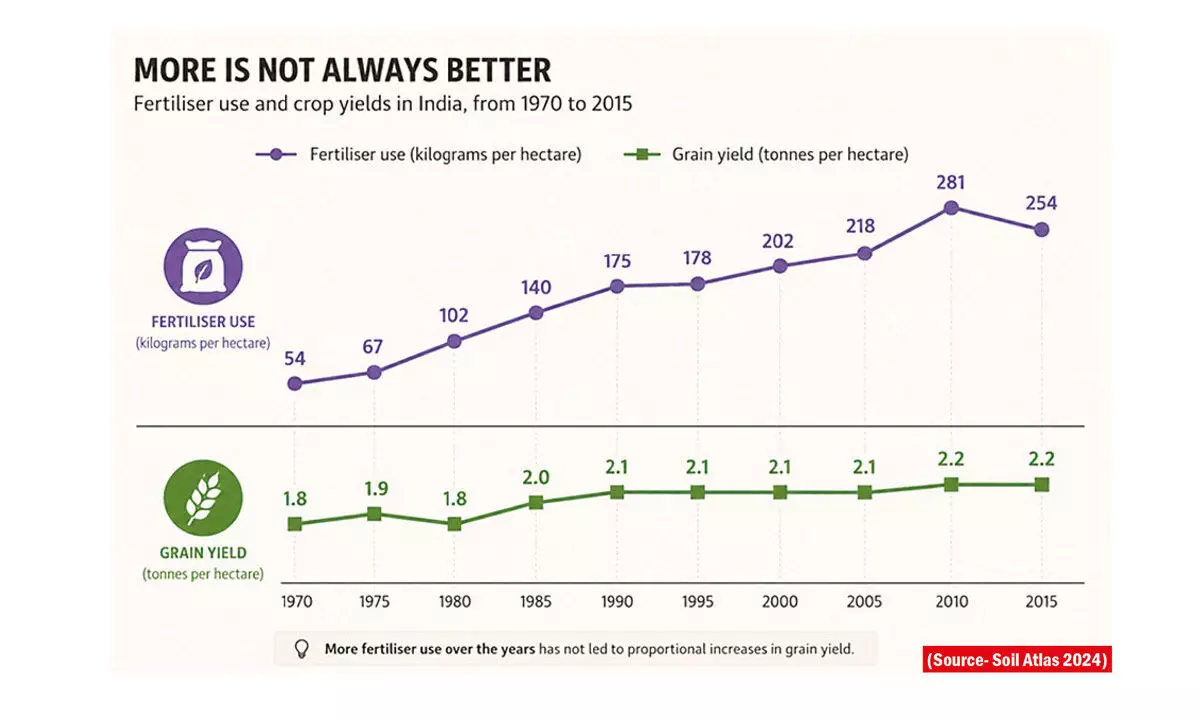
We have not even marginally improved in our yield by overusing fertilizers. Increased subsidies on fertilizers surges consumption as it incentivizes overuse. According to the ministry of chemicals and Fertilizers, urea is made available to farmers at a MRP of Rs 242 per 45 kg bag, DAP at Rs 1350 per bag while it costs the government around Rs 2,900 per MoP bag. The government fertilizer subsidy for FY 2022 stands at 1.53 lakh crore, which increased to 1.86 lakh crore in FY 2026.
Soil degradation is turning into a costly affair as we spend millions of dollars to import fertilizers that threaten our agriculture. It is an important fact that agriculture supports the livelihoods of two-thirds of the country’s population. Data shows that 37 per cent of our agricultural land is affected by soil degradation and over two thirds of samples out of 50 million samples collected between 2015 and 2019 were found to be deficient in key nutrients like nitrogen, phosphorus and potassium. Depleted soils not only hinder plant growth leading to erosion but poorly respond to the use of chemical fertilizers.
Effect on food prices:The Food and Agriculture Organization (FAO) has warned about the impending severe global food crisis within the next 6-12 months owing to shipping disruptions and geopolitical situations. The FAO food price index, which tracks monthly changes in the international prices of a basket of globally traded food commodities, rose for a third consecutive month in April. This is driven by high energy costs leading to expensive fertilizers and seeds resulting in lower yields. As a result, the commodity prices increase resulting in food inflation. The situation becomes worse with summer water shortages and changing temperature patterns across the regions.
Soil organic Carbon (SOC) is very important in keeping soil fertile, but the fertility is rapidly decreasing because the farmers are using less organic matter to the land. Heavy use of chemical fertilizers also harms the tiny living organisms in the soil that help recycle nutrients. Cutting down forests and building cities are also reducing the natural richness of soil. India’s SOC levels have dropped from one per cent to a mere 0.3 per cent in the past 70 years. In Punjab, only 6.9 per cent of soil had high organic carbon; this number went down further in 2024-25.
It’s time for us to wake up before we lose our future generations to the vulnerabilities of socio-economic consequences like threat to food security, malnutrition, loss of health, climate vulnerability. The government’s increased fiscal burden due to fertilizer subsidies is already distributed across taxpayers.
Risk mitigation strategies:The government can come up with some policy changes and recommendations to deal with the impending crisis. The concept of economic growth should rise from the soil but not trickle down to end with the soil. The government should come up with ways to create incentives and bring about the balance. Firstly, educate the farmers that the fertilizers import is not essential for greater incomes and desired results. Subsidies if not reduced should be directed and channeled to different areas. Global supply chain challenges can be taken as an opportunity to bring about a systemic change.
Aatmanirbhar Bharat can become more relevant by bringing about horizontal and vertical integration in the agriculture ecosystem. Farmers’ education is more important than providing subsidies to them.
Align govt policies with the agri ecosystem:
Farmers must be guided to improve nutrient use efficiency of soil and reducing fertilizer wastage. This can be achieved by providing funding for developing innovation in technologies like green ammonia, crop genetics, and effective use of biodegradable plant waste to improve nutrient efficiencies. Though this process will take 3-5 years, it can strengthen long-term resilience.
Subsidies /funds can be channeled towards developing early warning systems regarding the crop health. Provide insurance and monitoring mechanisms to help them act before a crisis.
Blanket subsidies can be avoided, and support must be provided to vulnerable small holding farmers.
An estimated 120 million soil health cards have been given, thanks to significant investments made by the Centre on its soil health mission.
Nutrient management must include both organics and biofertilizers (BF). Organic manures should be used efficiently; crop and livestock production systems should be integrated; biogas plants should be promoted and made more efficient; training and incentives should be provided for better manure management; better and enriched compost preparation should be guaranteed. Encourage horizontal integration, coordination and provide financial support to encourage animal husbandry and poultry alongside farming.
Encourage and expand affordable credit for MSMEs involved in agro business like producing organic fertilizers. This significantly improves the agro value chain. Incentives may be provided to fertilizer manufacturers opting for the manufacture of value-added fertilizers such as neem-coated urea and sulphur coated urea, among others.
Expand the access to the use of machinery like drones, precision agricultural technologies and solar powered systems for irrigation.
Provide guidance to the farmers towards small efficiency improvements like crop switching and inter cropping instead of using fertilizers for improvements. There is a need to develop new products and popularize more efficient methods of nutrient application.
It would be a good idea to introduce and offer carbon credits or incentives to farmers who engage in conservation agriculture to mitigate greenhouse gas emissions and impound carbon.
Conclusion:
The government must strive to limit cost hikes for companies impacted by the closure of the Strait of Hormuz. The central government has created an Economic Stabilization Fund worth Rs one lakh crore to achieve this goal.
Imported chemical inputs cannot be the only source of food security. To preserve farmers’ livelihoods and the affordability of food for customers, productivity and soil sustainability must be balanced. Intensive efforts by research institutions, government and the farmers together are the need of the hour to conserve the long-term health of Indian soils and agriculture.
(The writer is Associate Professor (Finance) at Christ University, Bangalore)
Printed & Published by K. Hanumanta Rao on behalf of M/s Hyderabad Media House Pvt.Ltd and Printed at Aamoda Press, H.No. 5-9-287/10 & 11, Plot No. 53 & 54, Prashanth Towers, Rajeev Gandhi Nagar, Moosapet, Kukatpally(M), Kukatpally Municipality, Medchal-Malkajgiri District. and published from Hyderabad Media House Ltd, Plot No.1042, Road No. 52, Jubilee Hills, Hyderabad-500033, TELANGANA.Chief Editor:P Madhusudhan Reddy. RNI No: TELENG/2011/38858
India's bowling combination, not batting, the real concern heading into Women's T20 WC, says Nasser Hussain
Omar meets PM Modi in Delhi, presses for early restoration of J&K statehood
Air India denies putting pressure on families of AI-171 Boeing crash victims
India Finland Relations, S Jaishankar, Digitalisation, Sustainability, Strategic Partnership
DK Shivakumar meets PM Modi in Delhi, seeks support for Karnataka's development priorities
Siddaramaiah accuses Zameer Khan of betrayal in Davanagere bypolls


