






- 'Is democracy in India being undermined like China, Russia and North Korea': Gehlot on FIR against Rahul, Priyanka Gandhi
- Delhi Seemapuri Building Collapse: Several Feared Trapped As Rescue Operation Underway
- Claude Users Can Work Across Google Docs, Sheets and Slides In-App
- Rapido Ride Turns Into Nightmare After Captain Flees With Injured Passenger
- 7 Must-Watch OTT Releases For Your Dussehra Holidays
- ‘His Lips Turned Blue’: Dentist Recalls 45-Minute Effort To Save Flydubai Pilot Smit Machchhar
- Airtel Postpaid Plans Bring Free International Roaming From Rs 499
- 'Politics means nation building to him': Rajnath Singh on PM Modi's 25 years in public service
India’s multi-alignment: A strategy or a mirage?
In Short
Multi-alignment is different. It does not say, “We belong to nobody.” It says, “We will work with everybody where our interests converge, while retaining the freedom to disagree where they do not.” That is a much more sophisticated proposition

Share :
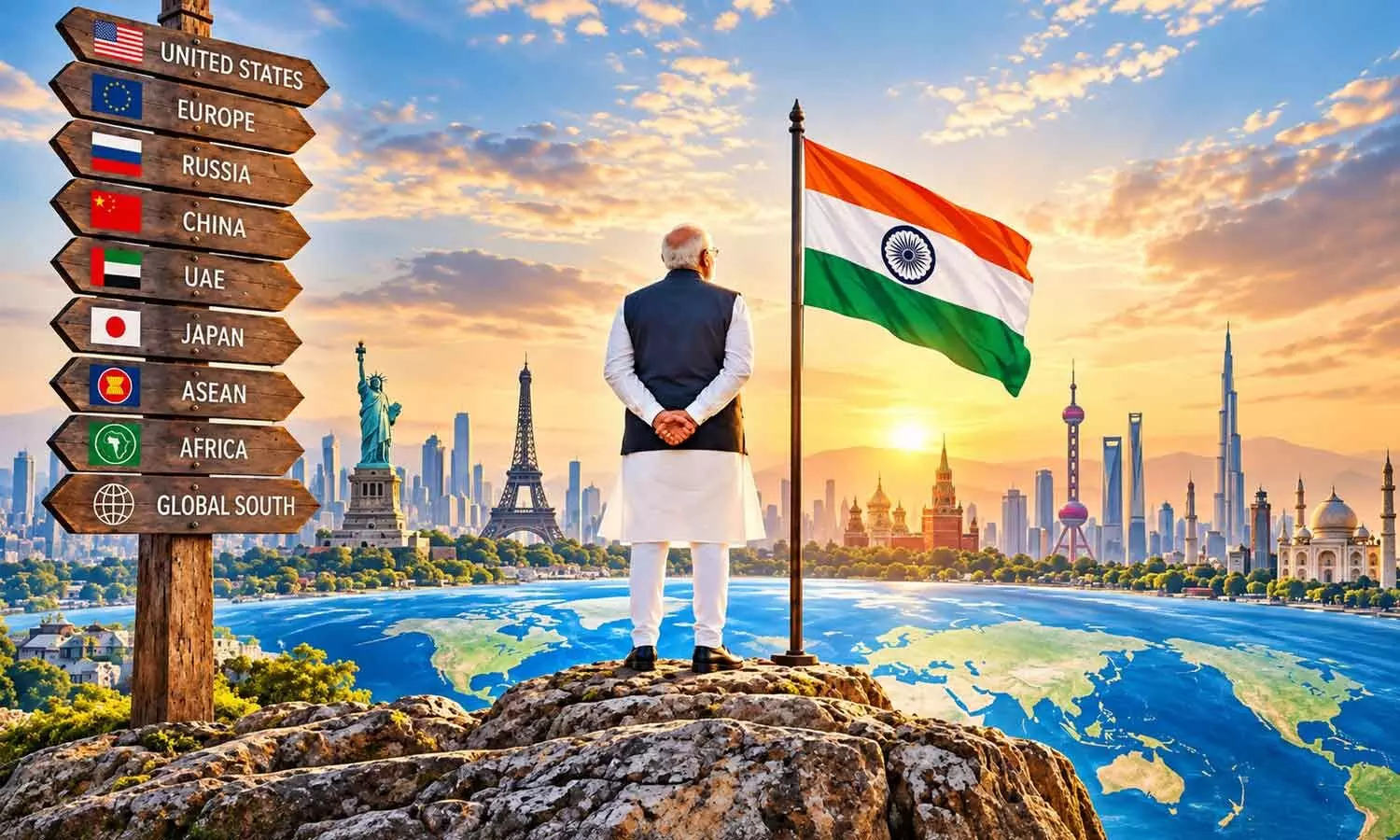
India’s multi-alignment: A strategy or a mirage?
For nearly seven decades, India’s foreign policy was defined by a powerful idea: non-alignment. It was born in a world divided into two rival blocs, where choosing one camp could easily mean surrendering strategic freedom to the other. India chose neither. It sought space to pursue its own interests, speak for the developing world and retain freedom of action. That world has disappeared.
Today, the international system is not neatly divided between two superpowers. It is increasingly multipolar, competitive and transactional. The United States and China are locked in strategic competition. Russia remains a major military and energy power despite its confrontation with the West. Europe is rediscovering hard power. The Gulf has acquired greater economic and diplomatic weight. The Global South is demanding a larger voice. Technology, energy, supply chains, semiconductors and critical minerals have become instruments of geopolitical power.
India has responded with what is increasingly described as multi-alignment. It is a significant evolution in our foreign policy. But it is also a strategy that demands exceptional discipline. India today can deepen its strategic partnership with the United States, remain closely engaged with Russia, participate actively in BRICS, work with the Quad, compete with China, cooperate with Europe, strengthen ties with the Gulf and simultaneously expand its influence across the Global South. India’s hosting of the 2026 BRICS Summit, while maintaining its expanding engagement with Western powers, is perhaps the clearest contemporary illustration of this approach.
The question, therefore, is not whether India has friends. The question is whether multi-alignment is becoming a coherent strategy or merely an accumulation of relationships. That distinction will determine whether this doctrine strengthens India’s rise or eventually becomes its vulnerability.
From non-alignment to multi-alignment
Non-alignment was fundamentally a response to the Cold War. It gave India diplomatic space at a time when the international system was organised around competing power blocs. Multi-alignment is different. It does not say, “We belong to nobody.” It says, “We will work with everybody where our interests converge, while retaining the freedom to disagree where they do not.” That is a much more sophisticated proposition.
India can cooperate with Washington on defence, technology, artificial intelligence, critical and emerging technologies and the Indo-Pacific without accepting every American position. It can maintain a deep relationship with Moscow in defence and energy while expanding its engagement with the West. It can participate in the Quad while sitting across the table from China in BRICS and other multilateral forums.
To someone looking at foreign policy through the old binary lens, this may appear contradictory. It is not. It is precisely what strategic autonomy looks like in a multipolar world. But there is an important caveat. Multi-alignment cannot mean being all things to all countries. That would be diplomacy without strategy. Every relationship must have a purpose.
The United States brings technology, capital, advanced defence capabilities and access to one of the world’s most important markets. Russia remains relevant to India’s defence architecture, energy security and strategic history. Europe offers technology, investment and sophisticated markets. Japan and Australia strengthen India’s Indo-Pacific partnerships. The Gulf provides energy, investment, trade and a vital bridge to India’s extended neighbourhood. BRICS provides a platform through which India can engage the emerging world and advocate reform of global governance.
India’s challenge is to make these relationships complementary rather than contradictory. That requires clarity about what India wants from each relationship and, equally importantly, what India is unwilling to compromise.
The real test of multi-alignment is the ability to say no
There is a tendency to judge diplomatic success by the number of strategic partnerships a country accumulates. I would argue that this is the wrong metric. A country is strategically autonomous not because it has many friends, but because it can say no to even its friends when its national interests demand it. This is where India’s current circumstances provide a useful test.
The debate over Russian oil is a good example. India has consistently argued that its energy policy must protect the interests of its population and economy. The United States, meanwhile, has moved towards stronger economic pressure on countries continuing to purchase Russian energy. On September 16, the US House passed legislation that could enable steep tariffs on countries such as India over Russian energy purchases. India has responded by stressing energy security and warning that such measures could affect bilateral relations.
This is precisely the kind of situation in which strategic autonomy stops being a slogan and becomes a test. India needs America. India also needs affordable and reliable energy. India cannot permit any external power to define the boundaries of its energy security.
At the same time, India must recognise that strategic autonomy works both ways. Other powers will also pursue their interests. Washington will expect reciprocity. Moscow will expect continued engagement. Europe will seek commercial and strategic alignment. China will attempt to shape India’s choices. The Gulf countries will increasingly pursue their own independent agendas.
The age when great powers gave countries unlimited diplomatic space is disappearing. Strategic autonomy will increasingly have to be negotiated, defended and paid for. And that brings us to the central reality of India’s multi-alignment strategy. Diplomatic autonomy ultimately rests on national capability.
A country that is economically dependent, technologically vulnerable, excessively reliant on imported defence systems or exposed to concentrated energy supplies will eventually discover that its diplomatic freedom has limits.
This is why foreign policy cannot be separated from economic policy. India’s semiconductor ambitions, defence manufacturing, energy diversification, domestic technology capabilities, critical minerals strategy, manufacturing competitiveness and export strength are not merely economic programmes. They are instruments of foreign policy. Every capability India develops at home expands the choices available to its diplomats abroad.
China is the hardest equation
If there is one relationship that will determine the quality of India’s multi-alignment strategy, it is China. India’s relationship with China cannot be reduced to either friendship or confrontation. It is a complicated combination of competition, economic interdependence, border security, regional rivalry and unavoidable engagement.
India cannot wish China away. Nor can India afford strategic naivety about China’s ambitions. This is where calibrated multi-alignment becomes essential. India must cooperate with China where cooperation serves Indian interests. It must compete where competition is inevitable. It must deter where national security requires deterrence. And it must keep diplomatic channels open even when disagreements are serious. That is not weakness. It is mature statecraft.
The recent BRICS Summit in New Delhi under the leadership of PM Narendra Modi demonstrated the complexity of this environment. India hosted leaders including China’s Xi Jinping and Russia’s Vladimir Putin while simultaneously maintaining deepening relationships with the United States and other Western powers. BRICS itself has become a more diverse grouping, with countries that have sharply different geopolitical interests.
India’s own BRICS declaration reflects this balancing act. It calls for a more representative international order, stronger multilateralism and a greater voice for emerging and developing economies, while also emphasising practical cooperation in technology, supply chains, finance and investment.
This is where India can potentially add something distinctive to the emerging global order. India need not choose between a Western-led order and a China-centred alternative. It can work towards an order in which India itself becomes one of the poles of influence. But that requires an uncomfortable degree of realism. India cannot build strategic autonomy merely through diplomatic positioning. It has to build the economic and military weight that makes strategic autonomy credible.
Where multi-alignment could become a mirage
There are five dangers we must consciously guard against.
The first is ‘strategic ambiguity’.
If every country is described as a strategic partner and every engagement is celebrated as a diplomatic achievement, the phrase “strategic partnership” eventually loses meaning. India must distinguish between relationships that are vital, relationships that are important and relationships that are simply useful.
The second is ‘overextension’.
India cannot have equal strategic bandwidth everywhere. A rising power must decide where its diplomatic capital produces the greatest return. The Indo-Pacific, the Indian Ocean, the Gulf, continental Asia, Europe, Africa and the Global South all matter, but they cannot all receive identical attention and resources.
The third is ‘economic vulnerability’.
Multi-alignment without diversification is dangerous. If one country or one bloc becomes indispensable for energy, technology, defence, finance or markets, diplomatic autonomy gradually becomes theoretical.
The fourth is the ‘changing nature of great-power politics’.
The world is becoming more transactional. Countries increasingly expect tangible reciprocity. Partnerships will be judged not merely by political warmth but by trade balances, market access, technology transfers, defence cooperation and strategic contributions.
The fifth, and perhaps most important, is ‘confusing diplomatic visibility with strategic influence’. Summits are useful. Declarations are useful. Strategic dialogues are useful. But they are not outcomes. Relationships are not strategy. Outcomes are strategy.
If a partnership gives India technology, market access, military capability, investment, energy security or greater influence in international institutions, it has strategic value. If it merely produces another photograph and another joint statement, its value is considerably less. That is the distinction India’s diplomats must keep firmly in sight.
The way forward: Calibrated multi-alignment
I believe India should retain multi-alignment but move it into its next phase. The next phase should be ‘calibrated multi-alignment’. And finally, India needs strategic clarity. Every major relationship should answer three questions: What does India gain? What does India contribute? And where are India’s red lines?
That is how multi-alignment becomes strategy rather than improvisation. The temptation in international politics is always to look for certainty. India does not have that luxury. The world around us is becoming more uncertain, more competitive and more transactional. Our answer cannot be to retreat into isolation. Nor can it be to become an appendage of any power bloc. India’s historic opportunity is much larger, and PM Narendra Modi understands it quite well.
(Author is a senior BJP leader, Chairman of Nation Building Foundation & a Harvard Business School certified Org.Strategist.” )
India condemns attacks on commercial vessels in Black Sea, reiterates call for dialogue and diplomacy
'Is democracy in India being undermined like China, Russia and North Korea': Gehlot on FIR against Rahul, Priyanka Gandhi
SSB pays tribute to bravehearts killed in Maoist attack 15 years ago
SSB pays tribute to bravehearts killed in Maoist attack 15 years ago
Pixel Moments to Politics For Cong As BJP Celebrates Modi@25
Dramatic face-off near Jantar Mantar. Rahul and Priyanka sit on the road
MPs vs Police. Chaos and High Drama Unfold on Delhi Roads
Henri Kagan, Kenso Soai Win 2026 Nobel Chemistry Prize for Autocatalysis
AP cabinet approves 12 agenda items
High Courts should not suggest custodial interrogation of accused, says Supreme Court


