






Institutional rot and greed turn a Delhi B&B into a deathtrap

Law is not law, if it violates the principles of eternal justice and basic human safety-Epictetus
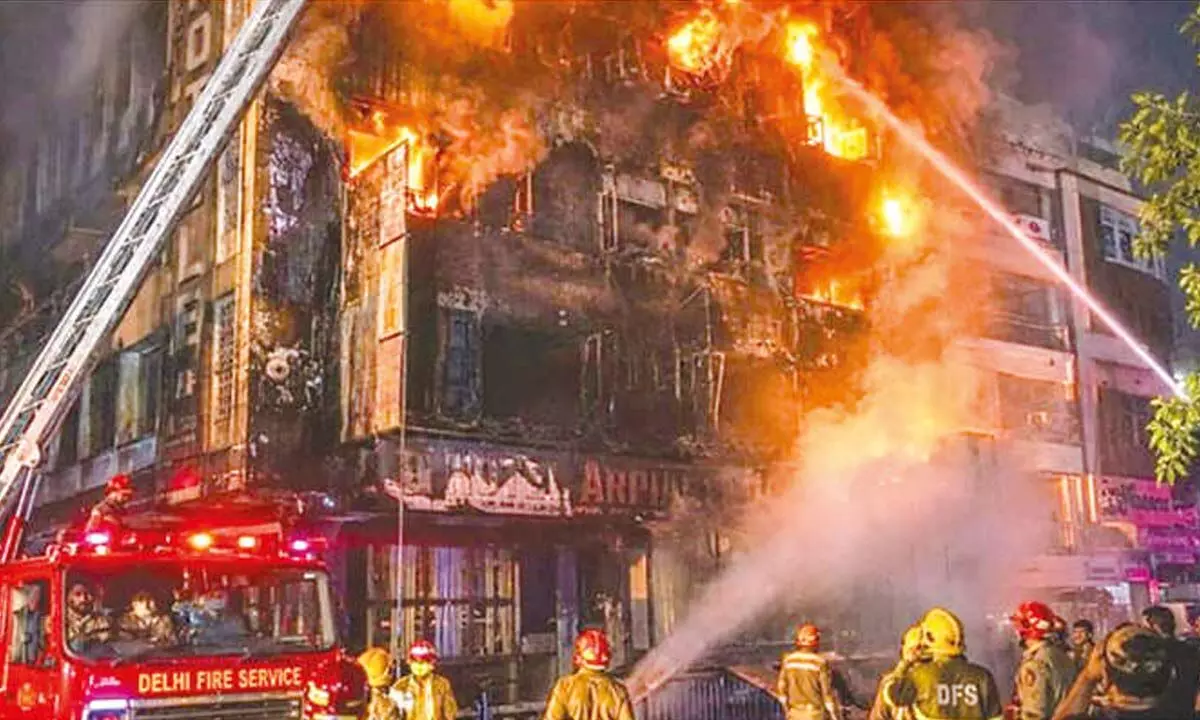
The narrow, suffocating lanes of Hauz Rani in Delhi’s Malviya Nagar became a vertical furnace. When the thick black smoke finally cleared from the charred remains of the Flourish Stay Bed & Breakfast, 21 lives were extinguished for no fault of theirs. Among the dead were ten Indians and eleven foreigners, including from Liberia, Nigeria, Mozambique and Turkmenistan. Rather ironically, they all had traveled thousands of miles to seek medical care at the neighboring Max Hospital. Sadly, they found a horrific end, trapped inside a building where, by all accounts, an accident was waiting to happen.
The tragedy is not merely a story of a devastating electrical short circuit or a sudden blaze originating from a ground-floor kitchen. It is a damning indictment of corruption, a total collapse of institutional oversight, and blatant violation of city codes that occurs in plain sight every single day across India.
25 rooms built against an approval for just six:
The arithmetic of this disaster is chillingly simple. Under the Delhi government’s Bed and Breakfast scheme, residential properties are stringently regulated to maintain low density and ensure safety. The owner of Flourish Stay had official permission to operate exactly six rooms.
Yet, driven by unbridled greed and an absolute absence of fear of the law, the builders constructed a five-floor deathtrap packed with twenty-five rooms, including heavily modified sections in the basement. To maximize real estate and squeeze profits out of every square inch, fundamental engineering and safety principles were cast aside:
• The single-exit trap: A five-storey commercial guest house was operating with only one narrow entry and exit point. When the ground floor caught fire, the solitary escape route became a chimney for toxic gases.
• No ventilation: Bathrooms and rooms were sealed without windows or exhaust structures, causing smoke to accumulate rapidly, resulting in lethal asphyxiation for most of the victims.
• No fire clearance: The establishment did not possess a mandatory Fire No Objection Certificate (NOC). Its sealed windows and locked basement doors meant that the first responders had to spend precious minutes smashing concrete and iron rather than rescuing people.
The great institutional collapse:
How does a building expand its capacity four-fold, list 25 rooms on global online booking platforms, and operate a bustling commercial hub without a single regulator noticing it? The answer lies in the profound rot within India’s civic and municipal monitoring agencies. The Municipal Corporation of Delhi (MCD), local enforcement wings, and fire safety inspectors have turned what should be a rigorous oversight mechanism into a transaction-based system of bribes. The officials, whose sole job is to check these structural encroachments, simply chose to look the other way.
This isn’t an isolated incident in Delhi; it is the structural template of urban India. From the illegal coaching centers of Rajinder Nagar to gaming zones in Gujarat, safety policies exist only on paper. The “observatory mechanism” has completely collapsed under the weight of institutionalized corruption. Enforcers act not as guardians of human life, but as toll-collectors who monetize illegalities.
Citizens become first responders
As the fire raged, the consequence of this official failure fell squarely on the shoulders of ordinary citizens. Witnesses described terrifying scenes of women breaking glass and leaping from the third floor. While emergency fire tenders reportedly struggled to navigate the congested, wire-entangled lanes quickly, local shopkeepers and residents became heroes. A mattress seller nearby emptied his stock onto the asphalt to cushion the falls of those jumping for their lives. Others braved the blinding smoke to administer CPR on the street. Civic bravery, however, cannot substitute for municipal governance. While the police have registered a culpable homicide FIR and arrested the building owner, it is a reactive measure for a proactive failure. Predictably, the tragedy has triggered a political blame game, with municipal bodies launching sudden “sealing drives” across South Delhi—a performative ritual of closing the stable door long after the horses have bolted.
“The death of the innocent is the ultimate price a society pays for the comfort of its corrupt institutions.”
(The writer is a former OSD to Union Civil Aviation Minister)
India's bowling combination, not batting, the real concern heading into Women's T20 WC, says Nasser Hussain
Omar meets PM Modi in Delhi, presses for early restoration of J&K statehood
Air India denies putting pressure on families of AI-171 Boeing crash victims
India Finland Relations, S Jaishankar, Digitalisation, Sustainability, Strategic Partnership
DK Shivakumar meets PM Modi in Delhi, seeks support for Karnataka's development priorities
Siddaramaiah accuses Zameer Khan of betrayal in Davanagere bypolls


