






Modi to surpass Nehru’s record tenure as PM today

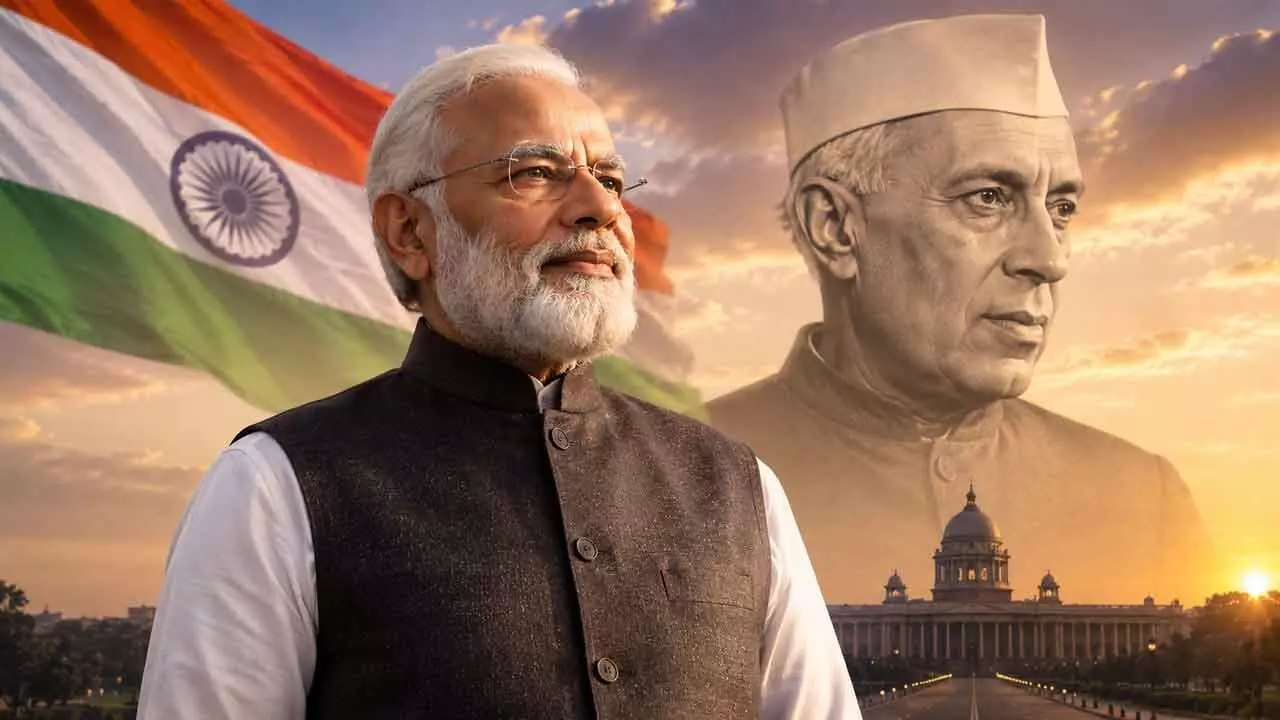
People’s mandate rewrites history
This year’s June 10 will go down in the annals of Indian democratic history as a Red-letter Day as it marks the day when Narendra Modi scaled a new high by completing 12 years and 14 days in office as the continuously elected Prime Minister. In effect, he eclipsed the tenure record of the country’s first prime minister Jawaharlal Nehru.
For Modi’s supporters, this achievement represents more than a statistical milestone. They view it as a reflection of sustained public trust and a testament to a democratic system that rewards leadership through repeated electoral endorsement.
Nehru and Modi-Two different political journeys:
A historical comparison between Jawaharlal Nehru and Narendra Modi highlights the different circumstances under which the two leaders assumed office. Nehru became the Prime Minister in 1947 before India held its first general elections. During the Congress Party’s internal consultations on leadership, several provincial Congress committees reportedly favoured Sardar Vallabhbhai Patel for the top job. However, following Mahatma Gandhi’s intervention and Patel’s decision to step aside, Nehru assumed office.
Modi’s rise followed a different path. Before becoming the Prime Minister, he served several terms as the Chief Minister of Gujarat and secured repeated electoral victories. He later led the BJP to victories in the 2014, 2019 and 2024 Lok Sabha elections, receiving successive mandates from voters across the country. Supporters argue that Modi’s tenure is distinguished by its direct electoral foundation and sustained public endorsement.
From humble beginnings to national leadership:
The personal backgrounds of Nehru and Modi have often been central to political discussions about leadership and public representation. Nehru belonged to a prominent political family and had his education in some of the world’s leading institutions. His family’s influence played an important role in India’s freedom movement and early political development.
Modi, by contrast, was born into a modest family in Gujarat. His journey from a small-town upbringing to the office of Prime Minister is frequently cited by supporters as an example of social mobility and democratic opportunity. Without belonging to a political dynasty, he rose through years of organisational work, grassroots engagement and electoral success. For many, his political journey symbolises the aspirations of ordinary Indians seeking advancement through hard work and perseverance.
A different governance model:
Many point out that Modi’s leadership reflects a shift from earlier governance models toward a more decisive and results-oriented approach. They contend that certain policy decisions during the Nehru era, including the handling of Kashmir at the United Nations and India’s approach toward China prior to the 1962 war, had long-term consequences for national security and strategic interests. In contrast, Modi’s government is credited with pursuing a stronger national security framework and addressing issues that remained unresolved for decades. The abrogation of Article 370, efforts to curb Maoist violence, progress on the Ram temple issue, and reforms such as the Citizenship Amendment Act and abolition of triple talaq are presented as major policy achievements. The government’s supporters also point to surgical strikes and air strikes against terrorist infrastructure as evidence of a more assertive security doctrine.
Tech-driven welfare and governance:
One of the defining features of the Modi government has been the use of technology in welfare delivery and public administration.
The JAM Trinity of Jan Dhan accounts, Aadhaar and mobile connectivity enabled large-scale Direct Benefit Transfers (DBTs), allowing welfare benefits to be deposited directly into beneficiaries’ bank accounts. His supporters maintain that this system has significantly reduced leakages and increased transparency.
Major welfare initiatives launched during this period include the Swachh Bharat Mission, Ujjwala Yojana, Ayushman Bharat and PM-Kisan. These programmes have targeted sanitation, clean cooking fuel, healthcare access and direct income support for farmers. They state that integration of technology with welfare delivery has transformed governance and improved service delivery for millions of citizens.
India’s rising global profile:
The Modi government’s foreign policy is often described by millions as one focused on strategic autonomy and national interest. India maintained relations with competing global powers during periods of international tension, including the Russia-Ukraine conflict, while continuing to strengthen ties with countries such as the United States and France.
India’s G20 presidency and the successful hosting of the G20 Summit are cited as important diplomatic achievements. His backers also highlight India’s role in securing permanent G20 membership for the African Union as an example of its commitment to representing the interests of developing nations.
Other initiatives frequently highlighted include the global recognition of International Yoga Day, the achievements of ISRO’s space missions, and the Vaccine Maitri programme during the Covid-19 pandemic.
Together, these developments are viewed by his supporters as indicators of India’s growing influence on the world stage.
Looking ahead to 2047:
As India approaches the centenary of its independence in 2047, the government’s vision of Viksit Bharat seeks to position the country among the world’s leading developed nations.
For many people, the June 9 milestone is not simply a record of longevity in office. It represents the confidence placed in him by millions of voters over three consecutive general elections and reflects the evolving aspirations of modern India.
They argue that his journey demonstrates how democratic legitimacy, public support and sustained electoral success can shape national leadership.
In their view, the milestone marks another chapter in India’s democratic evolution and its aspiration to emerge as a leading global power in the decades ahead.
(The writer is a member of the BJP National Council)
Bihar: EOU raids Hajipur Municipal Council Accountant’s premises, Rs 2 crore cash recovered
PM Modi delivering corruption-free governance: K’taka BJP
Delhi L-G orders repair of rainwater harvesting systems ahead of monsoon
World Bank lifts India growth outlook despite Gulf war
WHO releases updated heat-health action plans guidance
SC to hear Meenakshi Natarajan's plea against Rajya Sabha nomination rejection tomorrow


