






Neither executive nor legislature understands judiciary

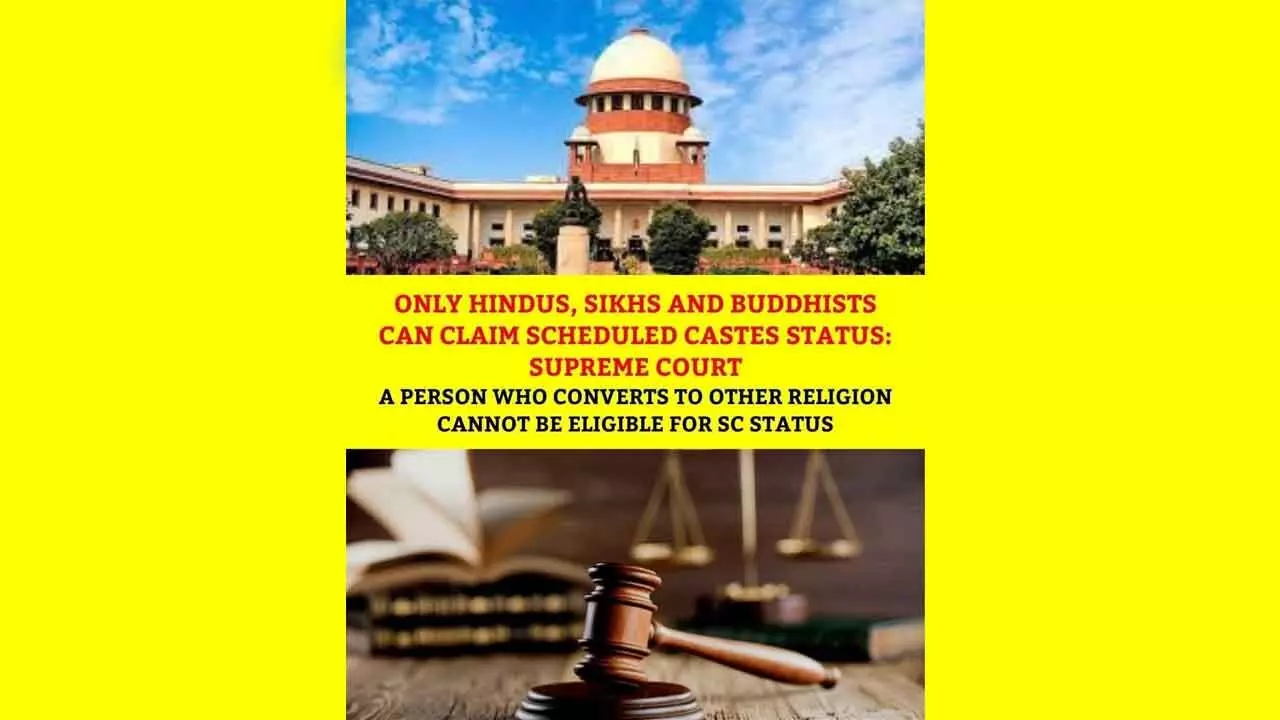
Various Acts concerning inter-caste and inter-religious statuses across states have created complete confusion, or perhaps the Executive merely pretends not to know.
The Constitution is our guiding code, and its principles must run through every Government Order (GO) and executive directive. The current issue originates from the Constitution (Scheduled Castes) Order, 1950, issued under Article 341 of the Constitution, commonly referred to as a Presidential Order. Clause 3 of this order explicitly states that a person who professes a religion other than the specified ones cannot be treated as a member of a Scheduled Caste (SC). Originally, this applied only to Hindus; later, it was expanded to include Sikhs in 1956 and Buddhists in 1990.
Historically, the rationale was that Scheduled Castes were identified primarily in relation to the practice of untouchability within Hindu society, and similar social realities were later recognized among Sikhs and Buddhists.
March 2026 ruling:
On March 24, while hearing an appeal filed by Chinthada Anand—who was born a Hindu-Madiga (SC) but converted to Christianity to become a pastor—the Supreme Court concluded that conversion to any other religion results in the “immediate and complete loss of SC status from the moment of conversion, regardless of birth.” The bench, comprising Justices Prashant Kumar Mishra and Manmohan, decided the case, with Justice Mishra authoring the judgment interpreting the 1950 Order.
The law:
The bench invoked Clause 3 of the Constitution (Scheduled Castes) Order, 1950, which mandates that “no person who professes a religion different from Hinduism shall be deemed to be a member of a Scheduled Caste.”
The facts:
Anand alleged that he had suffered repeated attacks and caste slurs. Seeking a remedy, he filed a case under the Scheduled Castes and Scheduled Tribes (Prevention of Atrocities) Act, 1989. In April 2025, the Andhra Pradesh High Court quashed the criminal proceedings, reasoning that he could no longer claim protection under the 1989 Act because he professed Christianity, a religion that does not legally recognize the caste system.
Is it a new law?
The Supreme Court in Soosai v. Union of India (1985) upheld the validity of Clause 3 of the 1950 Order, saying that Christians belonging to the Scheduled Caste origin cannot claim SC benefits after conversion, unless the law is changed by Parliament. This is the most important precedent.
Judicial trends:
Over time, courts have clarified related principles: (a) Conversion can end SC benefits, especially reservations or protections under the SC/ST Act. (b) Reconversion may restore status if the person proves original caste, genuinely returns to the original religion, and the caste community accepts him/her again.
What is new or different
in 2026:
The new judgment mainly does three things:
(1) Stronger interpretation of “profess.” The Court explained that “profess” means openly practicing and declaring a religion publicly.
(2) Explicit application to the SC/ST (Prevention of Atrocities) Act: Earlier cases often dealt with reservation benefits. This judgment clearly states: A convert cannot invoke protections under the SC/ST Atrocities Act if he is not legally recognised as SC. This is important because the case itself arose from a complaint under that Act.
(3) Clarification about reconversion: The Court laid down strict proof requirements: Proof of original caste; proof of genuine reconversion; acceptance by the caste community.
Difference between SC and ST in law (important part of the judgment):
The Supreme Court clarified a major distinction that says that religion restriction applies (Hindu, Sikh, Buddhist only), i.e., the Scheduled Castes. Regarding STs, religion is not the main test, and what matters is whether the person still belongs to the tribe culturally and socially. This distinction is significant in constitutional law.
Justification?
The judiciary usually relies on certain arguments: (A) The SC category was created to remedy untouchability linked to caste hierarchy, which historically arose in Hindu society and later in related communities. (B) Based on the constitutional structure (Article 341), only the President and the Parliament can change the SC list or conditions. The Courts cannot expand it.
Nature of affirmative action:
Reservations and protections are meant for a specific social disability, not just economic disadvantage. The courts say: If someone moves to a religion that officially rejects caste structure, the legal basis for SC classification changes.
Ongoing debate:
The recent judgment mainly reaffirms a long-standing legal position from the 1950 Order and the 1985 Soosai case but clarifies its application to the SC/ST Atrocities Act and reconversion rules.
Even though courts have upheld the rule, there is still a major national debate. Important arguments raised by critics are that caste discrimination continues even after conversion, Dalit Christians and Dalit Muslims still face social exclusion, and therefore, SC benefits should be religion neutral. This issue is currently pending in constitutional litigation and policy discussions, and Parliament may ultimately decide it.
Thus, it is not a new conclusion. It is a technical quasi-legal issue discussed by the judgment, with serious legal and working repercussions. Equality is the fundamental right. Backwardness is mixed with conversion. There is no synthesis of these factors.
Inter-caste, inter-religious convictions, interfering with specific Acts in different states, create complete confusion. The state wanted the confusion, conflict, controversy, and attack on equality and unity, and in consequence, fraternity, which is emphasized by our Constitution and Ambedkar.
A two-member bench cannot solve this question posed by the Supreme Court and the Andhra Pradesh High Court. My question is: whether the 1950 Order itself violates Articles 14, 15, and 25 of the Constitution today? The President and Parliament can change this situation and confusion.
(The writer is Advisor, School of Law, Mahindra University, Hyderabad)
NEET Paper Leak Fallout: Dharmendra Pradhan Steps Down as Education Minister, Says ‘I Never Shied Away From Responsibility’
AI Appreciation Day 2026: Trust and infrastructure emerge as the next frontier for AI, say experts
Few Takers for HILT Policy in Hyderabad Amid Low Response
Cockroach Janta Party Protest LIVE Updates: Demonstrators Assemble at Jantar Mantar
Fire breaks out at a building in Ameerpet of Hyderabad, fire brigade arrives
ED’s Vedanta raids raise questions about proportionality, perception


