






Of fathers, sons and supreme sacrifices

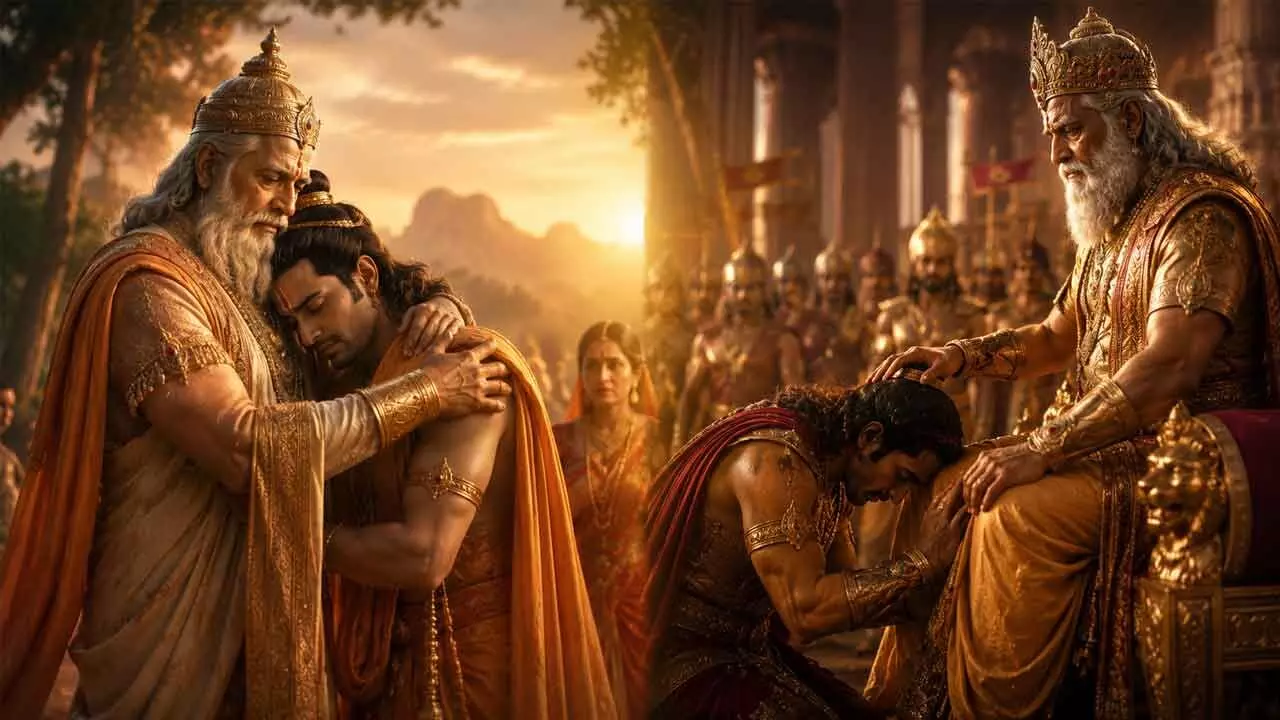
Explore the profound contrast between the filial sacrifices of Sri Rama and Bhishma. This analysis delves into how their respective vows shaped their legacies, the differences between moral clarity and austerity, and what these iconic figures reveal about the nature of duty in Indian epic traditions.
The two great Indian epics, Ramayana and the Mahabharata, present two extraordinary examples of filial sacrifice reflecting the profound relationship between fathers and sons.
Two towering figures immediately come to mind — Sri Rama and Bhishma.
At first glance, both appear similar. Both willingly sacrificed personal happiness for the sake of their fathers. Both renounce power and subordinate personal life to duty.
Yet their stories unfold very differently. Let us begin with Rama. King Dasaratha had three wives. The youngest, Kaikeyi, once saved him in a battle, and the grateful king promised her two boons whenever she desired. Years later, on the eve of Rama’s coronation, Kaikeyi — at Manthara’s prodding — claimed her reward. She demanded that Rama be banished to the forest and that her son Bharata be crowned king instead. The tragedy lies not merely in the demand itself, but in the irony of it. Kaikeyi was Dasaratha’s most beloved wife. Rama was his most beloved son.
The Ramayana portrays Dasaratha not as a majestic king calmly enforcing dharma, but as a broken old father trapped by his own promise. He pleads with Kaikeyi. Never in his life could he have imagined such humiliation and grief. Perhaps the most heartbreaking moment comes when Rama is summoned. Dasaratha cannot even raise his eyes to look at his son. Only the father’s grief tells Rama that something terrible has happened.
What follows is one of the noblest moments in world literature. Rama does not protest. He does not accuse Kaikeyi of any wrongdoing. Calmly he accepts exile. That serenity in sacrifice is what makes him Maryada Purushottama. Yet the true depth of Rama’s resolve becomes visible only later. Soon after he leaves for exile, Dasaratha dies grieving for his beloved son.
Bharata, enraged by his mother’s actions, rushes to the forest and implores Rama to return and assume the throne. At this point, Rama could easily have returned. Dasaratha was dead, Bharata had renounced the throne, and no injustice would have resulted had Rama accepted kingship. Yet Rama refuses. He insists that a father’s word, once accepted, must be fulfilled completely.
Now let us turn to Bhishma. To understand Bhishma, one must first understand the strange circumstances of his birth. King Shantanu falls deeply in love with the mysterious and beautiful Ganga. She agrees to marry him on one condition: he must never question or oppose any of her actions. Madly infatuated, the king agrees without foreseeing the terrible consequences.
A son is born to them. The delighted king dreams of an heir to his throne. But Ganga immediately takes the child and drowns him in the river. Shantanu is horrified. Yet, remembering his promise, he restrains himself. The horrifying cycle repeats itself seven times. Seven sons perish before the helpless eyes of their father.
One can scarcely imagine the torment of Shantanu — a father repeatedly losing children, an heirless monarch, and a man imprisoned by his own word. At last, when the eighth child is born, the king can endure no more. As Ganga once again walks toward the river carrying the infant, Shantanu finally intervenes. That single act saves the child. But it costs him his wife. Years later, Ganga returns the boy to his father. He is Devavrata. Shantanu sees in his son everything a king could desire — courage, wisdom, mastery of warfare, and profound nobility.
The old king believes happiness has returned permanently to his life. And then destiny intervenes once again.
Shantanu falls deeply in love with Satyavati. Her father agrees to the marriage only on one condition: Satyavati’s future son must inherit the throne. Shantanu genuinely wishes Devavrata to succeed him and declines the proposal. Yet he cannot overcome his longing for Satyavati and gradually withdraws into silent brooding. Devavrata notices his father’s sorrow and learns the reason. Immediately he renounces his own claim to the throne. But Satyavati’s father remains unsatisfied.
“What if your future sons later challenge my grandson’s right to rule?” At that moment Devavrata announces the terrible vow that shakes even the heavens. He vows lifelong celibacy. From that moment he becomes Bhishma — the man of the terrible vow. Perhaps the answer lies in the circumstances of his own birth.
Perhaps, Bhishma’s terrible vow arose not merely from duty, but from profound gratitude toward the father who saved his life. Yet Bhishma’s greatness lies not merely in making the vow, but in refusing ever to dilute it. After the death of Vichitravirya, the Kuru dynasty faces extinction. Satyavati herself urges Bhishma to ascend the throne and marry the widowed queens. Technically, Bhishma could easily have accepted. Yet he refuses absolutely. His vow had by then become inseparable from his identity. And yet the two men remain profoundly different.
Rama’s sacrifice preserves emotional warmth and moral clarity. Bhishma’s sacrifice gradually hardened into austerity. Over decades, Devavrata the man slowly disappears into Bhishma the institution — guardian of the throne, custodian of the dynasty, living monument to restraint. And perhaps, over time, something within him dries up.. A man who has conquered every personal impulse may eventually lose the ability for spontaneous moral rebellion. Thus, the two epics present two different visions of duty. Rama’s sacrifice heals moral order. Bhishma’s sacrifice gradually becomes tragic.
Though comparisons are often odious, one cannot help making them. Rama obeyed his father’s implicit command — itself the result of emotional manipulation. Bhishma, on the other hand, went to an unnecessary extreme of self-mortification.
And while Dasaratha dies grieving for his son, Shantanu shows no visible signs of remorse at the terrible vow undertaken by his son.
(The writer is a retired Principal Commissioner of Income Tax)
Bihar: EOU raids Hajipur Municipal Council Accountant’s premises, Rs 2 crore cash recovered
PM Modi delivering corruption-free governance: K’taka BJP
Delhi L-G orders repair of rainwater harvesting systems ahead of monsoon
World Bank lifts India growth outlook despite Gulf war
WHO releases updated heat-health action plans guidance
SC to hear Meenakshi Natarajan's plea against Rajya Sabha nomination rejection tomorrow


