






Preserving Valmiki’s symbolism at Bhadrachalam’s Sri Sita Ramachandra Swamy Devasthanam

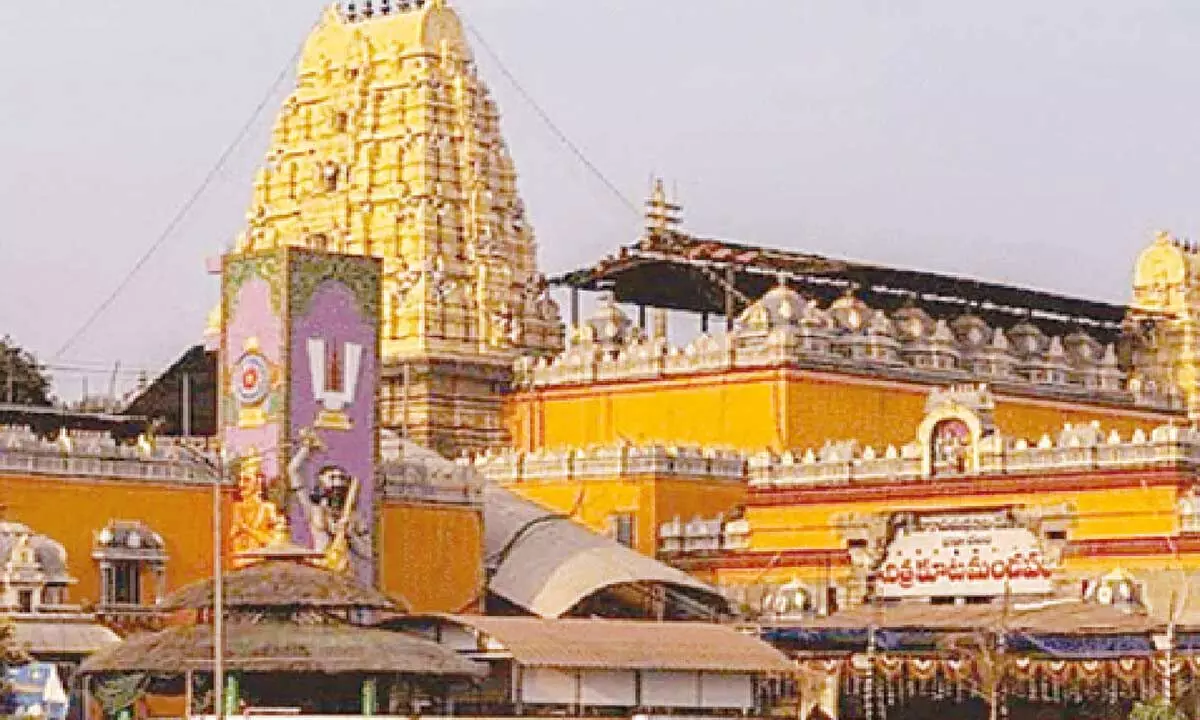
It may perhaps be inappropriate, for the highly learned and scholarly priests to cause confusion among the invitees (in recent times) through the marriage rituals performed on the Mithila Kalyana Mandapam under the auspices of the Bhadrachalam Sri Sita Ramachandra Swamy Devasthanam
FrequentlyI become inquisitive and question spiritual experts and mythical exponents to elicit clarification on marriages of the ‘Trimurti’, whether they were performed in accordance with the Vedic marriage procedure and them begetting children as progenitor.
Vedic marriage ritual (Vivaha Samskara) as described in Asvalayana, Paraskara, Baudhayana Grihya Sutras, and Rig Veda Vivaha Sukta, which includes, Vara-Aagamana (groom’s arrival), Kanya Dana, Panigrahana (holding of hands), Saptapadi (seven steps), Homa (sacred fire) and Mangala Sutra mantras are seldom observed for them.
My inquisitiveness is not without reason or rationale. At Bhadrachalam Sri Sitarama Swamy Temple, a typical situation prevails. The annual majestic ritual of Sri Sita Rama Kalyanam, or the divine marriage of Rama and Sita (Human Incarnations), to the proxy icons (Utsav Vigrahas), has been transformed as Ramanarayana, Laxmi Kalyanam. Initially referring to the bride and groom as Sita and Rama, few minutes before the muhurta, they are transformed as Laxmi and Ramanarayana. Their ancestral lineage (Pravara and Gotra) is also changed to Brahmins from Kshatriyas.
The original Puranic account of Laksmi choosing Vishnu (not to speak of Ramanarayana) does not describe such a ritual ceremony, yet temple tradition follows this. Kalayanotsavam is not a historical repetition of an original Vedic wedding of the deity. It is a ritual embodiment of puranic myth within temple culture. No attempt has ever been made to explain in a language understandable to scholars and to common individuals. Of course, there are a few interesting aspects from Valmiki’s Sanskrit Ramayana or Andhra Valmiki Vasudasu’s Ramayana Mandaram.
The Valmiki Sanskrit Ramayana, the Adi Kavya, and ‘Dhvani Kavya’ (suggestive poetry) consisting of 24000 Shlokas is a collection of Seed Syllables (Beeja Aksharas) composed by the Vedantin, a philosopher and social reformer, and Maharishi Valmiki.
According to Valmiki Ramayana, Sri Rama’s birth took place in the Vaivasvata Manvantara, Tretha Yuga, in the Lunar Vilambi Year, on the Navami Tithi of the Shukla Paksha in the month of Chaitra, under the Punarvasu Nakshatra on a Wednesday. Sri Rama’s Upanayana took place in Parabhava, when he was nine years old.
Vishwamitra took Sri Rama and Lakshmana to the city of Mithila, introduced to Janaka and asked him to show the Shiva Dhanush to Rama. Before showing, Janaka narrated the story of Sita’s birth. He stated that Sita was Virya Shulka (valour) and that he would give the Ayonija (not born from a womb) Sita in marriage only to the one who could string the Shiva Dhanush, which no one was able to accomplish until then. Rama opened its lid, effortlessly held the bow with his palm, lifted it out, and as he pulled the bowstring tight, it broke with a thunderous sound.
Janaka said that he would give Sita in marriage to him. Subsequently, King Dasharatha arrived in Mithila. While giving or taking a bride in marriage, one must know the family tree, background, and Pravara (lineage) of the bride and groom. Vashistha, explainedSurya dynasty's lineage, starting from the birth of Marichi to the four-faced Brahma, right up to Dasaratha. Janaka explained his lineage from Nimi down to his father Hrashvaroma. When Sri Rama was twelve years and Sita was six years old, their Kalyanam took place in the Saumya Lunar Year, on Phalguna Shuddha Shukla Trayodashi, under the Uttara Phalguni Constellation. It was not, however, on Chaitra Shukla Paksha Navami. Rama’s Pattabhishekam (coronation) took place in the year Dhata, on Chaitra Shuddha Saptami, Thursday, under the Pushyami constellation.
During the marriages of Ramanarayana (not Rama) and Lakshmi Devi (not Sita) in Bhadrachalam, held in the recent past, the Edurukolu, Kalyanam, and Pattabhishekam festivities were being conducted differently. It may perhaps be inappropriate, for the highly learned and scholarly priests to cause confusion among the invitees (in recent times) through the marriage rituals performed on the Mithila Kalyana Mandapam under the auspices of the Bhadrachalam Sri Sita Ramachandra Swamy Devasthanam.
By chanting ‘Achyuta Gotrodbhavaya’ they brought Ramanarayana Swamy in place of Sri Ramachandra. By birth a Kshatriya, Sri Rama, was instantly changed into a Brahmin with the ‘Achyuta Gotram.’ In place of Sita Devi, they brought Sita Mahalakshmi and changed the Pravara by assigning the Saubhagya Gotram, where Sri Rama’s Vasistha Gotra and Sita Devi’s Gautami Gotra vanished!
The scriptural origin (Birth) of Lord Maha Vishnu, as recorded in most Vaishnava Traditions is ‘Beginningless and Eternal.’ Bhagavata Purana describes Mahavishnu lying on the causal ocean. Thus, Vishnu is not born, but became the source of creation. Vishnu is not considered one who was born in the ordinary sense. In that case, how can he be one born of the Achyuta Gotra?
Divine marriages including Vishnu and Lakshmi were broadly ‘Theological Union’ and not a narrated vedic ritual marriage. The union is portrayed as a cosmic divine reunion. Similarly, Goddess Lakshmi emerged during the churning of the ocean (Samudra Manthana). After being adorned by the devas, Lakshmi chose Lord Vishnu as her eternal consort.
In that case, how did she become one born of the Saubhagya Gotra? There is also no mention anywhere regarding details such as the Varna, Pravara, or Gotra of those two.
That being so, what is the authority behind the ‘Achyuta’ and ‘Saubhagya’ Gotras? It is all incomprehensible. What is noteworthy is that during the Edurukolu, it felt as if the ‘two prominent Acharyas of Vasistha’s stature’ representing the sides of Sita Devi and Sri Rama engaged in a verbal duel of words. Pattabhishekam completely deviates from Valmiki Ramayana.
Chinese philosopher Lin Yutang in his monumental work, The Wisdom of China and India, wrote that the ancient Greek mathematician Euclid proclaimed, ‘There is no royal road to learning.’ This means that to understand knowledge or a specific subject, hard work is inevitable, and no kind of education is possible without effort. Perhaps this philosophy applies to the grand festivities conducted in Bhadrachalam.
Even the greatest of scholars, who studied the Vedas and Vedangas, absolutely have no choice but to engage in further, continuous study!!!
At least in this Parabhava Lunar year, the Sri Rama Navami festival to be held on Friday, March 27, in the most sacred shrine of Bhadrachalam, the southern Ayodhya, should be conducted as 'Sri Sitarama Kalyanam’ and certainly not as the ‘Ramanarayana and Mahalakshmi’ Kalyanam. And it shall be in accordance with the Bhakta Ramadas tradition, Valmiki Ramayana composition, and the faithful Telugu translation by Andhra Valmiki.
Humility should be preserved over adornments and ego, as well as inner sanctity and purity over outward display. Even if God forgives self-concocted liberties, mere mortals cannot digest them.
Sunetra Pawar warns leaders against ‘unnecessary interference’, hints at tough decisions
NCW summons comedians More, Jangra over Rs 370 biryani row
CM Fadnavis outlines ‘Viksit Maharashtra 2047', sets target for $5 trillion economy
Pakistan trying to reshape authority through 28th Constitutional Amendment: Report
Mir, Shah knocks help Afghanistan A get four-run win over India A via DLS method
Pro-Khalistan groups continue to provoke youth, advance own political agendas: Report


