






- 'Is democracy in India being undermined like China, Russia and North Korea': Gehlot on FIR against Rahul, Priyanka Gandhi
- Delhi Seemapuri Building Collapse: Several Feared Trapped As Rescue Operation Underway
- Claude Users Can Work Across Google Docs, Sheets and Slides In-App
- Rapido Ride Turns Into Nightmare After Captain Flees With Injured Passenger
- 7 Must-Watch OTT Releases For Your Dussehra Holidays
- ‘His Lips Turned Blue’: Dentist Recalls 45-Minute Effort To Save Flydubai Pilot Smit Machchhar
- Airtel Postpaid Plans Bring Free International Roaming From Rs 499
- 'Politics means nation building to him': Rajnath Singh on PM Modi's 25 years in public service
The mental health of our society
In Short
I call them the social diseases of our times. They are not psychiatric diagnoses. They are patterns of behaviour, attitudes and emotional dysfunction that are becoming so widespread that they are beginning to influence the way we relate to one another

Share :
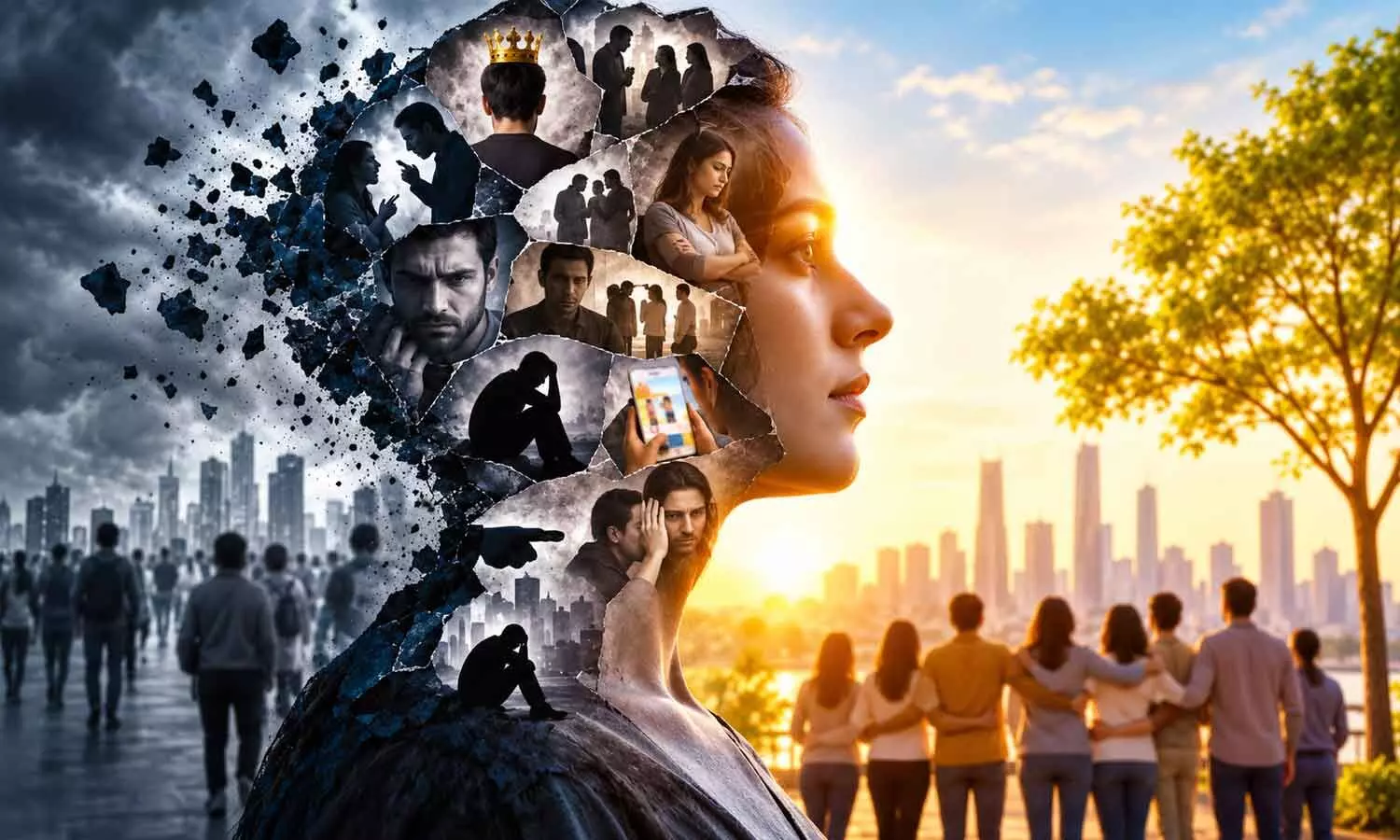
The mental health of our society
There is a mental health crisis around us that we rarely acknowledge. When we speak of mental health, we usually think of depression, anxiety, addiction, loneliness or other clinically recognised conditions. These are undoubtedly serious concerns and deserve professional attention. But there is another, less visible crisis unfolding in our homes, workplaces, friendships and communities, a deterioration in the emotional health of society itself.
I call them the social diseases of our times. They are not psychiatric diagnoses. They are patterns of behaviour, attitudes and emotional dysfunction that are becoming so widespread that they are beginning to influence the way we relate to one another. They manifest themselves in broken relationships, toxic workplaces, bitter family disputes, fractured friendships, workplace politics and an extraordinary inability to disagree without becoming disagreeable.
The paradox is striking. We have never been more connected, yet we seem increasingly incapable of connecting with one another. As someone who has spent years observing organisations, leadership and human behaviour through the lens of Emotional Intelligence, I believe that six particular social diseases deserve our urgent attention.
1. The disease of insufficient consideration
Perhaps the most fundamental social disease today is our declining ability to consider the feelings, circumstances and dignity of another person. We are becoming increasingly self-referential. What I want, what I feel, what I deserve and what I think mostly takes precedence over what another person may be experiencing.
Consideration is not weakness. It is not submission. It is the simple ability to pause before acting and ask: “How will this affect the other person?” In families, this disease appears when spouses stop considering each other’s emotional needs. In workplaces, it appears when leaders treat employees as resources rather than people. In society, it appears when inconvenience to oneself becomes more important than the legitimate needs of others.
The tragedy is that consideration costs very little. A little patience, courtesy, listening and sensitivity can prevent enormous emotional damage. Yet our increasingly hurried, competitive and individualistic lifestyles seem to be eroding precisely these qualities.
2. Chronic jealousy and the comparison syndrome
Jealousy has always existed. What has changed is its scale, visibility and frequency. Social media has transformed life into a continuous comparison exercise. Someone else’s holiday, house, career, children, wealth, marriage, social circle or success becomes a benchmark against which we quietly measure our own lives.
The result is a generation that is increasingly uncomfortable with another person’s success. Healthy competition can inspire us. Chronic jealousy destroys us. It makes us question the motives of successful people, diminish their achievements and sometimes even derive satisfaction from their failures. In organisations, jealousy produces unhealthy politics, withholding of information, sabotage, non-cooperation and resistance to talented colleagues. In families, it can create lifelong resentments between siblings and relatives.
The emotionally intelligent person understands a profound truth: “Another person’s success does not diminish one’s own worth”. We need to move from comparison to self-evaluation, from resentment to genuine appreciation.
3. The trust deficit
Trust is the invisible infrastructure of every healthy relationship. When trust disappears, communication becomes guarded, intentions are questioned, even innocent actions are interpreted suspiciously and relationships become exhausting.
We increasingly live in an environment of suspicion. We doubt what people say. We question motives. We assume hidden agendas. We demand proof where faith and goodwill once existed. The consequences are particularly damaging in families. When trust between spouses deteriorates, every disagreement becomes evidence of betrayal. Financial decisions become sources of suspicion. Friendships become transactional. Even professional relationships suffer when colleagues spend more energy protecting themselves than collaborating.
A trust deficit also has an enormous organisational cost. Organisations with low trust require more controls, more approvals, more monitoring and more bureaucracy. Decisions slow down and Innovation suffers. Employees become defensive rather than entrepreneurial. Trust, however, cannot be demanded. It has to be earned through consistency, transparency and integrity.
4. Weaponised communication - the disease of the sharp tongue
Words have always had the power to heal or hurt. Today, however, we seem to be losing our restraint. We speak impulsively, respond instantly and often use words not to communicate but to hurt and caused wounds. The sharp tongue has become a weapon. Sarcasm is mistaken for intelligence and Insults are disguised as honesty. Public humiliation is defined as “telling it like it is”.
Arguments quickly become abusive and personal. And once hurtful words are spoken, apologies often arrive too late to repair the damage. Imagine this is happening across all relationships, spouses, colleagues and even between young children and their parents.
Emotional Intelligence demands something very different: the ability to regulate the emotion before expression. Not every thought needs to be spoken. Not every provocation requires a response.
5. Emotional volatility
Another disturbing feature of our times is our declining capacity to regulate emotions. Small disagreements become major confrontations. Frustration quickly becomes anger and a difference of opinion becomes a personal attack.
We increasingly react before we reflect. Emotional volatility is particularly destructive because emotions are contagious. One person’s uncontrolled anger can destabilise an entire family, team or organisation. A volatile leader creates fear. A volatile parent creates insecurity. A volatile spouse creates an environment in which everyone learns to walk on eggshells.
Emotional regulation does not mean suppressing emotions. It means managing them intelligently.
One of the defining characteristics of emotionally intelligent people is their ability to create a small but enormously important space between what they feel and how they respond. That space is where maturity resides.
6. The disease of entitlement
Perhaps the most corrosive disease of all is entitlement, the belief that we are owed attention, respect, success, money, loyalty, recognition or preferential treatment simply because we expect it. Entitlement quietly destroys gratitude.
It makes people focus on what they have not received rather than what they have. It turns relationships into transactions: What have you done for me? What have you given me? What do I get in return?
In marriages, entitlement can turn partnership into scorekeeping. In families, it can create permanent grievances between generations. In organisations, it produces employees who demand rewards without accepting corresponding responsibility and leaders who expect loyalty without demonstrating fairness.
A healthy society must rediscover the difference between rights and privileges, expectations and gratitude, entitlement and responsibility. The question cannot always be, “What do I deserve?”, Sometimes it must be, “What do I owe?”
The social cost
These six diseases may appear individually insignificant. Collectively, they are enormously expensive. The cost is visible in rising family conflict, broken marriages, estranged children and parents, workplace toxicity, employee disengagement, declining trust, social polarisation and increasing loneliness.
There is also massive, quantifiable economic cost. Organisations pay for poor emotional intelligence through attrition, conflict, absenteeism, lost productivity, leadership failures and internal politics. Families pay through legal battles, counselling expenses, financial disputes and years of emotional estrangement. Society pays through declining social cohesion and an increasing burden on institutions that are forced to manage problems that could often have been prevented through better human behaviour.
And slowly, something fundamental changes: we begin to normalise dysfunction. That is perhaps the most dangerous consequence of all.
Can We Cure These Social Diseases?
The answer is yes, but there is no medication, app or government programme that can cure them. 5
The cure begins with self-awareness. We must become conscious of our own behaviour before judging the behaviour of others. We must learn to ask ourselves uncomfortable questions:
Am I sufficiently considerate? Do I become jealous of another person’s success? Do people trust me? Do my words heal or hurt? Can I control my emotions when provoked? Am I grateful or perpetually entitled? - These questions belong in our homes, schools and workplaces.
We need to teach Emotional Intelligence as seriously as we teach academic intelligence. Children should learn empathy, listening, conflict resolution, emotional regulation, gratitude and respectful disagreement as fundamental life skills.
Families must create cultures where difficult conversations can take place without humiliation. Couples must learn that winning an argument is often less important than preserving the relationship and parents must model the emotional behaviour they expect from their children.
Organisations, too, must recognise that Emotional Intelligence is not a soft corporate accessory. It is a strategic capability. Leaders who cannot regulate themselves, influenced by rumours, handle disagreement and build trust eventually become liabilities to the organisations they lead.
And perhaps most importantly, we need to rediscover the virtues that modern life is slowly pushing to the margins: kindness, patience, humility, gratitude, restraint, empathy and respect. None of these qualities is old-fashioned.
(Author is a senior BJP leader, Chairman of Nation Building Foundation & a Harvard Business School certified Org.Strategist)
India condemns attacks on commercial vessels in Black Sea, reiterates call for dialogue and diplomacy
'Is democracy in India being undermined like China, Russia and North Korea': Gehlot on FIR against Rahul, Priyanka Gandhi
SSB pays tribute to bravehearts killed in Maoist attack 15 years ago
SSB pays tribute to bravehearts killed in Maoist attack 15 years ago
Pixel Moments to Politics For Cong As BJP Celebrates Modi@25
Dramatic face-off near Jantar Mantar. Rahul and Priyanka sit on the road
MPs vs Police. Chaos and High Drama Unfold on Delhi Roads
Henri Kagan, Kenso Soai Win 2026 Nobel Chemistry Prize for Autocatalysis
AP cabinet approves 12 agenda items
High Courts should not suggest custodial interrogation of accused, says Supreme Court


