






War, peace and the future of (United) Nations

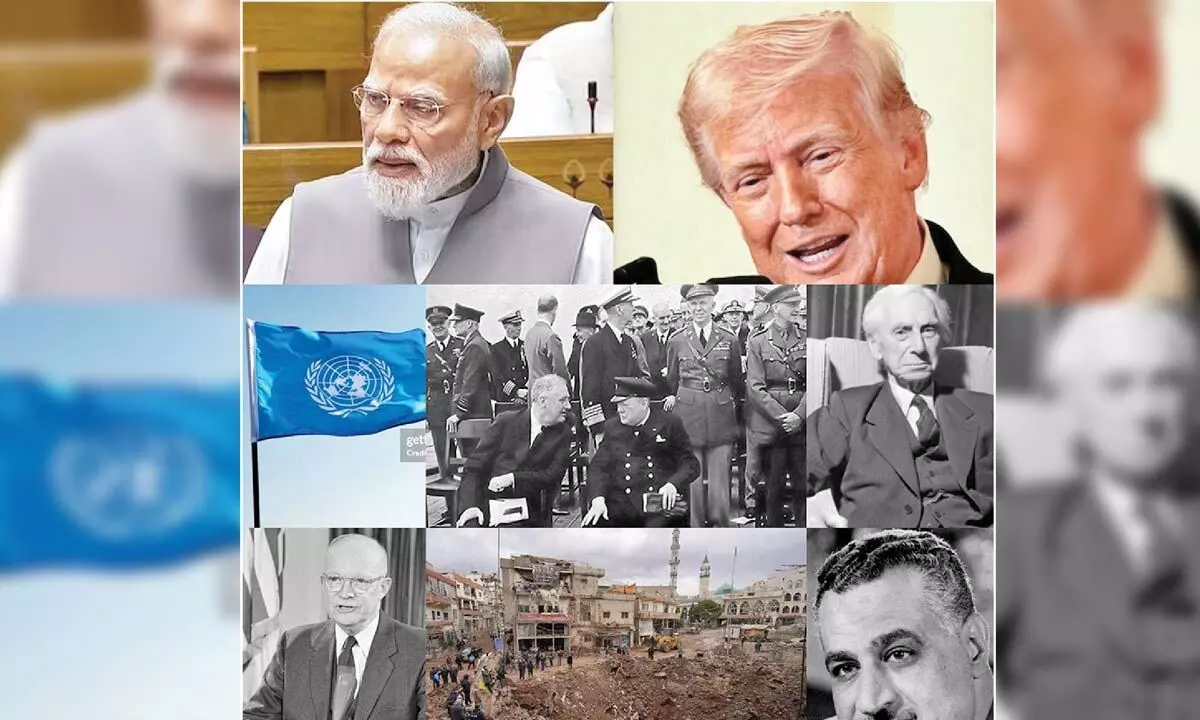
The 193-member UN’s record in preventing wars and sustaining peace remains deeply contested with limited successes. It is more a forum for debate than decisive action. A significant gap persists between the UN's founding ideals and present realities. The structure of the Security Council, particularly the veto power enjoyed by the five permanent members, frequently renders the organisation ineffective in moments of crisis. It often becomes a passive platform for deliberation rather than decisive intervention
Despitevarying geographical conflicts, patterns of rivalry, strategic interest, and human suffering remain similar. Reflections drawn from earlier global crises represent decades of inquisitiveness concerning war, peace, and international responsibility. Consequences of tensions between nations, often with little regard for civilian safety, transcend borders. An old Turkish saying that, ‘The horse kicked the mule, the mule kicked the horse, and it is the poor donkey that gets the shot’ is apt in modern geopolitical conflicts. The vulnerable, especially in the developing world, caught between the stronger powers, face untold misery.
The United Nations Organization (UNO) was born out of the ashes of World War II, when humanity resolved that another catastrophe must never occur. Sequence of historic developments, culminating in the San Francisco Conference on June 26, 1945, adopted the UN Charter. The UNO formally came into existence on October 24, 1945. It was to be a permanent global forum where disputes could be resolved through dialogue and diplomacy rather than war, embodying the collective conscience of humanity.
Tehran that figured in early diplomatic efforts during its formation now faces disruption and uncertainty amid ongoing hostilities, with civilians struggling to survive. The situation once again illustrates how regions, central to diplomacy in one era, can become theatres of conflict in another.
Meanwhile, the statesmanlike approach of Prime Minister Narendra Modi deserves applause. Briefing the Lok Sabha on March 23, he described the West Asia war as ‘deeply concerning,’ cautioning that its consequences are likely to be felt for longtime.
In a world increasingly marked by fragmented responses and reactive policies, such clarity, restraint, and emphasis on national unity stand out as a model of responsible leadership. Equally noteworthy were the Centre’s measures on the nation’s energy needs, demonstrating foresight and preparedness amid global uncertainty.
Interestingly, the same day, a contrasting development unfolded in the United States. President Donald Trump, known for his uncharacteristic ‘point of no return’ decision-making style, who had earlier issued a 48-hour ultimatum to Iran to reopen the Strait of Hormuz or face strikes on its power infrastructure, in an unexpected U-turn, postponed the decision by five days, citing what he described as ‘very good and productive talks with Iran.’
Equally motivating was Modi’s X post the following morning. To ensure that the strait of Hormuz remains open, secure, and accessible, he and Trump agreed to stay in touch. A day later, Tehran dismissed the US proposal to end the war and set out its own terms for peace. While thanking India for its ‘significant help’ in the context of its sunken vessel, allowed its ships through Hormoz Straits, along with three other countries.
The 193-member UN’s record in preventing wars and sustaining peace remains deeply contested with limited successes. It is more a forum for debate than decisive action. A significant gap persists between the UN's founding ideals and present realities.
The structure of the Security Council, particularly the veto power enjoyed by the five permanent members, frequently renders the organisation ineffective in moments of crisis. It often becomes a passive platform for deliberation rather than decisive intervention.
History offers numerous examples of how regional leadership and global power politics intersect. In the Middle East, figures such as Gamal Abdel Nasser, Anwar Sadat, and Muammar Gaddafi shaped their nations’ trajectories while navigating complex global dynamics. Similarly, leadership in the United States has long influenced international relations through diplomacy, alliances, sanctions, and, at times, military action. These leaders emerged during periods of transformation. Their decisions reflected both national priorities and the pressures of an evolving global order. The interplay between power, ideology, and strategic interest continues to shape international outcomes.
A deeper philosophical question persists: why does humanity repeatedly return to war despite centuries of painful lessons? Part of the answer lies in the power structure, considering that nations pursue security, influence, and prestige. In this context, ethical reflection becomes essential. Bertrand Russell devoted much of his intellectual life to the cause of peace, warning that technological progress, particularly nuclear weapons, fundamentally altered the nature of war.
At this juncture, it is both relevant and enriching to recall that long before modern political theory evolved, the Adi Kavya Valmiki Ramayana articulated profound insights into the conduct of power and responsibility. The epic never glorified war as an end in itself, but as a last resort, guided by dharma. Strategy, in this classical narrative, was in service of balance, not domination. In a contemporary context, this translates into a deeper sense of civic and global responsibility during times of conflict, where decisions taken by a few reverberate across millions.
Movements for peace often arise from courageous intellectuals, scientists, writers, and civil society leaders. The voices of Nobel Peace laureates serve as reminders that the ultimate purpose of power and diplomacy must be the preservation of human dignity. When they advocate restraint and dialogue, they help restore perspective in moments of crisis. If the international community truly seeks lasting peace, institutions designed to safeguard it must evolve.
When peace is seen as strength rather than weakness, leaders are more likely to pursue diplomatic solutions. In an interconnected world, conflicts produce ripple effects far beyond their immediate regions. Human history demonstrates both the tragedy of war and the possibility of peace. Institutions created after World War II were built on the hope that humanity had learned from its past. Whether that hope endures, depends on the choices made today by nations and their leaders. A renewed commitment to dialogue, restraint, and mutual respect remains essential.
In reflecting on the future, the enduring relevance of Valmiki Ramayana offers a subtle yet powerful reminder that the true strength of any civilisation lies not merely in its capacity for power, but in its ability to exercise restraint with wisdom, the Modi way. As the world grows more complex, these lessons encourage the cultivation of inner weaponry, wisdom, compassion, restraint, and resolve.
Such qualities are indispensable in shaping a balanced and humane global order. Ramayana thus ceases to remain a story of the past, and instead emerges as a living guide for the present and the future.
Despite its limitations, the United Nations continues to represent one of humanity’s most ambitious efforts to maintain global peace. Its humanitarian work, peacekeeping missions, and diplomatic platforms continue to serve millions. The real challenge lies not in its existence, but in the willingness of member states to strengthen and reform it for the collective good.
In the evolving international landscape, the role and outlook of leadership in major powers naturally attract global attention. The policy approach of Trump, once again entrusted with high office, is observed with interest. Understanding the broader framework guiding such leadership, its goals, methods, and long-term vision, are essential to strengthen global stability and the collective pursuit of peace.
Sunetra Pawar warns leaders against ‘unnecessary interference’, hints at tough decisions
NCW summons comedians More, Jangra over Rs 370 biryani row
CM Fadnavis outlines ‘Viksit Maharashtra 2047', sets target for $5 trillion economy
Pakistan trying to reshape authority through 28th Constitutional Amendment: Report
Mir, Shah knocks help Afghanistan A get four-run win over India A via DLS method
Pro-Khalistan groups continue to provoke youth, advance own political agendas: Report


