






With advanced features, C-ART focuses on transforming weather intelligence
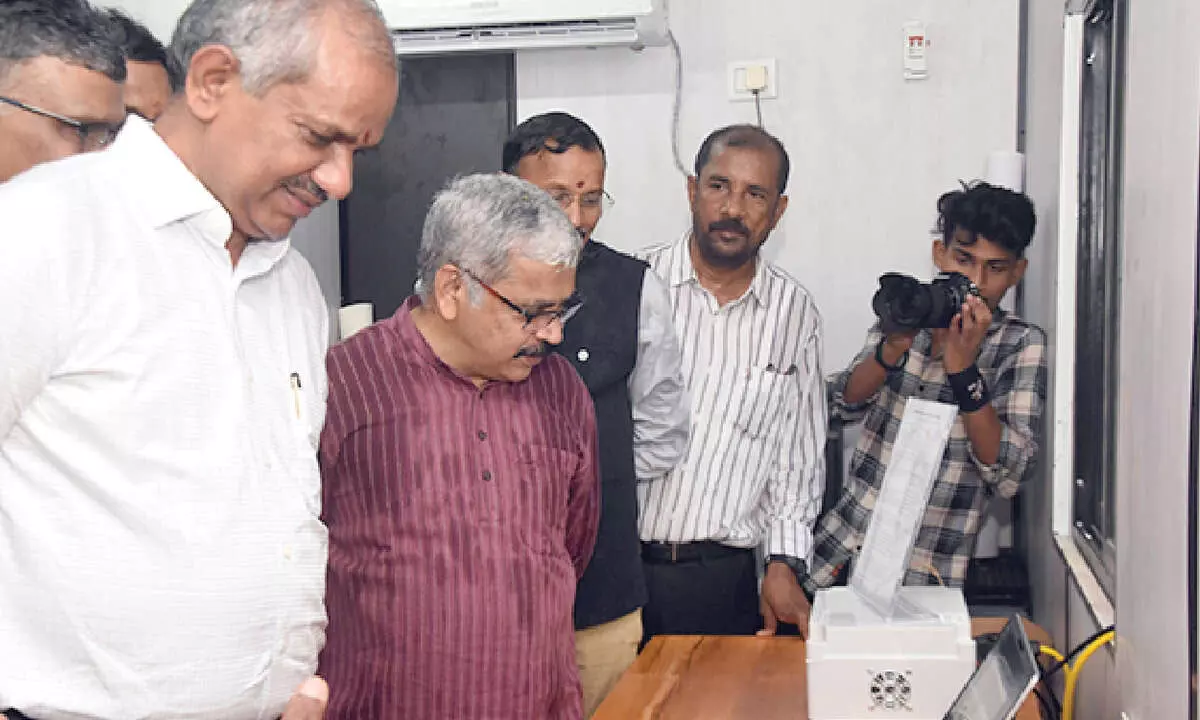
MoES Secretary M Ravichandran, AU Vice-Chancellor GP Raja Sekhar and IITM-Pune Director A Suryachandra Rao at the Coastal Atmospheric Research Testbed facility in Andhra University campus in Visakhapatnam on Friday
Visakhapatnam: By integrating observations,improving coastal weather forecasts and strengthening resilience, the Coastal Atmospheric Research Testbed (C-ART) facility at Andhra University (AU) aims to transform coastal weather intelligence and disaster risk mitigation.
Envisioned as a collaborative endeavour, the facility, set up by Indian Institute of Tropical Meteorology (IITM)-Pune under the aegis of the Centre’s Mission Mausam at AU campus, focuses on integrating observations and modelling to enhance forecasts of coastal weather systems and sustainable development.
On Friday, an open-field observatory of the C-ART was launched on campus.
After the first phase of the Coastal Atmospheric Research Testbed facilitated at the department of meteorology to the tune of Rs 60 crore, the second phase of the unit will be developed at an estimated cost of Rs 120 crore. The Rs 180 crore facility will serve as an effective coastal research platform with enhanced monitoring, research and early warning of extreme weather conditions along the east coast.
Laying emphasis on the facility developed as a step towards national-commitment to make the country weather-ready, Secretary of Ministry of Earth Sciences (MoES) M Ravichandran mentioned that weather patterns have been evolving and so are their dimensions. “Tropical weather conditions are quite hard to predict. With advanced facility such as C-ART, the forecasts are made more accurately. Apart from optimum utilisation of resources, the concentration should be on collaboration among students, scientists and faculty members to derive effective observations and climate data,” he recommended after inaugurating the open field observatory of the C-ART. He also encouraged AU students to adopt the facility’s instruments so that they can gain a better grasp of the subject, understand its importance, and broaden their horizons.
After Bhopal, the C-ART facility has been set up in Visakhapatnam, informed A Suryachandra Rao, Director of IITM-Pune. “With the facility, we can predict cyclones and other calamities in advance, at least a week before, and prepare for improved disaster mitigation plans. The forecasts help in minimising the risks associated with the calamities,”
Elaborating about the unit, Andhra University Vice-Chancellor GP Raja Sekhar mentioned that the testbed focuses on deriving accurate weather forecasts, climate data based on several parameters and observations.
Staffed by faculty members and scientists from IITM-Pune and AU, the facility is equipped with advanced features such as LTOF aerosol mass spectrometer, cloud condensation nuclei counter, Eddy covariance system, radio Sonde balloon facility, among others. Next, the testbed will include a proton transfer reaction mass spectrometer, wind lidar, Doppler weather radar and wind profiler.
The pact for the facility was signed between the IITM and AU during the centenary valedictory ceremony.
Sunetra Pawar warns leaders against ‘unnecessary interference’, hints at tough decisions
NCW summons comedians More, Jangra over Rs 370 biryani row
CM Fadnavis outlines ‘Viksit Maharashtra 2047', sets target for $5 trillion economy
Pakistan trying to reshape authority through 28th Constitutional Amendment: Report
Mir, Shah knocks help Afghanistan A get four-run win over India A via DLS method
Pro-Khalistan groups continue to provoke youth, advance own political agendas: Report


