







- President Droupadi Murmu arrives in Mizoram on three-day visit
- Abhishek issues whip to Trinamool MPs as CM Adhikari seeks NCPI support for Delimitation Bill
- Rift in MVA: Maha Congress reminds Sharad Pawar of RS backing amid delimitation row
- Mayawati welcomes 33 pc women’s quota, seeks separate reservation for SC/ST women
- Nifty, Sensex snap 4-week rally amid profit booking, higher crude prices
- Delimitation Bill approval clears path for women's reservation in 2029 polls, says UP CM
- Gold and silver rates today 28 Nov, 2026 slashes in Bengaluru and Chennai, check gold prices of 18K, 22K, 24K
- Gold and silver rates slashes today, 28 Nov, 2026 in Delhi, Mumbai, check gold prices of 18K, 22K, 24K
INDIA Bloc's Blind Opposition: Long on Rhetoric, Short on Reason
In Short
The special session on Monday will witness an interesting scenario, provided the fractured group of the INDIA bloc participates in the discussion on the delimitation bill.

Share :
INDIA Bloc's Blind Opposition: Long on Rhetoric, Short on Reason
The special session on Monday will witness an interesting scenario, provided the fractured group of the INDIA bloc participates in the discussion on the delimitation bill.
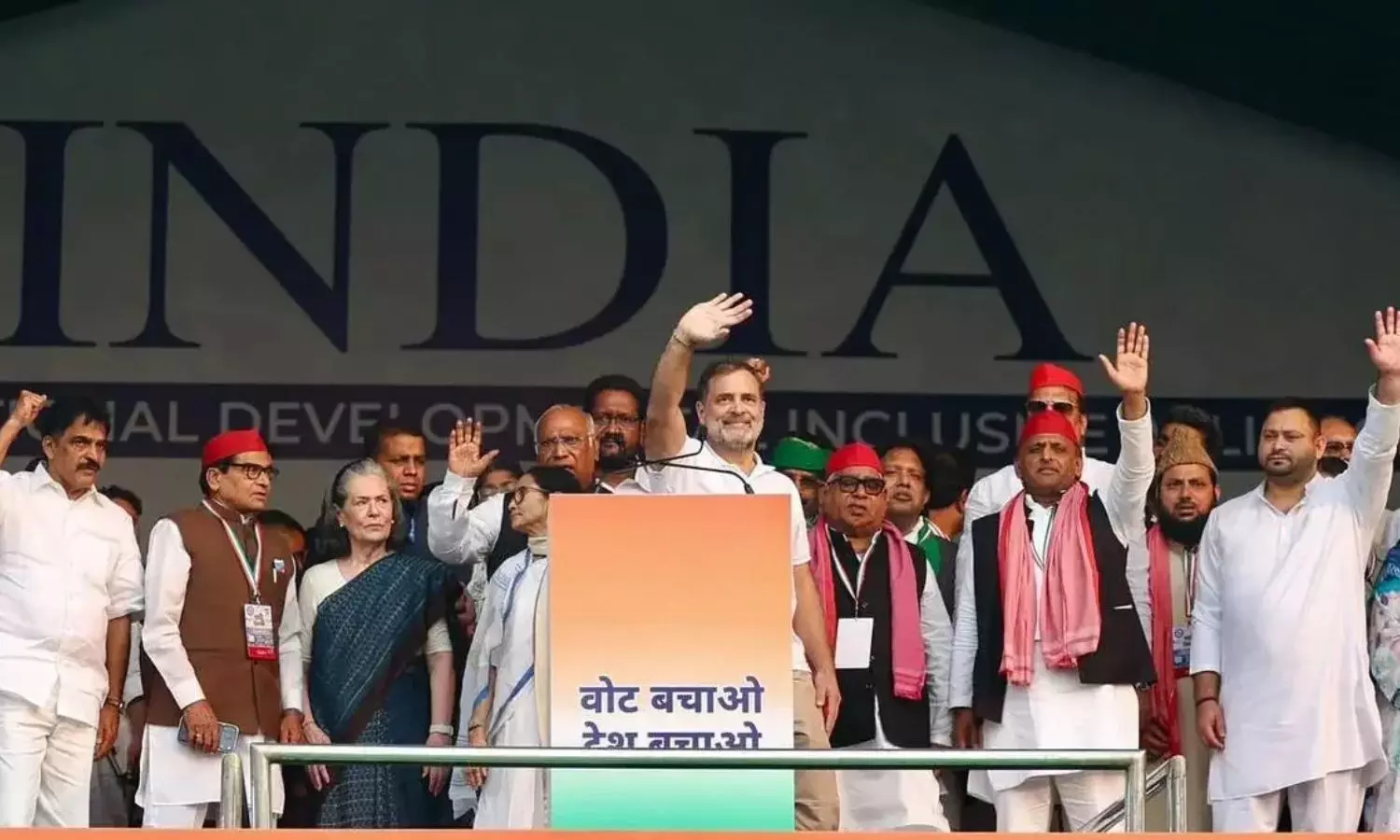
Though the few members of the bloc consisting of Congress president Mallikarjun Kharge, former party chief Rahul Gandhi, TMC's Abhishek Banerjee, Kapil Sibal (Congress) , RJD's Abhay Kumar Singh and Manoj Jha, CPI's P Sandosh Kumar, IUML's ET Mohammed Basheer, RSP's NK Premchandran who attended the meeting decided to oppose the bill. But there are apprehensions that they might try to disrupt the house by raising Vote Chori issue and try to stall the proceedings.
Kharge alleged that "They are indulging in this 'Natak'. We have decided to together oppose this bill, as it is not in favour of SC/ST and they intend to finish democracy in the country," he said, claiming that the government is working strongly towards usurping power forever. They are also breaking parties like TMC, Shiv Sena, and others in this direction, he claimed.
Kharge said that the delimitation bill is aimed at not giving the SCs/STs their increased share in Lok Sabha seats as per their latest population. It will hurt the interests of SCs/STs and termed the move a bid by the BJP-RSS to permanently capture power and end democracy in the country, the INDIA bloc members felt.
Neither Kharge nor any of the bloc members had any clear explanation about the reason for their opposition to the bill. They spoke about Prime Minister Narendra Modi and BJP’s poll slogan “Ab ki Baar 400-paar” during the last general elections. BJP wants to achieve that number by buying MPs, they alleged. The BJP wants to increase the number of LS seats to 800 so that they can be permanently in power and alter the Constitution, Kharge said.
How can one be in power permanently? Well, none of them had any reply. They also could not explain how the bill was against the Constitution. Do they think that the parties which decided to support the bill have no idea about the bill and its impact? They do not have any reply. Their only argument is that, through this bill, they want to "finish democracy" in the country.
"Once the power goes into their hands, they will do anything to use this bill as a weapon to remain in power permanently. We will oppose this bill," Kharge told reporters.
The Congress chief claimed that India will become like China, where they raise hands in thousands to get a majority.
"They want to end democracy and give the government in the hands of the BJP/RSS forever. Manusmriti will be implemented, this is certain," he added.
He had no explanation about why the opposition, which opposed in April, has now changed its stand. They went on repeating that "The Modi government's Constitutional amendment bill is a big threat to democracy, as it threatens to end democracy and take control of power permanently," but had no clear explanation. They also did not explain how this proposed amendment would finish the democracy?
The Lok Sabha is likely to reverberate with the slogans like vote chori aur ab seat chori
No leader of the NCP-SP, which is part of the INDIA bloc, attended today's meeting as Supriya Sule had announced that she would not be able to make it due to her father's ill health.
Congress general secretaries Jairam Ramesh, Priyanka Gandhi Vadra and K C Venugopal, among others, also attended the meeting. Non-INDIA bloc parties such as the DMK, AAP and BJD were also invited for the meeting; they chose to stay away.
The Centre is set to introduce a fresh constitutional amendment Bill in the Lok Sabha on Monday to roll out one-third reservation for women by increasing each state and Union territory's seat allocation in the House and the strength of their legislative assemblies by 50 per cent, and freeze the revised allocations and boundaries until 2051.
The Constitution (132nd Amendment) Bill, 2026, slated for introduction in the Lok Sabha on Monday, seeks to raise the House's maximum strength to 850, with up to 815 members from states and 35 from Union territories. It also proposes to raise the ceiling on the size of a state Assembly from 500 to 650.
The objective of the present Bill is to give immediate effect to one-third reservation for women, including women belonging to the Scheduled Castes and the Scheduled Tribes, in the House of the People and the Legislative Assemblies of the States and the Union territories, through a delimitation exercise, the Bill's Statement of Objects and Reasons says.
It says the exercise shall provide for an increase of 50 per cent in the number of seats in the House of the People and the Legislative Assemblies of the States and Union territories, over and above the number of seats existing immediately before such delimitation.
INDIA Bloc's Blind Opposition: Long on Rhetoric, Short on Reason
Defiance to Compliance: Supreme Court Makes TVK Government See the Light
K’taka to adopt Japanese models in urban transport, waste management and industrial development
NDA 3.0 completes 200 days in Assam; CM Sarma highlights welfare schemes, jobs
TVK takes dig at Stalin over DMK's support for delimitation bill with morphed image
Hope all parties will rise above 'partisan considerations': Nitin Nabin on delimitation, women's reservation


