






Visa and OpenAI Join Forces to Enable AI-Powered Shopping Through ChatGPT

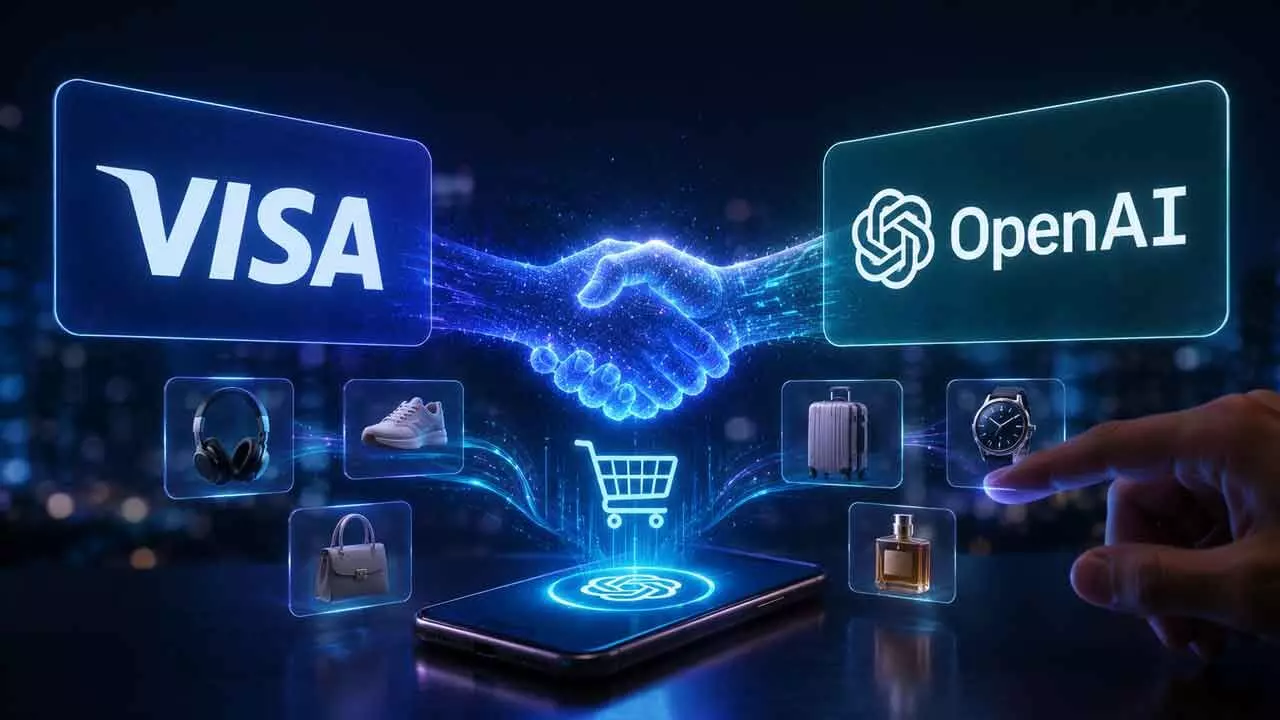
Visa and OpenAI are transforming online shopping by enabling ChatGPT to securely complete purchases on behalf of users.
Visa has announced a groundbreaking partnership with OpenAI that could reshape the future of online shopping by allowing ChatGPT-powered AI agents to make purchases on behalf of users. The collaboration integrates Visa’s global payment infrastructure directly into ChatGPT, enabling the AI assistant not only to recommend products but also to complete transactions seamlessly.
The initiative marks a significant step forward in the evolution of AI-driven commerce. Previously, AI assistants were largely limited to helping consumers discover products or compare options. With Visa’s payment capabilities embedded into ChatGPT, users will be able to authorize the chatbot to find, select, and purchase items from merchants that accept Visa payments.
OpenAI had previously experimented with e-commerce through its Instant Checkout feature, introduced late last year. The tool enabled ChatGPT to search across the internet and assist users with product purchases. However, the service faced challenges, including operational errors and limited merchant adoption due to transaction fees. OpenAI eventually discontinued Instant Checkout in March.
The new partnership differs significantly from earlier efforts. Instead of relying on a closed network of participating merchants, Visa’s vast payment ecosystem allows AI-driven transactions to be processed across a much broader range of retailers. Users will be able to connect their Visa cards to ChatGPT, giving the AI agent the ability to initiate purchases while Visa manages payment authorization and fraud prevention.
OpenAI will provide the underlying artificial intelligence technology that enables agents to understand user requests, evaluate options, and make purchasing decisions. Visa, meanwhile, will supply the payment processing infrastructure and security mechanisms necessary to support these transactions at scale.
"As AI agents become active participants in the economy, Visa's focus is to ensure transactions are trusted, secure and seamless," said Jack Forestell, chief product and strategy officer at Visa.
Speaking at a company event in San Francisco, Forestell demonstrated a potential use case in which a customer asks ChatGPT to find wireless headphones priced under $150. The AI assistant would then identify a suitable product and complete the purchase on the customer’s behalf.
Neither Visa nor OpenAI disclosed financial details of the agreement. The companies also did not provide information regarding potential fees for consumers or merchants. OpenAI’s previous Instant Checkout service reportedly charged merchants 4 per cent of the transaction value, a pricing model that many retailers considered too costly.
The concept of AI agents conducting purchases independently has raised concerns among financial institutions and retailers. Questions remain about accidental overspending, incorrect purchases, and disputes involving unauthorized transactions. To address these concerns, Visa says the system will include consumer safeguards such as spending limits, approval requirements, and controls over which merchants can receive AI-initiated payments.
The move comes as competition intensifies in AI-powered commerce. Mastercard, Visa’s primary rival, has also been expanding AI shopping capabilities within its payment network. Mastercard recently announced solutions that allow AI agents to procure services on behalf of businesses, such as purchasing advertising services for marketing campaigns.
As artificial intelligence becomes increasingly integrated into everyday commerce, partnerships like the one between Visa and OpenAI could pave the way for a future where digital assistants play a direct role in buying goods and services on behalf of consumers and businesses alike.
Omar meets PM Modi in Delhi, presses for early restoration of J&K statehood
Air India denies putting pressure on families of AI-171 Boeing crash victims
India Finland Relations, S Jaishankar, Digitalisation, Sustainability, Strategic Partnership
DK Shivakumar meets PM Modi in Delhi, seeks support for Karnataka's development priorities
Siddaramaiah accuses Zameer Khan of betrayal in Davanagere bypolls
Bengal: CID takes over probe against Abhishek Banerjee in poll violence case


