






- Delhi Seemapuri Building Collapse: Several Feared Trapped As Rescue Operation Underway
- Claude Users Can Work Across Google Docs, Sheets and Slides In-App
- Rapido Ride Turns Into Nightmare After Captain Flees With Injured Passenger
- 7 Must-Watch OTT Releases For Your Dussehra Holidays
- ‘His Lips Turned Blue’: Dentist Recalls 45-Minute Effort To Save Flydubai Pilot Smit Machchhar
- Airtel Postpaid Plans Bring Free International Roaming From Rs 499
- 'Politics means nation building to him': Rajnath Singh on PM Modi's 25 years in public service
- 'Rising Together': India sets out vision for 2036 Olympic and Paralympic Games ambition
A tale of two states
In Short
The two states share a common language and a deep historical bond, yet their post-Independence trajectories have been markedly different.

Share :
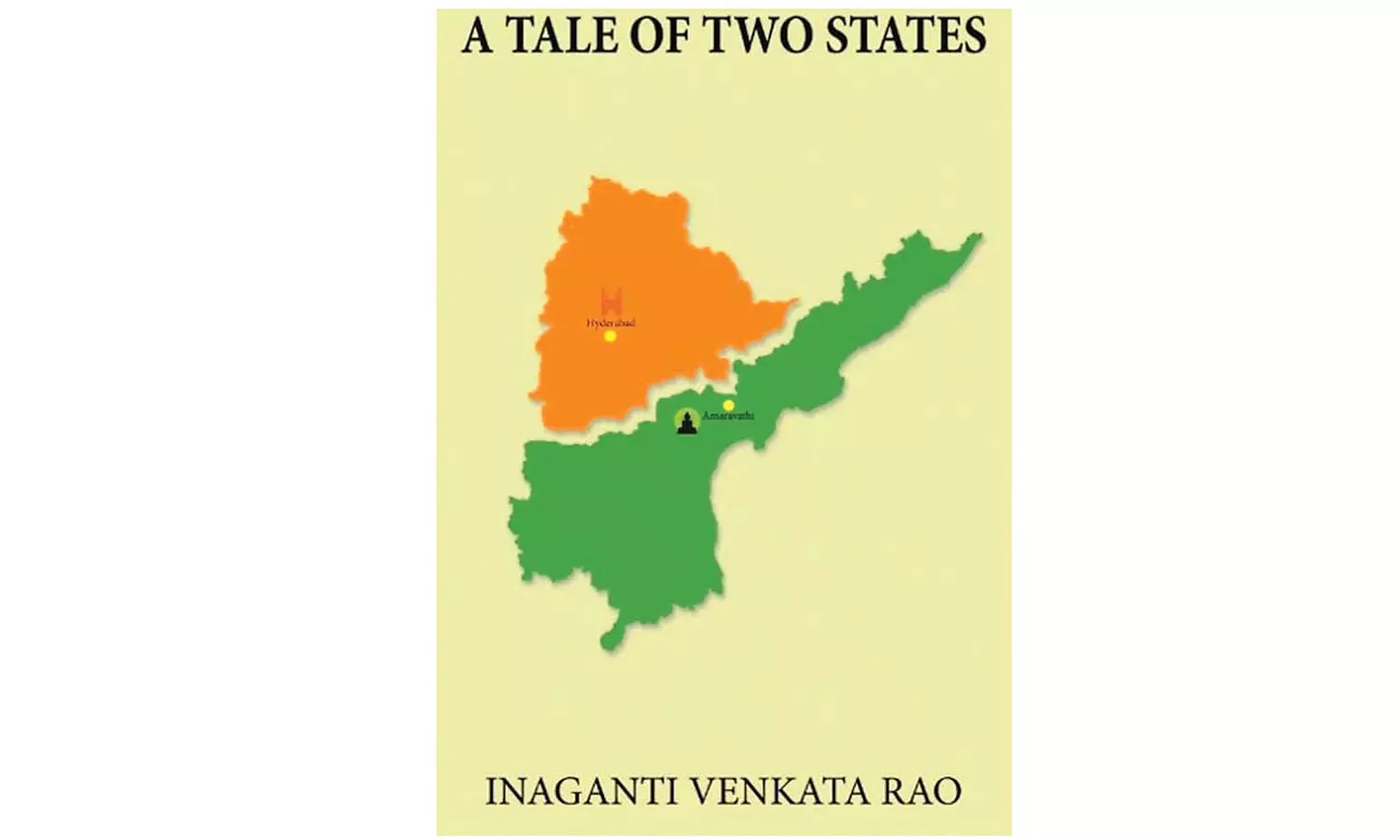
A tale of two states
Charles Dickens opened A Tale of Two Cities with the immortal words, “It was the best of times, it was the worst of times.” Published in 1859, the novel became so iconic that its title has endured in popular memory. Borrowing from Dickens with a subtle twist, noted Andhra Pradesh journalist Inuganti Venkata Rao has titled his recent work A Tale of Two States, a political history of Andhra Pradesh and Telangana.
The two states share a common language and a deep historical bond, yet their post-Independence trajectories have been markedly different. The book traces this complex journey from the historical regions of Andhra and Telangana to the formation of Andhra Pradesh in 1956 and, ultimately, the creation of Telangana as a separate state in 2014.
Before Independence, the coastal districts and Rayalaseema had become part of British India, while Telangana remained under the Nizam of Hyderabad until the integration of Hyderabad into the Indian Union in 1948. The formation of Andhra Pradesh in 1956 was driven by the principle of linguistic reorganisation. However, differences in economic conditions, employment opportunities, river-water sharing and allocation of resources gradually sharpened regional tensions.
A Tale of Two States chronicles this journey from linguistic unity to political division. Rao argues that while language can serve as a basis for political formation, it cannot by itself sustain a state. Historical experiences, economic interests and social realities are equally important in shaping political relationships. The book is also a detailed account of political leadership, party dynamics, caste equations and pressure groups in the two states. Drawing on his long career as a journalist and his interactions with political leaders, Rao offers pen portraits that combine political analysis with personal observations.
A substantial section examines the chief ministers of Andhra State, united Andhra Pradesh and Telangana. The narrative begins with the formation of Andhra State in 1953, with Kurnool as its capital, and discusses leaders such as Tanguturi Prakasam Pantulu and Bezawada Gopala Reddy. It then moves through the political history of Hyderabad State and the successive governments of united Andhra Pradesh.
From Neelam Sanjeeva Reddy to Kiran Kumar Reddy, the book documents the chief ministers of united Andhra Pradesh with considerable anecdotal detail. The Telangana section includes profiles of K. Chandrashekar Rao and A. Revanth Reddy. The author’s personal interactions with several leaders add an insider dimension to these accounts, revealing aspects of their personalities and political styles.
The chapter on N.T. Rama Rao, titled “The Man for the Ages”, is particularly engaging. Rao also gives several leaders distinctive descriptions: Bhavanam Venkatarami Reddy is described as the “Accidental Chief Minister”, P.V. Narasimha Rao as receiving “Destiny’s Second Call”, while Nadendla Bhaskara Rao is remembered as the “One-Month Chief Minister”. These profiles provide an accessible entry point into the political history of the region while also examining the influence of caste on electoral politics.
Originally written in Telugu as Vileenam–Vibhajana (Merger–Bifurcation), the book has been translated into English by the author’s daughter, Anuradha Nagalla. The translation retains the character and cadence of the original without appearing derivative, making the work accessible to a wider readership.
The volume concludes with a chronological list of the chief ministers and deputy chief ministers of the two states, accompanied by photographs. The paperback edition also includes a message from former Vice President M. Venkaiah Naidu, a foreword by Andhra Pradesh Chief Minister N. Chandrababu Naidu and a message from K.T. Rama Rao.
Overall, A Tale of Two States is a useful addition to the literature on contemporary South Indian politics. Beyond documenting merger, political contestation and bifurcation, it raises larger questions about linguistic identity, regional aspirations and the making of modern states.
To borrow Dickens once again, the political story of Andhra Pradesh and Telangana has indeed contained both “the best of times” and “the worst of times.”
Book:A Tale of Two States: The Story of the Twin Telugu States
Author:Inuganti Venkata Rao
Translator:Anuradha Nagalla
(The writer is a Professor of History (Retd.), University of Hyderabad.)
Dramatic face-off near Jantar Mantar. Rahul and Priyanka sit on the road
MPs vs Police. Chaos and High Drama Unfold on Delhi Roads
Henri Kagan, Kenso Soai Win 2026 Nobel Chemistry Prize for Autocatalysis
AP cabinet approves 12 agenda items
High Courts should not suggest custodial interrogation of accused, says Supreme Court
Telangana govt issues orders on DA hike


