






Vijaypath begins: TN’s Dravidian order faces its biggest earthquake since 1967
Beyond DMK and AIADMK: The Rise of a new Tamil Nadu
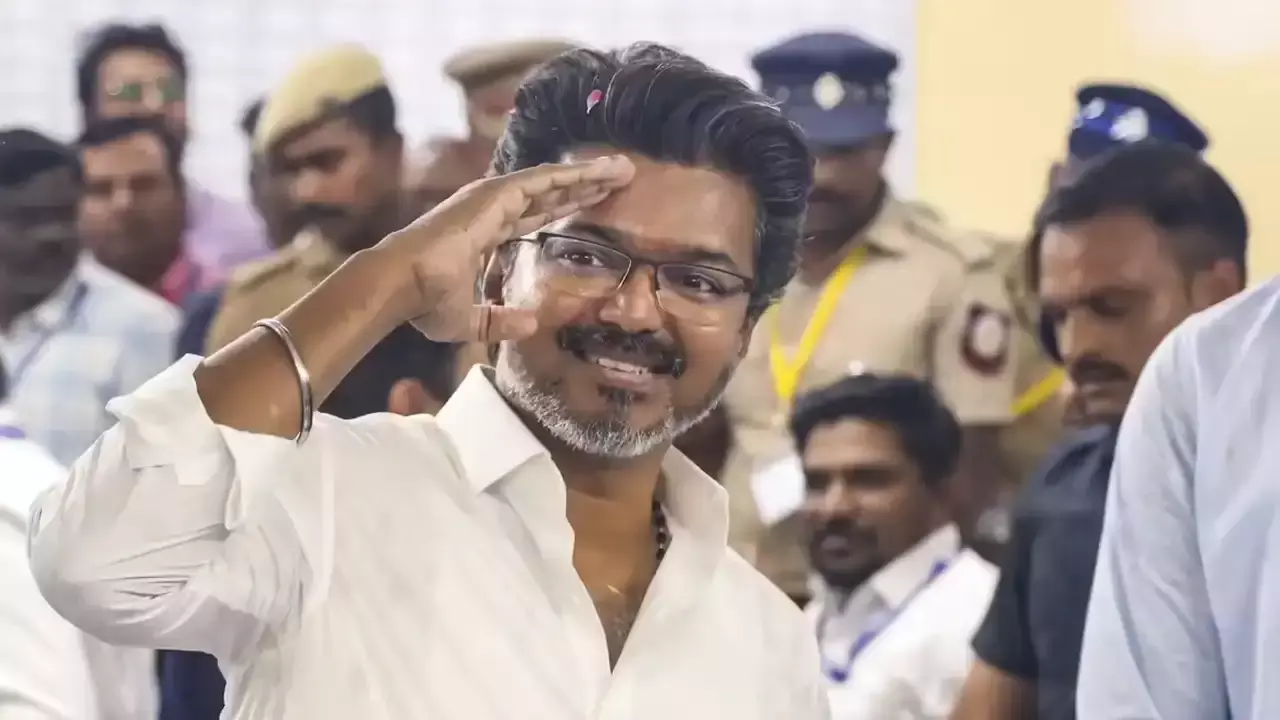
After four days of extraordinary political turbulence — perhaps the most dramatic since the rise of the Dravidian order in 1967 — the road now appears cleared for Vijay and the Tamilaga Vettri Kazhagam (TVK) to form the government. The Congress, CPI and CPM have extended support, enabling Vijay to cross the majority mark and setting the stage for what could become Tamil Nadu’s first genuine political transition in half a century. Each supporting party is expected to receive a Cabinet berth.
The past four days, however, exposed one of the ugliest spectacles of opportunistic politics the State has witnessed in decades.
Virtually every major political formation appeared less interested in respecting the people’s verdict than in manipulating arithmetic, delaying constitutional processes and engineering bizarre combinations merely to keep rivals away from power. The crisis stripped away the moral pretensions of almost the entire political class.
The DMK, AIADMK, BJP, Congress, Left parties and smaller regional outfits all appeared trapped in the same cynical instinct: survival at any cost. But one thing that needs to be seen is that these parties too were part of DMK, which was perceived as heading a corrupt government. People voted against them. Now they are part of TVK. The big question is can he keep up his word of corrupt free government?
This was not politics of ideology. It was politics of fear.
As the deadlock deepened, both DMK and AIADMK camps signalled that if Vijay failed to form the government within 48 hours, alternative combinations would be explored. In most democracies, parties that suffer electoral setbacks pause for introspection. In Tamil Nadu, defeated camps appeared more eager to subvert the public mandate than to understand it.
Most astonishing was the whispered possibility of a tacit understanding between the DMK and AIADMK — two parties that built their political identities on fierce hostility toward each other for over five decades. If such an arrangement had materialised, it would have represented the final ideological collapse of the old Dravidian binaries that dominated Tamil Nadu politics for generations.
The obvious question is: why is the establishment so desperate to prevent Vijay from taking office and proving his majority on the Assembly floor? The answer is equally obvious. The old order fears displacement.
For nearly six decades, Tamil Nadu politics revolved around the DMK-AIADMK axis. Elections, alliances, cinema, welfare politics, caste calculations and ideological discourse all operated within that framework. Vijay’s emergence has disrupted not merely electoral arithmetic, but the emotional chemistry of Tamil Nadu politics.
The anxiety within the two Dravidian camps stems from one possibility: if Vijay is allowed to govern — even briefly — and manages to project efficiency, anti-corruption credentials, administrative energy and aspirational politics, he could permanently fracture the monopoly of the traditional parties. What they fear is not merely another rival, but the emergence of a mass phenomenon comparable to M G Ramachandran (MGR).
Yet the real test for Vijay begins only now.
Campaign rhetoric is easy; governance is unforgiving. Vijay must simultaneously manage alliance compulsions while attempting to fulfil the sweeping promises that powered his campaign. His ‘nine guarantees were ambitious, expansive and financially daunting. He promised ₹2,500 monthly assistance for women heads of households below 60 years, free bus travel for women, six free LPG cylinders annually, marriage assistance schemes, interest-free loans for women’s self-help groups, and a separate department for women, children and senior citizens. He promised ₹25 lakh health insurance coverage for every family, improved healthcare infrastructure and a “Citizen Privilege Card” aimed at reducing corruption and bureaucratic harassment.
On education, he promised free higher education for farmers’ children, interest-free education loans up to ₹20 lakh, 500 creative residential schools, timely examinations and financial support to prevent school dropouts. For youth, the promises were even more ambitious: five lakh government jobs, five lakh internships annually, ₹4,000 unemployment assistance for graduates, preferential opportunities for locals in private-sector jobs, and major AI and technology skill-development initiatives.
Farmers and fishermen were promised farm loan waivers for small farmers, 100 percent crop insurance, enhanced MSP for sugarcane and free education for their children.
These promises generated enormous emotional resonance among younger and economically stressed voters. But delivery will be extraordinarily difficult. Tamil Nadu already faces mounting fiscal pressures, rising welfare burdens and slowing revenue expansion. Vijay will quickly discover that governance is not cinema, and slogans do not automatically translate into administrative capacity. If he fails to show measurable progress within the first two years, the same emotional electorate that lifted him could rapidly turn impatient.
Still, his rise reflects a deeper structural shift underway in Tamil Nadu.
The AIADMK no longer possesses a charismatic figure capable of emotionally mobilising voters across regions and caste lines. The DMK under M K Stalin remains organisationally formidable, but it no longer commands the emotional dominance once enjoyed by earlier Dravidian icons like M Karunanidhi or J Jayalalithaa. Simultaneously, younger voters appear less invested in traditional Dravidian rhetoric and increasingly focused on jobs, investment, corruption, governance quality and upward mobility.
That is why 2026 feels fundamentally different from earlier political crises. Tamil Nadu has witnessed several turning points before — the 1967 defeat of Congress, MGR’s split from the DMK in 1972, the AIADMK fragmentation after MGR’s death in 1987, the anti-Jayalalithaa wave of 1996, and the instability following her death in 2016. Yet every upheaval eventually returned to the familiar DMK-versus-AIADMK framework.
This time, that framework itself appears to be weakening.
The constitutional handling of the post-election situation has also raised troubling questions. Conventionally, when a party emerges as the single largest formation and falls short by only a few legislators, it is ordinarily invited to form a minority government and prove its majority on the floor of the House.
The delay in inviting Vijay to form the government inevitably fuelled allegations that the Governor’s office was under intense political pressure and that constitutional processes were being stretched to facilitate backroom negotiations. Whether entirely fair or not, such perceptions damage institutional credibility.
The BJP, too, faces uncomfortable questions. Allegations persist that sections within the party preferred engineering alternative combinations merely to prevent Vijay’s rise, even if it meant indirectly benefiting the very Dravidian forces the party has spent years attacking.
Ironically, this resembles the same “outside support” politics once mastered by the Congress at the Centre — exercising influence without assuming responsibility. India’s political history is littered with such unstable arrangements. The Charan Singh government in 1979, Chandrasekhar’s government in 1990, and the Deve Gowda and I K Gujral governments in the 1990s all collapsed under similar political manipulations.
Tamil Nadu may now be entering not merely another electoral cycle, but a genuine post-Dravidian transition — one where old ideological certainty is eroding, charismatic monopolies are fading, and voters are searching for a new political grammar.
Whether Vijay ultimately succeeds or fails is still uncertain. But one reality is already undeniable: the old order is no longer invincible.
(The author is former Chief Editor of The Hans India)
NEET Paper Leak Fallout: Dharmendra Pradhan Steps Down as Education Minister, Says ‘I Never Shied Away From Responsibility’
AI Appreciation Day 2026: Trust and infrastructure emerge as the next frontier for AI, say experts
Few Takers for HILT Policy in Hyderabad Amid Low Response
Cockroach Janta Party Protest LIVE Updates: Demonstrators Assemble at Jantar Mantar
Fire breaks out at a building in Ameerpet of Hyderabad, fire brigade arrives
ED’s Vedanta raids raise questions about proportionality, perception


