







- Rs 32.49L cr bet post CII Partnership Summit 2026: Naidu with a fire in the belly nudges AP towards an industrial revolution
- Name Of The Game Is Speed Of Doing Business...State gets into mission-mode to emerge as industrial juggernaut
- Wealth needs health: the missing line in your retirement plan
- New HMDA chief urges inter-departmental synergy
- 57 ancient temples brought under Hyderabad-based trust initiative
- Gujarat CM attends hospitals and healthcare expo 'Hospica 2026', confers excellence awards
- Erode's organic palm jaggery reaches Europe for the first time, India's chocolate exports rise 25 pc
- Delimitation Bill a victory for South India, says BRS leader KTR
UP polls and BJP’s big move sentiment
In Short
After 2016 noteban, 2021 farm laws’ reversal, saffron party comes out with delimitation move ahead of 2027 UP elections

Share :
UP polls and BJP’s big move sentiment
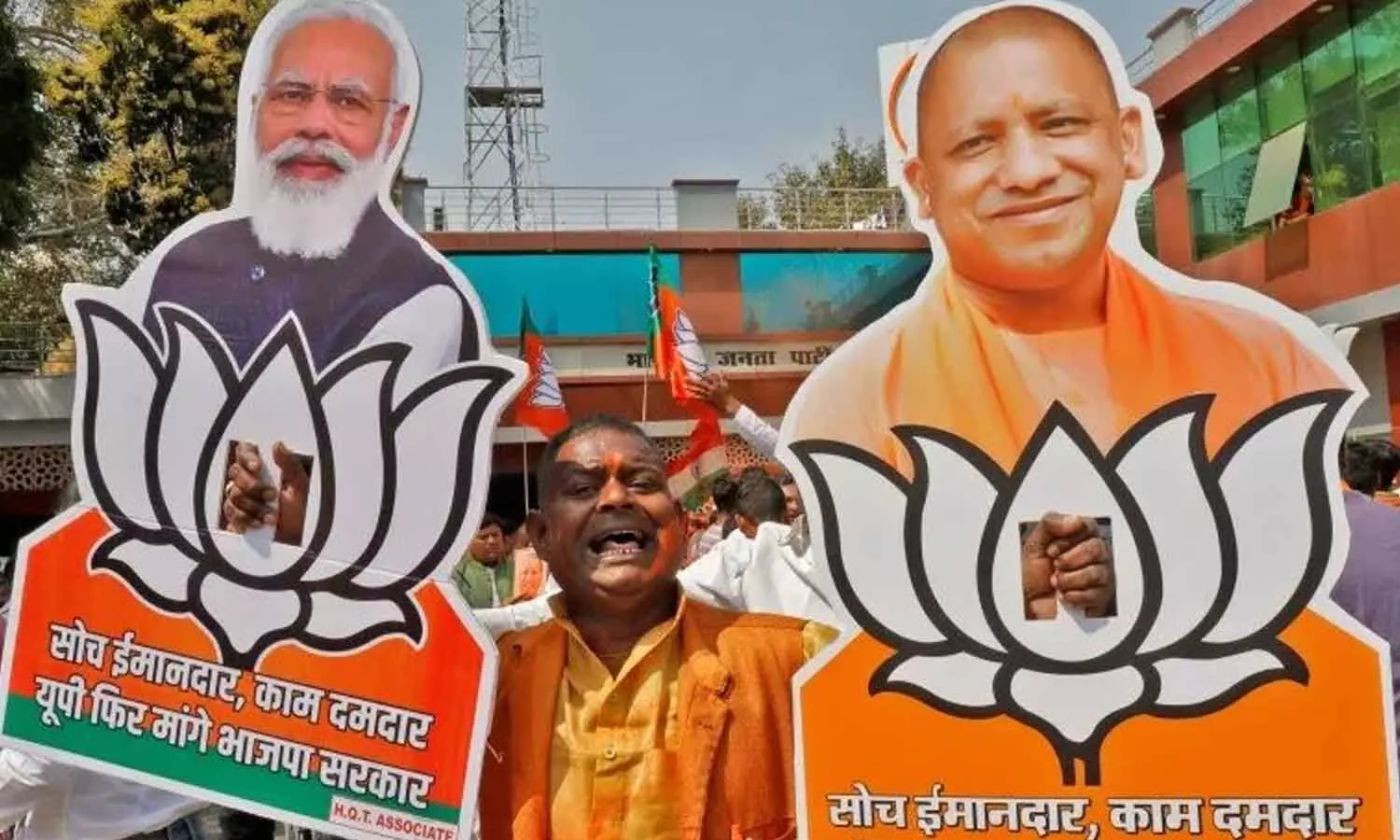
With the 2027 Assembly polls of key Uttar Pradesh state round the corner, I was wondering what big decision Prime Minister Narendra Modi would pull out of his hat this time around. On September 13, 2013, Bharatiya Janata Party (BJP) declared Narendra Modi, then Chief Minister of Gujarat for more than a decade, as the party’s prime ministerial candidate.
Five months before that key announcement, BJP madeAmit Shah, Modi’s closest confidante, as the party’s in-charge for Uttar Pradesh in May 2013. At that time, Shah’s appointment was a clear indication of where Modi’s political future was heading. The political move also was a gamechanger for Modi as well as BJP because the saffron party under the leadership of Amit Shah won a whopping 71 MP seats out of 80 in the 2014 General Elections in UP.
Compare this with BJP’s performance in the previous years in the country’s largest state by population- 10 Lok Sabha seats each in 2004 and 2009. That way, the BJP’s 2014 revival in Uttar Pradesh is unparalleled in recent Indian political history. And that’s what propelled BJP into power at the Centre and Modi into prime ministerial position with an own Lok Sabha tally of 282 seats in 2014. BJP-led National Democratic Alliance’s score was at 336 out of 543. Modi, who contested from two seats in that polls, retained UP’s Varanasi. These indicate that Modi realised the importance of UP as an electoral base even before he entered national politics. And he continued to do that even after becoming the Prime Minister.
That’s the reason why he has been taking a major decision before everyUP Assembly poll. For instance, on November 8, 2016, Modi went for the demonetisation of banknotes of Rs 500 and Rs 1,000 denominations, a decision that sent shockwaves across the country. But that surprise decision came in handy for NDA not only in the UP Assembly elections held during February-March 2017, but also two years later in the 2019 General Elections in that state. BJP won 312 of 403 Assembly seats in UP in 2017, up from 47 in 2012.
Five years later, Modi announced withdrawal of farm laws on November 19, 2021, a few months before the UP went to Assembly polls in February-March in 2022. He even tendered an apology to farmers. The farm laws were repealed following a year-long agitations by farmers. And BJP retained power in UP under Chief Minister Yogi Adityanath, but with a reduced majority.
This time too, the Modi government chose November to take a major decision ahead of the UP Assembly polls scheduled for early 2027. It called for a Special Lok Sabha session on November 30 to pass the constitutional amendment for the delimitation of Lok Sabha and Assembly constituencies besides securing a 33 per cent reservation for women in these elected legislative bodies. Rajya Sabha will take it up on December 2.
However, the Modi government already secured parliamentary nod for the women’s reservation way back in 2023. But as per that legislation, the quota will come into effect only after the delimitation exercise and increase in the number of Lok Sabha seats. That way, the quota will not be implemented for the 2029 General Elections. Now, the Modi government wants to take up delimitation exercise and increase seats so that it can implement women’s quota in the 2029 polls itself.
For that, it called for a special parliamentary session in April this year to pass the new legislation but failed to muster requisite support as the Opposition led by Congress party voted against it. Several parties and some Chief Ministers also opposed increase in seats based on population as southern states, which controlled population, would be at a disadvantage. Congress also expressed fears that BJP would indulge in gerrymandering to redraw boundaries of constituencies to suit its political goals.
But in the last few months, BJP opened backchannel talks with some allies of Congress party and succeeded in turning parties like Tamil Nadu’s DMK and Maharashtra’s Nationalist Congress Party (Sharad Pawar) in its favour by going for uniform 50 per cent increase in seats across all states.
Going by signals from BJP, it seems to have secured enough numbers to pass the bill this time. However, Congress’ fears of gerrymandering by BJP are not without suspicion. As I wrote in one of my earlier columns, one senior RSS functionary hinted at redrawing of the Hyderabad Lok Sabha constituency during the delimitation exercise to weaken AIMIM. He told me this way back during the 2019 General Elections when I visited Amethi in Uttar Pradesh. And that’s the reality.
However, Congress would have done the same thing had it been power. Which political party will forgo such an advantage? Congress did so when it took up delimitation exercise in undivided Andhra Pradesh. But I don’t think such tactics would pay long term political dividends. Congress was wiped out in residual Andhra Pradesh while it was out of power in Telangana for over a decade post the bifurcation! Therefore, the Opposition’s argument that BJP would stay in power forever post the delimitation, might not hold much ground.
However, this is not to say that the Opposition will not face any challenges. Of course, it will, especially Congress. Increase in seats means increase in election funding. Congress saw its income dip in recent times thanks to its sustained campaign against corporates. Its organisational strength also weakened over the years. Now, the Grand Old Party (GOP) is in power in just four states - Telangana, Karnataka, Himachal Pradesh and Kerala.
Three of these states will go to polls in the next two years. Congress’ capacity to give a good fight in the 2029 polls depends on whether it retains power in these three states besides dislodging BJP from power in some of those states wherein Congress is in direct contest with the saffron party.
So, it’s not going to be easy for Congress to provide funding for increased seats and face other challenges arising out of the delimitation exercise. However, it can’t stonewall the constitutional amendment for delimitation that BJP has cleverly linked with women’s quota. If it does, it will be branded as anti-women in the upcoming polls. It will also lose some of its key allies. Does Congress have any strategy that can help it come out of the delimitation dangal with least number of bruises?
On its part, BJP seems to be hell-bent on bringing in the new legislation on delimitation and women’s quota. For it doesn’t want to take any chances while going into the poll battle in the key UP state. The saffron party suffered a setback during the 2024 General Elections and saw its tally fall to 33 MPs from 62 in 2019 in UP even though its vote share remained intact. BJP suffered as a large chunk of Bahujan Samaj Party’s voters shifted to INDI Alliance comprising Samajwadi Party and Congress.
That’s the reason why Modi’s majority also came down in Varanasi. However, when it comes to Lok Sabha polls, each MP seat comprises multiple Assembly constituencies. A big majority in one or two Assembly constituencies helps a candidate win if he or she remains competitive in other Assembly seats. Assembly polls are a different ballgame. Will INDI Alliance have that luxury in Assembly polls?
Anyway, BJP will leave no stone unturned to secure a third consecutive win in the UP Assembly polls. The way it has mustered support for the proposed delimitation legislation is a clear indication of that.
But will the big delimitation move before the UP polls help the saffron party to have an edge over rivals? As of now, the saffron party and NDA are relatively strong compared to its rivals in UP. Narendra Modi and Yogi Adityanath seem to be still formidable when it comes to their personal images.
The PM’s push for women’s quota and delimitation might enhance the saffron party’s image not only in UP, but also in other states which are going to polls. But polls are still a few months away and therefore, the chances of changes in political equations can’t be ruled out as time goes by. Nevertheless, to know the real answer, we will have to wait till the election results are out.
AP Panchayat elections live updates: Second phase of Andhra panchayat polls begins
Around 9336 contestants to fight third phase panchayat polls
Congress’s ‘Brother Stalin’ Outreach Fails; No Rethinking ‘Brother Stalin’ Tells ‘Brother Rahul’
Last-Minute Damage Control: Embarrassed Congress Runs to Allies
‘Death of democracy’: Rahul Gandhi on BJP ‘bid to redraw’ India's electoral map
President Murmu visits tribal freedom fighters’ museum, typical Mizo village in Mizoram


