






- 'Is democracy in India being undermined like China, Russia and North Korea': Gehlot on FIR against Rahul, Priyanka Gandhi
- Delhi Seemapuri Building Collapse: Several Feared Trapped As Rescue Operation Underway
- Claude Users Can Work Across Google Docs, Sheets and Slides In-App
- Rapido Ride Turns Into Nightmare After Captain Flees With Injured Passenger
- 7 Must-Watch OTT Releases For Your Dussehra Holidays
- ‘His Lips Turned Blue’: Dentist Recalls 45-Minute Effort To Save Flydubai Pilot Smit Machchhar
- Airtel Postpaid Plans Bring Free International Roaming From Rs 499
- 'Politics means nation building to him': Rajnath Singh on PM Modi's 25 years in public service
India’s War on Plastic Is Taking A New Shape With The Research Of This Young Scientist, Dr. Yethindra Vityala
In Short
Explore the research-driven journey of Dr. Yethindra, a researcher whose work on microplastic mitigation has shaped national sustainability policies in India.

Share :
Microplastics are particles of plastic less than 5mm in size, they are an ecosystem and human health concern that is contaminating water bodies, soil and now even food chains.
A young, independent researcher Dr Yethindra from Telangana, has become a strong scientific voice in national sustainability discussions. He has been awarded by several constitutional and government institutions for his research on microplastics, sustainable packaging, and public health outreach.
Dr Yethindra’s work on microplastic mitigation
On February 24, 2022 Dr. Yethindra met Shri Bhagwanth Khuba former Union Minister of State Chemicals and Fertilizers and New and Renewable Energy, Karnataka in his presence presented his work “A comprehensive report on Microplastics, a threat to marine ecosystems of India: Perspectives, Challenges and Recommendations” for controlling and reducing microplastics. He then got a call from the Minister’s Additional Private Secretary inviting him to give his input and help for policy framing in developing bio-based milder alternatives to plastic packaging. Absent any scientific leaps, this translation of sustainability science to actionable practice has been achieved with the help of many researchers like him who were convinced that a solution to the plastic crisis is of utmost urgency.
His work earned him huge acclaim in the years following this but the highlight of Dr. Yethindra’s career was on September 1st 2022 when he got a two-minute call of appreciation from the President of India’s office, Rashtrapati Bhavan for his work during COVID 19.
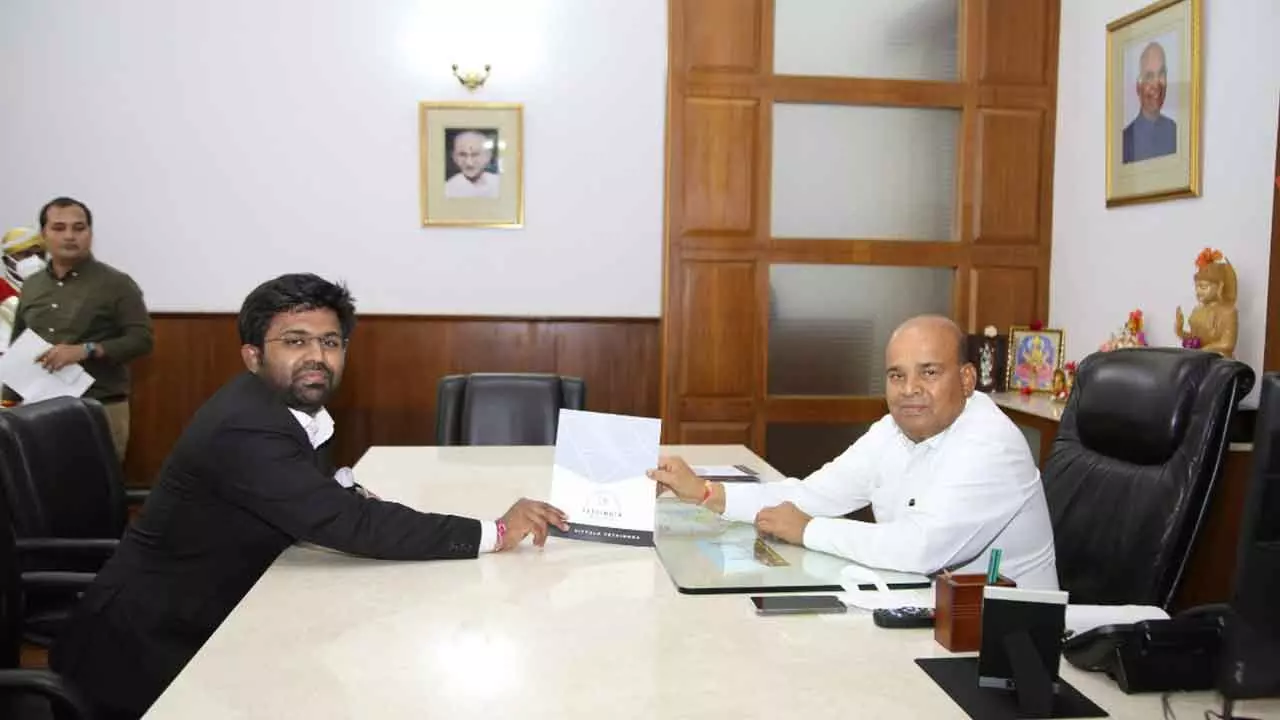
Several other prominent personalities appreciated him, including the Governor of Karnataka, Shri. Thawar Chand Gehlot, where he praised Dr. Yethindra for his work on microplastics and the ‘Yethindia’ Covid-19 Awareness Campaign (the world’s first QR code-based awareness campaign) and also agreed to consider his suggestions for Karnataka.
In the same year, he had an opportunity to meet Shri. Vaddiraju Ravichandra, a Rajya Sabha MP, and Shri. V. Srinivas Goud, a former minister of Telangana to present his research and policy reports on microplastics, sustainable packaging and his works and campaigns during COVID-19.
The five governmental engagements are built on a single foundational strength which is a peer- reviewed research with enormous public health implications. It also shows the seriousness with which India’s top offices view the issue of microplastic particles contaminating bodies, food systems and ecosystems and their commitment to build mitigation strategies.
The Ground-breaking Research that exposed India’s plastic concerns
Dr. Yethindra’s work “Microplastics in Water and Terrestrial Environments: A growing concern to public health” published in International Journal of Preventive, Curative and Community Medicine yielded many unsettling results: plastics that infants use in bottles can cause them to ingest 4.55 million microplastic particles a day, 20% of an adult’s food is contaminated with microplastics, 126 of 419 chemicals in plastic toys marketed to children are known to be a cancer risk or affect health.
Dr. Yethindra’s article also reported that the pandemic of COVID-19 worsened the global plastic crisis. The government suspended regulations on the single-use plastics and the production of virgin plastics rose because of the low oil prices. The rationale was to focus on infection control, and that the public health impact of unnecessary excessive plastic use is yet to be explored.
From a Solution Report to the National Economic Strategy
Not only did Dr. Yethindra’s report identify the problem, it also proposed a solution, the fact that inspired government recognition. His report cited alternatives to petroleum-based plastics that were also commercially viable. They are starch derived films, plant-essential-oil antimicrobials from cinnamon, rosemary and oregano, silver nanoparticle packaging, and bio-based polymer systems that are ocean safe.
In 2026 the India Brand Equity Foundation, Ministry of Commerce & Industry released a report stating that India’s bio-packaging grew 23% annually to reach RS. 32,500 crores by FY35
Dr. Yethindra’s journey is a reminder that science per se, when pursued with honesty and integrity, can solve even the toughest of problems
India condemns attacks on commercial vessels in Black Sea, reiterates call for dialogue and diplomacy
'Is democracy in India being undermined like China, Russia and North Korea': Gehlot on FIR against Rahul, Priyanka Gandhi
SSB pays tribute to bravehearts killed in Maoist attack 15 years ago
SSB pays tribute to bravehearts killed in Maoist attack 15 years ago
Pixel Moments to Politics For Cong As BJP Celebrates Modi@25
Dramatic face-off near Jantar Mantar. Rahul and Priyanka sit on the road
MPs vs Police. Chaos and High Drama Unfold on Delhi Roads
Henri Kagan, Kenso Soai Win 2026 Nobel Chemistry Prize for Autocatalysis
AP cabinet approves 12 agenda items
High Courts should not suggest custodial interrogation of accused, says Supreme Court


